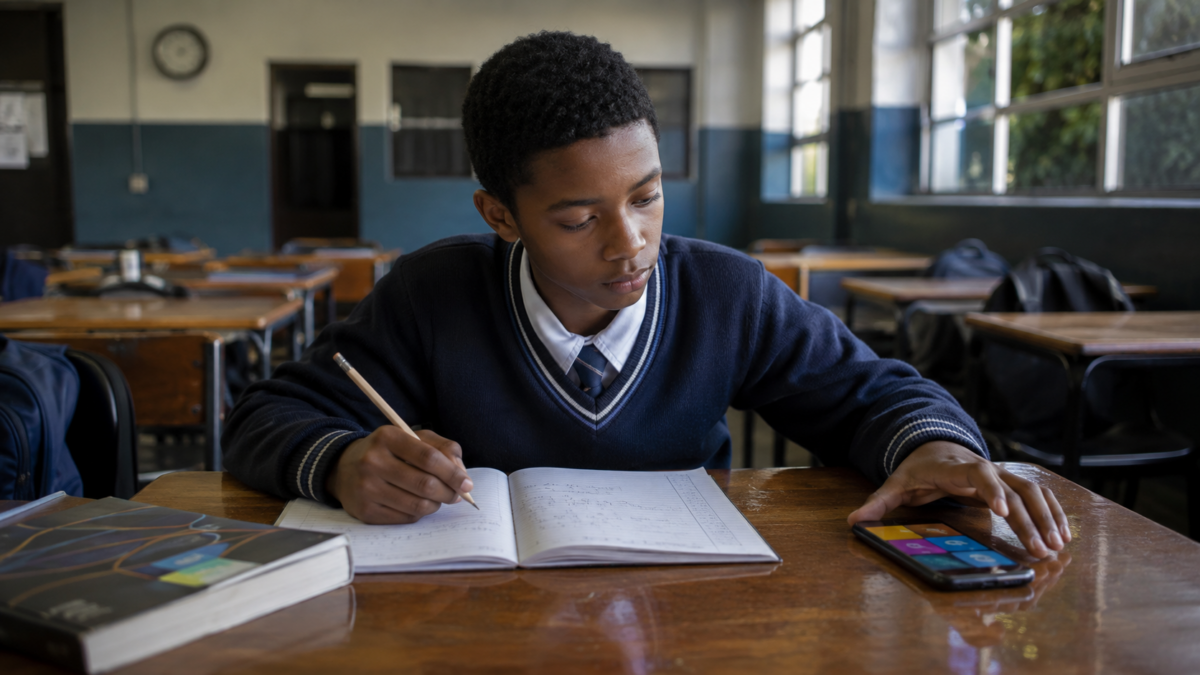





A learner can carry a camera, calculator, internet browser and video laboratory into class in one pocket.
The same device can also deliver games, messages and social media before the teacher has finished explaining the lesson.
That tension has made smartphones difficult for schools to manage. They offer access to educational resources that many classrooms cannot otherwise provide, but they can just as easily become a source of distraction.
New South African research suggests that both teachers and learners see potential in using smartphones to teach Physical Sciences. Their support, however, comes with an important condition: the devices need to be integrated deliberately rather than simply permitted in the classroom.
Researchers from the University of South Africa surveyed 338 learners and nine teachers at three disadvantaged rural secondary schools. Around two-thirds of participants expressed positive views about using smartphones during Physical Sciences lessons. Learners were somewhat more enthusiastic than teachers, although the difference between the groups was not statistically significant.
A laboratory that fits inside a pocket
Physical Sciences becomes a separate subject in Grades 10 to 12 and often requires demonstrations or experiments to make difficult concepts understandable.
Yet many under-resourced schools face limited laboratory equipment, high replacement costs and unreliable access to specialist learning materials.
A smartphone cannot replace a properly equipped science laboratory.
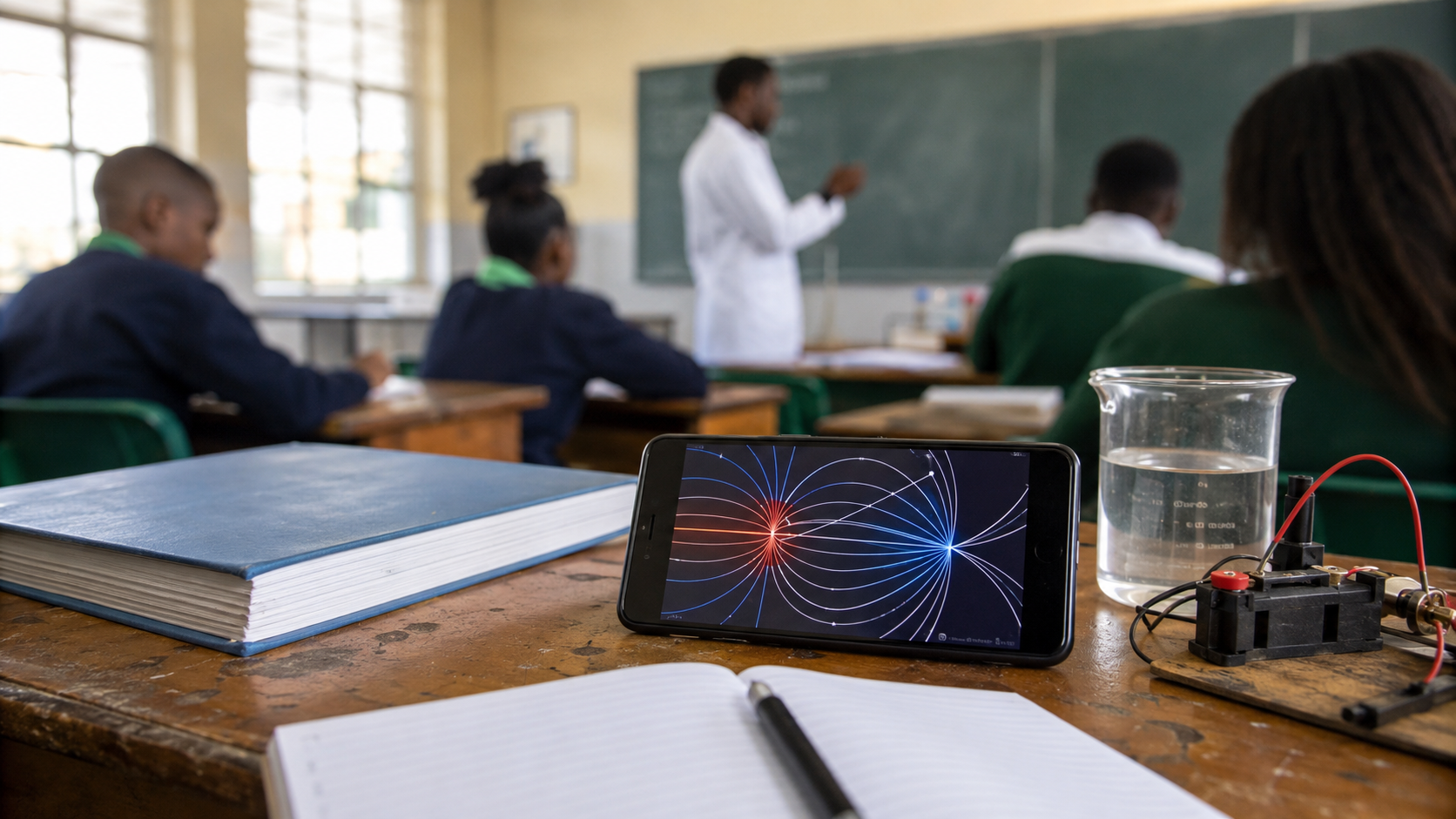
It can, however, give learners access to videos, articles, simulations and demonstrations that help them see processes that may otherwise remain confined to a textbook.
The teachers interviewed during the study described using smartphones to show virtual experiments, demonstrate difficult concepts and administer online assessments that produced immediate results. Learners similarly viewed the devices as useful for accessing information and supporting their understanding of the subject.
This makes smartphones particularly interesting in schools where the device may already be more available than the educational infrastructure it could connect to.
The research does not suggest that every learner owns an appropriate phone or can afford sufficient mobile data. It shows that teachers and learners recognise how the devices could extend what is available inside the classroom.
Learners were ready, but not uncritical
Learners recorded a mean perception score of 3.84 out of five, compared with 3.45 among teachers.
Both results reflected generally positive attitudes.
Teachers supported using smartphones for flexible learning and improved access to educational material. Learners were especially interested in the convenience of receiving information, watching demonstrations and finding additional explanations when classroom resources were limited.
Enthusiasm did not remove concern.
Participants identified data costs, inconsistent internet access, off-task behaviour, gaming, social-media distractions and cheating as potential problems. Some teachers were also concerned about whether digital systems could reduce or alter their role in the classroom.
These concerns matter because educational access is not determined by the presence of technology alone.
A school may allow smartphones while some learners lack devices, dependable connectivity or money for data. What appears to be a digital learning solution can therefore reproduce existing inequality unless access is addressed alongside implementation.
The difference between permission and integration
The study’s most useful implication may be that smartphone use requires more than a change in school rules.
Teachers need guidance on when the devices should be used, which applications and resources are appropriate, and how learners’ attention will be managed. Learners also need clear expectations separating educational use from ordinary personal activity.
The researchers recommend structured oversight, teacher training and policies that address affordability, connectivity and responsible use.
Without that structure, a smartphone can remain both a learning tool and a distraction competing for the same screen.
This is why blanket enthusiasm and blanket prohibition may both miss the educational question.
The issue is not simply whether phones belong in classrooms.
It is whether schools can create conditions in which the educational value of the device outweighs the disruption it can cause.
What the study cannot show
The research measured perceptions and readiness.
It did not test whether learners who used smartphones achieved higher Physical Sciences marks than learners taught without them. Nor did it follow classrooms long enough to determine whether positive attitudes translated into sustained educational use.
The teacher sample was also very small, with only nine teachers from three purposely selected rural schools. The researchers caution that this limits how widely the findings can be generalised.
The study therefore does not prove that smartphones improve science education.
It shows that the people expected to use them are broadly open to the idea — and are already aware of many of the risks.
A tool is only as useful as the system around it
South African schools do not need technology merely because it is modern.
They need tools that help teachers explain difficult material and give learners meaningful opportunities to engage with it.
For some Physical Sciences classrooms, the smartphone may offer access to simulations, demonstrations and information that would otherwise remain unavailable.
But the device cannot solve inadequate connectivity, unequal access or insufficient teacher preparation on its own.
A phone in a learner’s hand is only potential. Education begins when the school decides how that potential should be used.
Source Information
Study Title: Teachers’ and learners’ readiness to integrate smartphones in South African Physical Sciences education
Authors: Godfrey C. Muyambi, Nkopodi Nkopodi and Maria Jakovljevic
Journal: Discover Education
Published: 16 January 2026
DOI: 10.1007/s44217-025-01076-3