








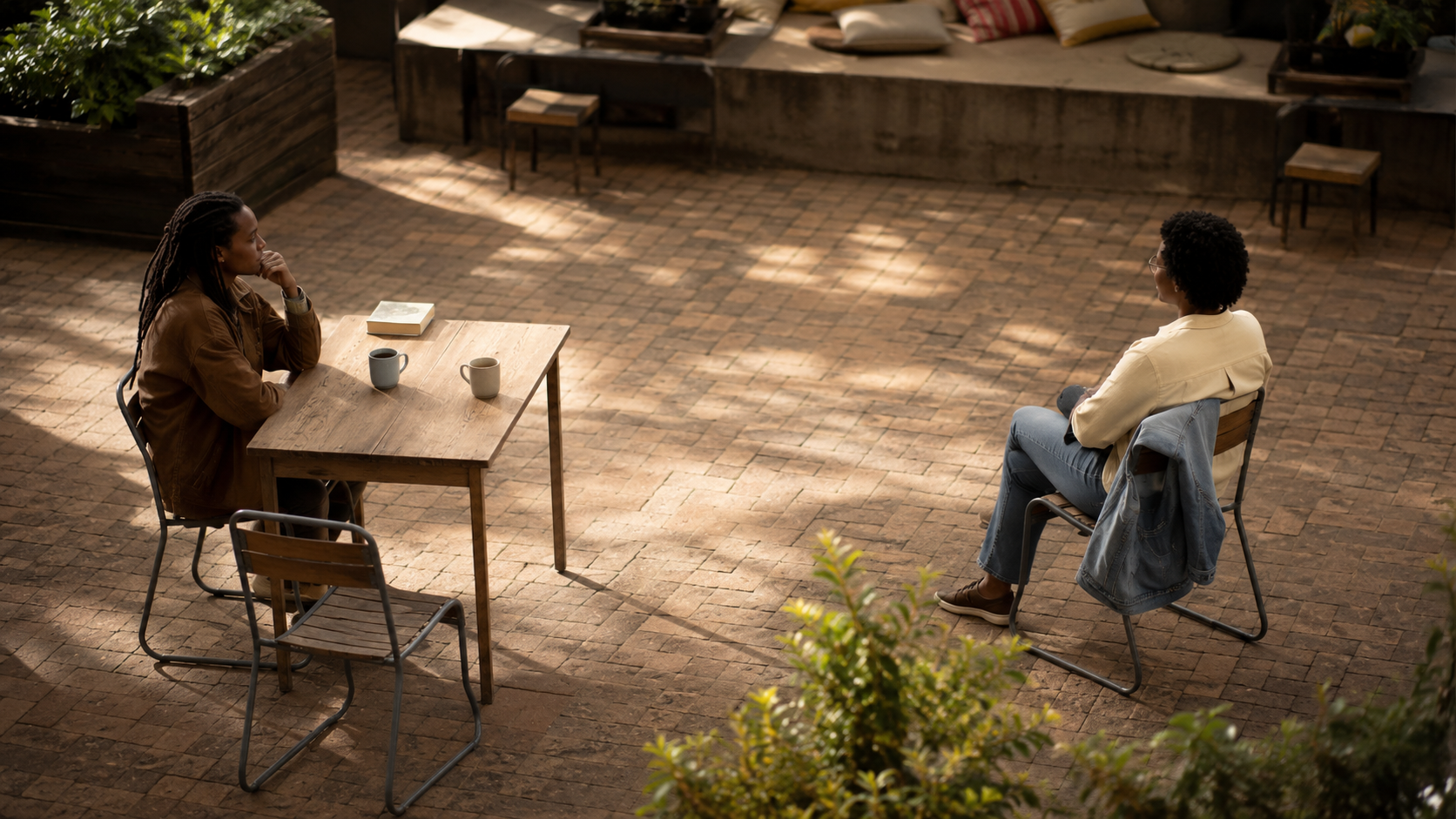
Some people stand close when they speak.
Others take a small step backwards without even thinking about it.
The movement can be so subtle that neither person consciously notices. Yet the distance we keep from others is not random. It can be shaped by culture, familiarity, anxiety, social context and what closeness has come to mean through earlier experiences.
New South African research suggests that difficult experiences during childhood may remain visible in this quiet part of adult social behaviour.
In a study involving 1,048 adults from the Cape Town metropolitan area, people who reported greater exposure to childhood maltreatment generally preferred more physical distance from both friends and strangers.
The effect was statistically significant but small, meaning childhood experience was associated with personal-space preferences without determining them completely.
The finding offers a useful reminder.
What appears to be coldness, discomfort or withdrawal may sometimes be another person’s way of creating enough space to feel safe.
Personal space is partly invisible
Comfortable interpersonal distance refers to the physical space a person prefers to maintain during a social interaction.
It is often measured using what researchers call the stop-distance task.
In a traditional version of the experiment, another person moves closer until the participant asks them to stop. The point at which closeness becomes uncomfortable is then recorded.
For this study, the researchers used an online version of the task. Participants watched representations of either a friend or a stranger approaching and responded when the imagined person had come close enough.
Although the test occurred online, previous research has found that this kind of task is associated with the distances people maintain in real-life interactions.
The researchers then compared participants’ responses with questionnaires about childhood experiences, social relationships, perceived economic position and psychological well-being.
Earlier experiences were associated with greater distance
Participants who reported higher overall levels of childhood maltreatment responded sooner during the approaching-person task.
In practical terms, they preferred the approaching figure to stop further away.
The pattern appeared whether the approaching person was described as a friend or a stranger.
This is significant because friendship normally changes personal space.
Most people allow someone they trust to stand closer than someone unfamiliar. The study found that the relationship between early adversity and preferred distance remained visible across both types of interaction.
The researchers suggest that greater interpersonal distance may serve a protective function.
When closeness has previously been associated with unpredictability or danger, maintaining additional space may help a person feel more in control of an interaction.
That interpretation should not be treated as a diagnosis.
A person who prefers more space has not necessarily experienced childhood adversity, and someone with difficult early experiences will not necessarily avoid physical closeness.
Personal space has many influences.
The study identifies a relationship between two variables. It does not provide a simple explanation for any individual person’s behaviour.
Friends did not remove the effect
One might expect the presence of a friend to eliminate much of the discomfort associated with physical closeness.
That did not happen consistently.
The overall relationship between childhood maltreatment and preferred interpersonal distance did not differ significantly between the friend and stranger conditions.
This may help explain why some people need more physical or emotional room even inside relationships they value.
Trust and affection do not necessarily erase learned responses immediately.
A person can care deeply about a friend or partner while still becoming uncomfortable when someone approaches too quickly, touches them unexpectedly or assumes that closeness is always welcome.
The study does not examine how friends or partners responded to those boundaries.
But it raises an important interpersonal question: how often do we interpret another person’s need for space as a judgement about us, when it may have very little to do with us?
Different forms of adversity showed different patterns
The researchers also examined several categories of childhood maltreatment.
Physical neglect, emotional neglect, physical abuse and sexual abuse were each associated with larger preferred interpersonal distance in the study. Emotional abuse, considered separately, did not show a statistically significant relationship with the distance measure.
These results do not mean one experience is more or less serious than another.
They show that different experiences may relate to later social behaviour in different ways.
The researchers also found some differences in how neglect-related experiences interacted with whether the approaching person was a friend or stranger. However, the effects were small and require further investigation.
Human social behaviour rarely develops through a single pathway.
Two people can experience similar events and respond very differently, depending on their personalities, relationships, resources and later experiences.
Economic security may shape the pattern
The study also examined whether current social and economic circumstances affected the relationship.
Subjective socioeconomic status — where people felt they stood relative to others in society — significantly influenced the association between early adversity and preferred distance.
Social strain also appeared significant when examined separately, although it no longer remained significant when both factors were included together in the same model.
This makes the result more complicated than saying that money or supportive relationships simply undo earlier experiences.
The researchers suggest that greater perceived security and fewer stressful relationships may help shape how earlier adversity is expressed later in life. But their analysis cannot establish exactly why the interactions appeared or whether improving someone’s circumstances would directly change their personal-space preferences.
What it does show is that childhood experience does not operate in isolation.
The environment surrounding a person in adulthood still matters.
The study reflects a specific South African sample
The participants were recruited from the general population in the Cape Town metropolitan area.
The final sample included 1,048 adults, with an average age of approximately 32. Around 64.5% were women.
The questionnaires were available in English, Afrikaans and isiXhosa, and data were collected online between October 2021 and March 2022.
This gave the researchers a considerably larger sample than many earlier studies of interpersonal distance.
It also allowed the relationship to be examined in a South African context rather than assuming that findings from Europe or North America apply everywhere.
Culture affects expectations around personal space.
So do housing conditions, public transport, community life, inequality and exposure to social risk.
The meaning of standing close to someone may therefore differ across countries and communities.
The findings have important limits
The research was cross-sectional.
Participants completed the measures at one point in time, so the study cannot prove that childhood maltreatment directly caused larger preferred interpersonal distance.
The childhood experiences were also reported retrospectively by adults. Memory, interpretation and willingness to disclose personal information can affect self-report research.
The personal-space task was completed online rather than during a physical face-to-face interaction, and the researchers did not include separate attention-check questions in the broader questionnaire.
The sample was drawn from one metropolitan region and may not represent every South African community.
The researchers also note that many Afrikaans- and isiXhosa-speaking participants chose to complete the survey in English, which prevented meaningful comparison between language groups.
Most importantly, the effect sizes were small.
Earlier experiences appear to form one part of the story, not the whole explanation for how close someone allows another person to stand.
A boundary is not always rejection
People regularly communicate boundaries without words.
They move a chair.
They choose the end of a bench.
They step backwards during a conversation or prefer a greeting that involves less physical contact.
These behaviours can be misread as unfriendly, distant or overly cautious.
The new study does not tell us how to interpret every movement.
It does suggest that people arrive in social situations carrying different histories of what closeness has meant to them.
Respecting personal space does not require knowing that history.
It requires recognising that comfort is not universal.
Sometimes the most considerate way to become closer to another person is to notice how much space they need first.
Source Information
Study Title: Combined effects of socio-economic status, social strain, and childhood maltreatment on comfortable interpersonal distance
Authors: Dan Jenkins, Roxanne Sopp, Shilat Haim-Nachum, Monique Pfaltz, Soraya Seedat and Georgina Spies
Journal: Current Psychology
Published: 11 May 2026
DOI: 10.1007/s12144-026-09500-z