









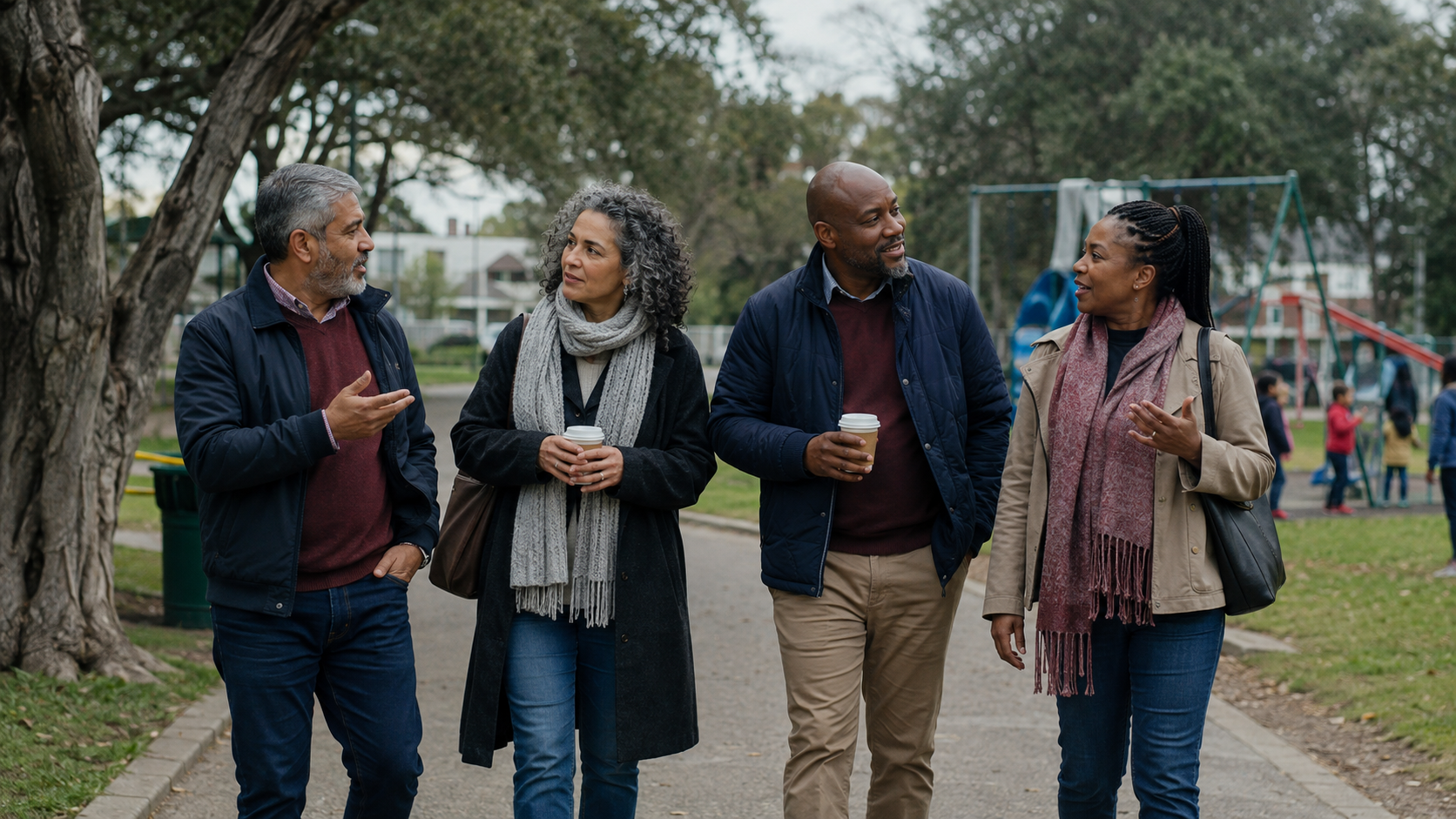
A study of more than 19,000 adults across 25 countries found that regular contact with friends was consistently associated with lower loneliness, even as traditional family structures differed between people’s lives.
There is an assumption built into the way we often imagine loneliness.
People with partners and children are surrounded by relationships. People without them are more likely to be alone.
Real life is considerably less tidy.
A person can have children who live hundreds of kilometres away. Someone can be married and still feel disconnected. Another person may live alone but spend several evenings each week with friends, colleagues, neighbours or members of a community they have known for decades.
New international research suggests those distinctions matter.
Among adults aged 45 and older, being without a partner was strongly associated with loneliness. Being childless, however, was not.
Regular friendship appeared to tell another part of the story.
Researchers compared almost 20,000 lives
The study, published in Social Science & Medicine, analysed 19,289 adults aged 45 and older across 25 countries.
Researcher Christine Mair used data from the International Social Survey Programme together with country-level information from the World Health Organization and World Values Survey.
The study examined several different aspects of social life.
Participants were grouped according to whether they had a partner and whether they had children. Researchers also considered how often they saw friends and compared these relationships with several measures of loneliness.
This distinction is important because loneliness is not simply a count of how many people someone knows.
It describes the gap between the connection people have and the connection they feel they need.
Someone can therefore be socially isolated without feeling particularly lonely, while another person can experience loneliness despite being surrounded by people.
Not having a partner mattered more than not having children
One of the clearest findings concerned partnership.
Adults without partners were considerably more likely to report loneliness, particularly a lack of companionship.
That makes intuitive sense.
Partners often provide frequent contact that is difficult for other relationships to reproduce. They may share meals, routines, decisions, worries and the ordinary parts of a day that rarely appear important until they disappear.
The result for children was different.
Being childless was not independently associated with greater loneliness in the study.
That does not mean relationships with children are unimportant.
Children can provide companionship, practical assistance, emotional support and care later in life. But simply having children did not appear to protect people from loneliness in the way that might be assumed from family structure alone.
A relationship existing on a family tree is not necessarily the same as regular social connection.
Seeing friends every week made a consistent difference
Friendship produced one of the strongest recurring patterns.
People who had contact with friends at least weekly were less likely to report loneliness across the different outcomes examined.
The association appeared among people with conventional family structures as well as those with fewer immediate family ties.
It was particularly important for people without partners.
This does not mean friendship simply replaces a spouse, child or other family relationship.
Different relationships provide different forms of connection.
A partner may offer daily intimacy. An adult child may provide family continuity and support. A long-standing friend can offer shared history, familiarity and a relationship that exists largely because both people continue choosing it.
What the findings challenge is the idea that friendship becomes secondary once adulthood becomes organised around work, marriage and family.
For some people, it may become more important.
Friendship is often treated as the relationship that can wait
Adult friendships face an unusual disadvantage.
Romantic partnerships carry expectations of regular attention. Parenting creates responsibilities that cannot easily be postponed. Work arrives with deadlines.
Friendship is more flexible.
That flexibility is part of its appeal, but it can also make friendships easier to neglect.
A dinner can be moved to next month. A message can be answered tomorrow. Friends who once saw one another every week may gradually settle into birthdays, occasional weekends and promises to arrange something soon.
Nothing dramatic necessarily happens.
The relationship simply receives whatever time remains.
The new research cannot show that increasing weekly contact will automatically remove loneliness. It is observational rather than an experiment designed to establish cause and effect.
But the consistency of the association across countries suggests that friendship should not be dismissed as a pleasant extra in adult life.
Regular contact appears to matter.
Culture changes what loneliness looks like
The study also found that relationships do not exist outside the societies surrounding them.
Loneliness among unpartnered adults was greater in countries where friendship was valued less strongly.
By contrast, people living in societies that placed greater importance on friendship tended to face a lower risk of loneliness.
That finding adds another layer to the discussion.
Whether someone experiences their family circumstances as socially limiting may depend partly on what alternatives their community considers normal and meaningful.
A society built almost entirely around couples and nuclear families can make people outside those structures feel unusually exposed.
Communities where friendships, neighbours and wider social networks occupy more legitimate space may offer more routes to belonging.
It is a reminder that loneliness is personal, but it is not entirely private.
The structures around people influence which relationships are easy to build and maintain.
South Africa’s households are changing too
The 25-country study did not include South Africa, so its results should not simply be treated as a description of South African relationships.
There is nevertheless a relevant local shift.
Statistics South Africa reported that 26.9% of South African households consisted of a single person in 2024.
Among older South Africans specifically, 11.1% were living alone in 2024, compared with 9.9% in 2003.
Living alone is not the same as being lonely.
That distinction is precisely why the international study is useful.
A household tells us where somebody sleeps. It tells us much less about the relationships that fill the rest of their life.
For a South African living alone in Johannesburg, Cape Town or a rural town, regular contact with siblings, church communities, neighbours, friends or former colleagues may produce a very different social experience from someone living in a larger household but feeling disconnected from the people around them.
Counting household members cannot capture all of that.
The study cannot tell us which friendships matter most
There are important limitations.
The analysis relied on survey data originally collected in 2017, meaning it captures relationships at one period rather than tracking how individuals’ friendships and loneliness changed over many years.
It also focused on adults aged 45 and older.
The social lives of younger adults may operate differently, particularly as digital communication changes how friendships are maintained.
Frequency is another imperfect measure.
Seeing a friend every week says little about the quality of that relationship. A brief habitual interaction is not necessarily more meaningful than a deep conversation with someone seen less frequently.
And because the study is observational, it cannot establish whether seeing friends reduces loneliness or whether people who feel less lonely find it easier to maintain regular friendships.
Both may occur.
Family structure does not tell the whole story
Perhaps the most interesting lesson is what the study does not allow us to assume.
Having children does not automatically mean someone feels connected.
Living alone does not automatically mean someone feels lonely.
And friendship does not stop being psychologically important simply because adulthood has supplied other relationships.
The people who become part of an ordinary week may matter more than the categories on a census form suggest.
Relationships are ultimately experienced through contact: the phone call answered, the coffee that actually happens, the person who knows what has been going on without needing the entire story explained again.
Families remain enormously important.
But a full social life can be built from more than one kind of relationship.
For many adults, friendship may be one of the relationships doing considerably more work than we give it credit for.
Source Information
Study Title: Limited family ties, friendship, and contextual variation in loneliness risk across 25 countries
Author: Christine A. Mair
Journal: Social Science & Medicine
Published Online: 24 March 2026
DOI: 10.1016/j.socscimed.2026.119233