








Conventional computer processors have spent almost two decades hovering around clock speeds of roughly 5 GHz. Researchers have now demonstrated a different kind of computer that performs parts of its computation entirely with light and can operate at up to 80 GHz.
For years, buying a faster computer meant expecting a faster processor.
A 1 GHz chip became 2 GHz. Then 3 GHz. Then 4 GHz.
And then the climb largely stopped.
Modern processors have become enormously more powerful since the mid-2000s, but much of that improvement has come from adding more cores, specialised accelerators and increasingly parallel architectures rather than dramatically increasing how quickly one processing cycle follows another.
Researchers have now demonstrated an alternative approach.
Instead of moving information primarily through electronic circuits, their experimental computer uses pulses of light.
And those pulses can move very quickly indeed.
The 5 GHz barrier has lasted nearly two decades
Computer clock rate describes how quickly a processor can move between sequential operations.
Modern commercial CPUs typically operate at several billion cycles each second. But clock speeds have remained in roughly the same range since around 2005, even as transistor counts and overall computing performance continued to increase.
There is a physical reason for this.
Pushing conventional silicon electronics to ever-higher frequencies creates problems involving heat, power consumption and the movement of data between memory and processing components.
The industry responded by becoming wider rather than simply faster.
Multiple processor cores work simultaneously. Graphics processors perform enormous numbers of operations in parallel. Dedicated AI accelerators handle particular mathematical workloads more efficiently than general-purpose CPUs.
The new research asks whether another route is possible: make the computation itself optical.
The computer processes information as laser pulses
The system, described in Light: Science & Applications, is an all-optical recurrent neural network.
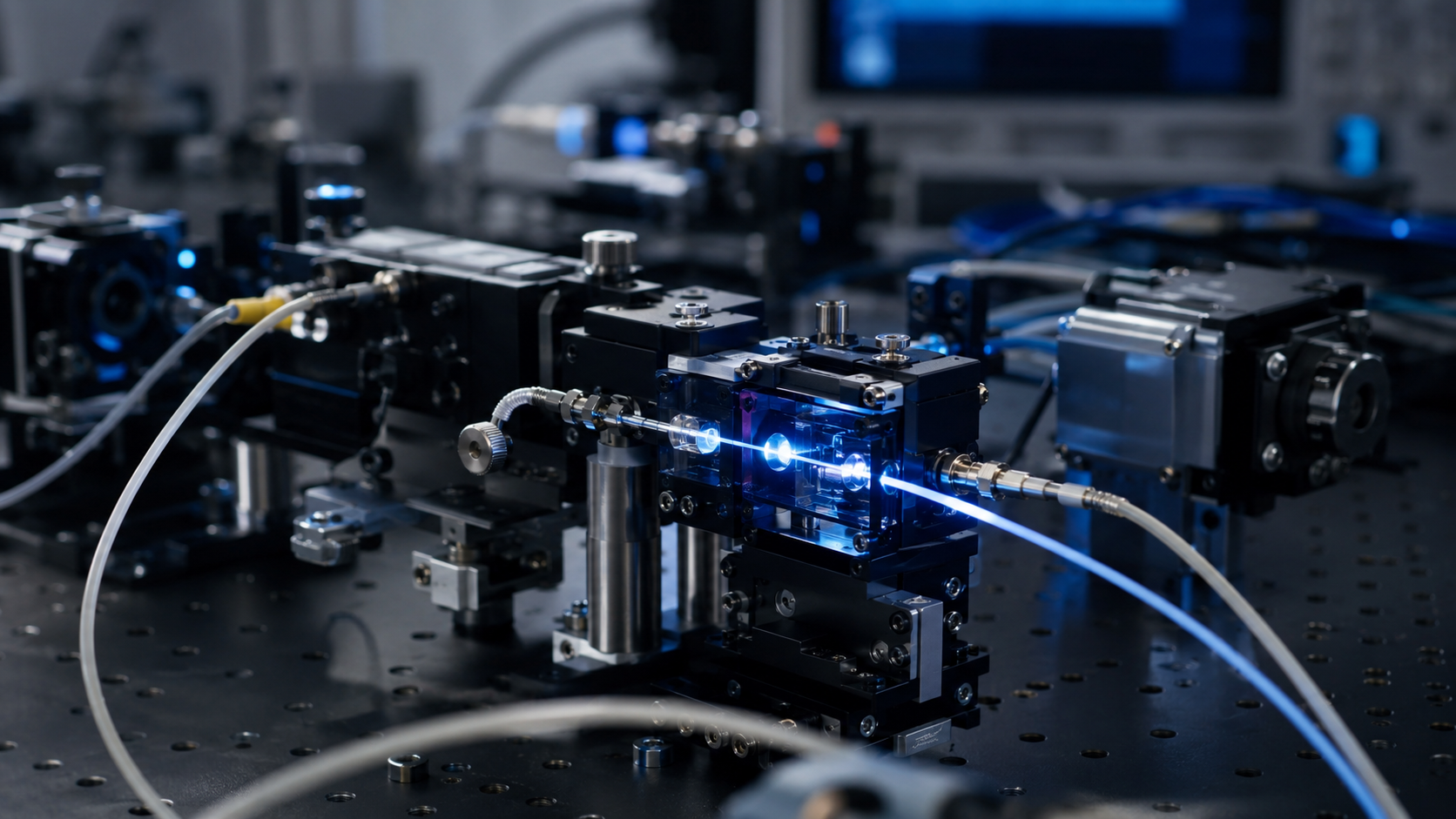
Information enters the system through ultrashort laser pulses travelling through optical components operating at a wavelength of around 1.55 micrometres, a wavelength already widely associated with fibre-optic communications.
The researchers used interference to perform linear mathematical operations, nonlinear optical effects to transform the signals, and an optical feedback cavity to provide memory between successive steps.
That last component matters.
Previous optical computers have often been extremely fast at one specialised calculation but still depended on electronics for other parts of the process.
Here, linear operations, nonlinear activation and memory could all occur in the optical domain during inference with fixed network weights.
The result was not simply light carrying information between electronic processors.
Light was doing the processing.
The system remained useful at up to 80 GHz
The researchers tested the computer using several tasks.
One involved identifying noisy waveforms including sine, square, triangle and sawtooth patterns.
At 10 GHz, the optical system classified these signals with 97.5% accuracy.
At 50 GHz, accuracy remained at 92%.
As the clock rate climbed further, performance began to deteriorate. At 100 GHz, classification accuracy dropped to 58%, although it remained above random guessing even at the maximum tested rate of 120 GHz.
The important threshold was 80 GHz.
Up to that point, the complete nonlinear optical system still outperformed a comparable purely linear model, which the researchers describe as demonstrating a nonlinear optical computing advantage.
That is roughly sixteen times the 5 GHz clock frequency around which conventional CPUs have plateaued.
But the comparison needs care.
An 80 GHz optical computer is not an 80 GHz laptop CPU
Clock speed alone does not determine how powerful a computer is.
Different architectures perform different amounts and types of work during each clock cycle.
The current optical system performs a maximum of only eight operations per clock period. Modern processors and GPUs can execute enormous numbers of operations simultaneously through parallel processing.
So an 80 GHz optical computer should not be interpreted as a machine that would run Windows, games or spreadsheets sixteen times faster than a conventional 5 GHz processor.
It is a specialised experimental architecture.
The prototype was also assembled largely from off-the-shelf fibre-optic equipment rather than being built as a compact integrated chip.
Training the neural network still required a conventional digital computer, while the optical system became fully optical during inference only when its weights remained static.
Some tasks also required electronic components that limited the practical speed of the overall system.
These limitations matter because they separate a laboratory breakthrough from a product.
There is no 80 GHz optical laptop around the corner.
The first applications may never look like normal computers
The most interesting use for the technology may be somewhere conventional processors already struggle.
Many modern systems generate information directly as light.
Fibre-optic communications carry enormous volumes of data as optical signals. LIDAR systems measure distance using laser pulses. High-speed spectroscopy and scientific imaging can generate events on timescales far shorter than electronic computers can process in real time.
Normally, those optical signals eventually need to be converted into electronic information before conventional processors can work with them.
That conversion creates another bottleneck.
An optical computer could potentially analyse some of the information while it is still optical.
The researchers demonstrated this principle by using the system to analyse ultrafast soliton states produced by optical microresonators.
In practical terms, the machine could react to optical events at speeds that conventional electronic systems may struggle to follow.
AI is one reason this technology is becoming more interesting
The experiment is also part of a wider search for alternatives to conventional electronic computing.
Artificial intelligence has sharply increased demand for specialised computing hardware, particularly systems capable of performing large numbers of mathematical operations efficiently.
Optical computing offers several attractive properties.
Light can carry multiple signals simultaneously. Optical operations can occur with extremely low latency. Some calculations can also be performed physically as light passes through a component rather than by repeatedly moving data between conventional memory and processor circuits.
The researchers even demonstrated a proof-of-concept image-generation task using quantum fluctuations as the initial source of randomness.
That part of the system was more limited and still relied on electro-optic components, however.
It is an interesting demonstration rather than evidence that optical computers are about to replace the GPUs currently training generative AI models.
South Africa may encounter the technology in networks first
For South African consumers, the significance is unlikely to begin with personal computers.
It is more likely to emerge deeper inside communications infrastructure.
South Africa’s connectivity continues to expand: ICASA’s latest sector report shows that the proportion of households with access to the internet from any location increased from 78.6% in 2023 to 82.1% in 2024.
More connectivity means more information moving through communications networks.
If optical computing develops into a practical technology, processing high-speed signals directly within fibre and telecommunications systems could ultimately be more relevant than placing optical processors inside consumer laptops.
That remains a future application rather than a demonstrated South African deployment.
But it illustrates why the research matters beyond an impressive clock-speed number.
Light solves one bottleneck and introduces others
The experiment does not mean silicon computing has reached the end of the road.
Electronic processors are cheap, programmable, compact and supported by decades of manufacturing infrastructure.
Optical computing still faces difficult questions around integration, programmability, input and output conversion, memory, precision and scaling.
The researchers themselves identify a trade-off between the exceptionally high clock speed of their prototype and its overall computational throughput.
Future systems would need to combine fast optical computation with much greater parallelism.
There is reason to think the hardware can become considerably smaller. The current experiment relied heavily on fibre components, while integrated photonic technologies could place many of these functions onto chips.
The researchers argue that newer optical materials could eventually support even higher operating frequencies.
For now, the important result is simpler.
After almost two decades in which conventional computer clock speeds stopped rising dramatically, researchers have demonstrated that computation does not necessarily have to operate on the same timescale as electronics.
Sometimes the fastest way around an electronic limit may be to stop using electrons for the calculation at all.
Source Information
Study Title: All-optical computing towards 100-GHz clock rates
Authors: Gordon H. Y. Li, Midya Parto, Jinhao Ge et al.
Journal: Light: Science & Applications
Published: 17 July 2026
DOI: 10.1038/s41377-026-02314-5