






Inside an ordinary computer, information is processed by billions of electronic switches etched into silicon.
Inside a new class of experimental computers, part of the processing is alive.
Researchers are now connecting laboratory-grown neurons directly to electronic hardware and allowing software to communicate with the cells in real time.
The result is known as biological computing, and what was recently a highly specialised laboratory experiment is beginning to resemble an actual computing platform.
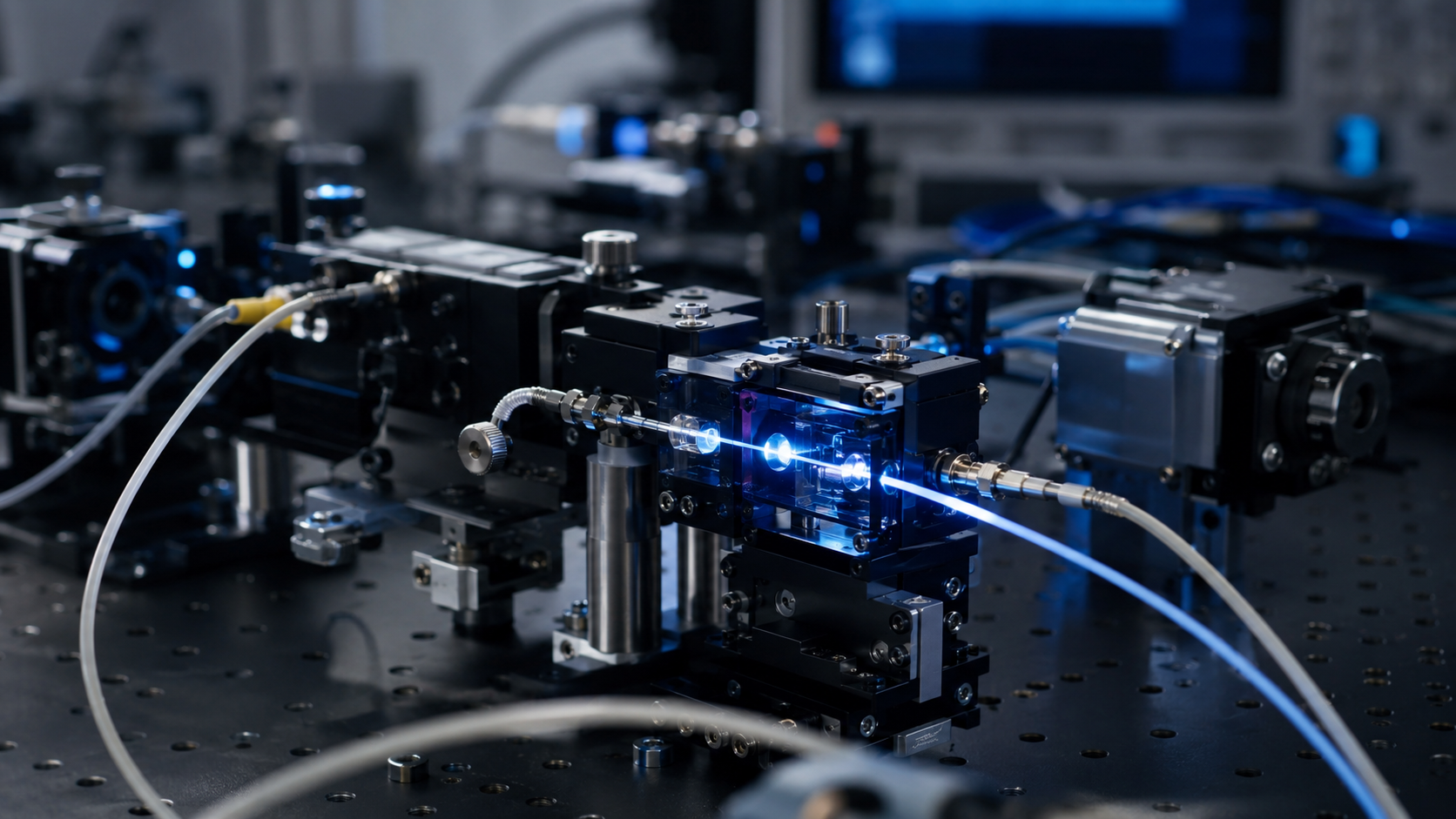
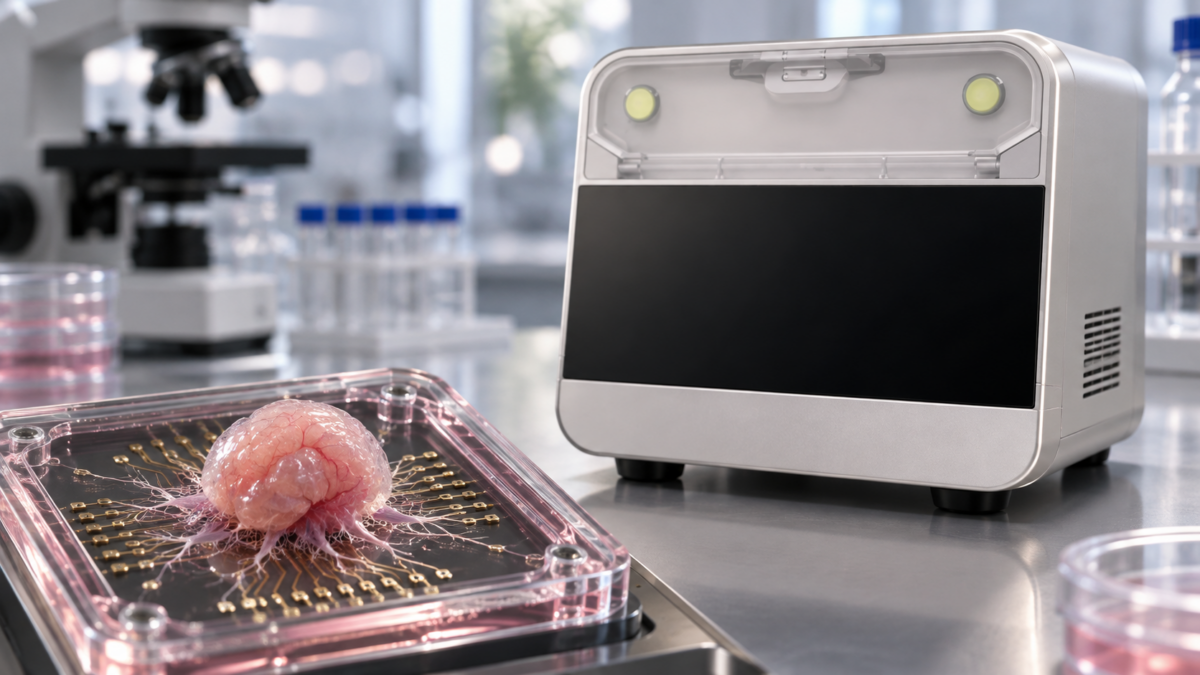
Australian company Cortical Labs has developed a system called CL1 in which living neural cells grow directly over a silicon chip containing electrodes capable of both stimulating the neurons and recording their electrical activity.
Developers can send information to the neuronal network, observe how it responds and build software around those responses.
Cortical Labs describes the CL1 as the first code-deployable biological computer and is currently offering both physical systems and remote access through its Cortical Cloud.
The technology has attracted renewed attention following a September 2026 article in Nature Physics examining whether biological neural networks could eventually provide an alternative to some of the extraordinarily energy-intensive computing used in modern artificial intelligence.
There is an important clarification.
This is not a human brain inside a computer.
The systems use cultures of laboratory-grown neurons containing only a tiny fraction of the cells and biological complexity found in an actual human brain.
But the neurons are alive, they communicate electrically and previous experiments have shown that networks of these cells can change their behaviour in response to feedback.
The idea began with neurons learning to play Pong
One of the foundations for the current technology came from an experiment published in Neuron in 2022.
Researchers led by Brett Kagan at Cortical Labs created a system called DishBrain.
Approximately 800,000 neurons derived from either human stem cells or mouse brains were grown on a high-density multielectrode array.
The electrodes allowed a computer to communicate with the cells in both directions.
Electrical stimulation provided information to the neuronal network.
Electrical activity generated by the neurons could then be interpreted by the computer as an output.
The researchers connected the system to a simplified version of the classic video game Pong.
The neurons received electrical information representing the location of the ball and their own electrical activity was used to control the paddle.
When the system responded successfully, it received predictable feedback.
When it missed, the feedback became unpredictable.
Over repeated sessions, the neural cultures improved their performance.
The researchers reported apparent learning within approximately five minutes of gameplay, while control conditions without meaningful feedback did not show the same improvement.
No one taught the cells the rules of Pong
This is one of the aspects that made the experiment so unusual.
The researchers did not programme a set of digital instructions telling individual neurons how to move the paddle.
The network reorganised its electrical activity while interacting with the environment.
That is fundamentally different from conventional software.
A normal processor executes instructions created by programmers.
A biological neural network changes the strength and organisation of its connections in response to experience.
This property is called plasticity.
Plasticity is one of the fundamental mechanisms underlying learning in biological nervous systems.
The researchers referred to the resulting system as synthetic biological intelligence.
The term remains controversial, particularly because intelligence itself is difficult to define and the complexity of these cultures is minuscule compared with a complete brain.
But the experiment demonstrated something more modest and much harder to dispute: living neurons could be incorporated into a closed-loop digital system and adapt their activity according to feedback.
The CL1 attempts to turn that experiment into a platform
DishBrain required specialised laboratory equipment.
The CL1 attempts to package many of those components into one self-contained system.
Living neurons are cultured above an electrode array inside the device.
The system also contains the infrastructure required to keep the biological component alive, including temperature control, gas regulation and nutrient circulation.
Cortical Labs says its life-support system can maintain neuronal cultures for up to approximately six months.
The hardware continuously records neural electrical activity while also allowing software to stimulate selected electrodes.
This creates a closed loop.
Software generates an environment.
The neuronal network receives information about that environment through electrical stimulation.
The neurons respond.
The computer interprets that response and changes the environment accordingly.
The process then repeats.
Developers can actually write software for it
This is the feature that makes the technology more interesting than a biological laboratory demonstration.
The neurons can be placed inside programmable digital environments.
Cortical Labs has developed what it calls a Biological Intelligence Operating System, or biOS, to manage communication between software and the cells.
Researchers can therefore design tasks and send those tasks to the living neural network.
The company has also launched Cortical Cloud, which allows researchers to interact with biological neural systems remotely rather than maintaining living neuronal cultures in their own laboratories.
This means a developer can, in principle, write code on a conventional computer and connect that code to a biological processing system located elsewhere.
That is a strange reversal of conventional computing.
For decades, engineers have tried to make silicon behave more like neurons.
Biological computing instead asks what happens if actual neurons become part of the machine.
The potential advantage is energy efficiency
Modern artificial intelligence requires enormous amounts of electricity.
Large AI models rely on data centres containing thousands of specialised processors that perform huge numbers of mathematical operations.
The brain solves very different problems, so direct comparisons must be treated cautiously.
But its energy efficiency is extraordinary.
The human brain operates on roughly 20 watts of power.
That is comparable with a relatively small household light bulb.
Despite that modest energy budget, it continuously processes vision, language, movement, memory and sensory information while adapting to unfamiliar situations.
A July 2026 review in Nature Computational Science argues that this combination of parallel processing, learning and energy efficiency is one reason researchers are increasingly interested in organoid intelligence and other forms of biological computing.
The goal is not necessarily to replace conventional processors.
It is to determine whether living neural networks might perform particular kinds of adaptive computation more efficiently.
Traditional computers keep memory and processing apart
Part of the difference lies in architecture.
Most conventional computers separate processing from memory.
Data must constantly move between memory and the processor.
This creates what computer scientists call the von Neumann bottleneck.
Moving information consumes time and energy.
Biological neurons operate differently.
Processing and memory are deeply intertwined.
A synapse is both part of the communication system and part of the mechanism through which previous activity changes future behaviour.
In other words, the system can alter itself while it computes.
Artificial neural networks imitate this concept mathematically, but they still ultimately run on conventional digital hardware.
Biological computing attempts to use the physical phenomenon directly.
Recent research suggests neural cultures have some of the machinery required for learning
The scientific case does not depend only on Pong.
A 2025 study in Communications Biology examined neural organoids derived from human induced pluripotent stem cells.
The researchers found several biological characteristics considered fundamental to learning and memory.
The organoids developed functional connections between neurons.
They displayed changes in synaptic strength after stimulation.
They also demonstrated short- and long-term forms of synaptic potentiation and depression.
These mechanisms resemble processes through which biological nervous systems strengthen or weaken connections based on activity.
A 2026 review in Nature Computational Science subsequently identified organoid intelligence as an emerging stage in the long progression from conventional algorithms to artificial neural networks, neuromorphic chips and, potentially, computers incorporating living neural structures.
Other laboratories are building biological processors too
Cortical Labs is not alone.
In August 2026, researchers from Eindhoven University of Technology published another human-neuron-based computing platform in Scientific Reports.
Their Bio-adaptive Processing Unit used human stem-cell-derived neuronal networks connected through a microfluidic brain-on-chip architecture.
Rather than trying to reproduce the CL1 directly, the work demonstrates that multiple research groups are now treating living neural networks as potential computational substrates.
Another approach known as reservoir computing uses the naturally complex dynamics of neuronal tissue to transform information before a conventional computer interprets the output.
The field remains extremely young.
But biological computation is no longer represented by only one experimental demonstration.
This is not going to replace your laptop
Calling the CL1 a biological computer can create the impression that it is a normal PC with neurons replacing the CPU.
That is not what it is.
Living neurons are exceptionally good at adaptive behaviour, pattern formation and responding dynamically to stimulation.
They are terrible at many tasks where conventional computers excel.
No biological culture is going to outperform a modern processor at calculating a spreadsheet, rendering a video or executing billions of perfectly repeatable arithmetic operations.
Biology is noisy.
Two neural cultures are not identical.
The same culture can behave differently over time.
Cells age and die.
They require nutrients.
Temperature and chemical conditions must remain controlled.
Silicon is popular partly because it is extraordinarily reliable.
A processor that needs feeding creates very different engineering problems
A biological computer cannot simply be manufactured and forgotten.
The living component has to remain alive.
The CL1 therefore contains what is effectively a miniature life-support system alongside its electronics.
That creates additional complexity that ordinary computers do not face.
A conventional processor can be switched off for a year and started again.
A culture of neurons cannot.
Researchers also have to account for contamination, biological variation and deterioration over time.
Replacing a damaged transistor and replacing a living neural network are fundamentally different problems.
This is one reason the most realistic future may involve hybrid computers.
Silicon would continue performing deterministic calculations, storage and communication while biological components handle particular learning or adaptive tasks.
The word “human” also requires some explanation
The neurons used in this field do not generally come from pieces of a functioning adult brain.
Human neural cells can instead be produced from induced pluripotent stem cells.
These are ordinary human cells that have been reprogrammed into a stem-cell-like state and then directed to develop into neurons.
This allows researchers to produce human neuronal cultures without removing brain tissue from a person.
It also creates intriguing medical applications.
Cells derived from an individual patient could potentially be transformed into neurons carrying that person’s genetic characteristics.
Researchers could then study how the network responds to drugs or how particular neurological disorders affect electrical activity.
Drug testing may arrive before revolutionary computing
This could prove to be one of biological computing’s most practical early uses.
Traditional drug development relies heavily on animal models and simplified cell cultures.
Neither perfectly reproduces human brain biology.
Living human neural networks capable of producing measurable behavioural responses could provide researchers with a new type of experimental model.
Instead of asking only whether a drug kills neurons or changes the concentration of a molecule, researchers could investigate whether it changes how an entire neural network processes information.
Cortical Labs has already explored this approach experimentally.
A biological computer could therefore be useful even if it never becomes a competitor to conventional AI.
Then comes the uncomfortable ethical question
If researchers create increasingly sophisticated neural systems capable of learning, when do those systems deserve ethical consideration?
There is currently no evidence that the CL1 contains anything remotely comparable with human consciousness.
A culture of neurons lacks the enormous anatomical organisation, sensory systems and billions of interconnected cells that constitute a human brain.
Learning is also not equivalent to consciousness.
Single cells and simple organisms can adapt to their environments without possessing anything resembling human subjective experience.
Nevertheless, scientists and ethicists are already debating where future boundaries should be placed.
A July 2026 commentary in Nature highlighted one particularly immediate issue: people donating biological samples for medical research may not have anticipated that their cells could eventually become part of a computing system.
The authors argue that consent practices need to evolve as organoid and biological-computing applications expand.
The donors may never have agreed to become part of a computer
Modern biomedical research frequently stores donated tissue and cell lines for future experiments.
A sample originally collected to study a disease might later be converted into induced pluripotent stem cells.
Those cells could then become neural tissue.
If that tissue is subsequently used as part of a computational system, the purpose may be considerably different from what the original donor imagined.
The ethical concern exists even if the neurons themselves have no consciousness.
It is a question of what people consented to when their biological material was collected.
This illustrates how quickly the technology is moving.
The engineering problem is no longer the only question.
The biological computer is currently more research instrument than PC
For now, the most accurate way to understand the CL1 is as a sophisticated laboratory platform.
It combines a cell-culture system, electrode array, software interface and conventional computing hardware.
Researchers can programme experiments and observe how the living network responds.
That is remarkable.
But it is very different from buying a biological gaming PC or replacing the processor in a laptop.
The real significance is that scientists now have a reusable interface between software and living neuronal computation.
What developers eventually discover that it is useful for remains an open question.
AI may have spent decades copying the brain only for engineers to return to the original
The history of artificial intelligence is deeply connected to biology.
Artificial neural networks were inspired by simplified mathematical models of neurons.
Deep learning expanded these artificial networks to enormous scales.
Neuromorphic chips went a step further by designing electronics that behave more like networks of biological neurons.
Biological computing takes the idea to its logical extreme.
Instead of simulating neurons, use neurons.
That does not guarantee better computers.
Biology brings enormous disadvantages alongside its remarkable efficiency and adaptability.
But it creates a completely different computational material for scientists to explore.
The strangest computer in the room may also be the one that is alive
There is an appealing simplicity to silicon.
A transistor does precisely what its circuit tells it to do.
A neuron does not.
It responds to thousands of signals, modifies its connections, changes its behaviour and forms networks whose collective dynamics can be difficult to predict.
For conventional engineering, that unpredictability is a problem.
For learning, it may be the feature researchers want.
The CL1 does not contain a tiny person, a trapped brain or a biological version of ChatGPT.
It contains something both less dramatic and scientifically more interesting: living neural cells communicating directly with software.
Four years ago, cultures like these were being taught to control a paddle in Pong.
Today, developers can access biological neural networks through dedicated computing hardware and cloud infrastructure.
The unanswered question is no longer whether living neurons can become part of a computer.
They already have.
The question is what computers will become once some of their hardware is alive.
Source Information
Current Commentary: Life in the machine
Author: Mark Buchanan
Journal: Nature Physics
Published: 9 September 2026
DOI: 10.1038/s41567-026-03437-7
2026 Review: Computing inspired by the brain: a journey from algorithms to organoids
Authors: Paris Brown and Shyni Varghese
Journal: Nature Computational Science
Volume: 6
Pages: 686–696
Published: 3 July 2026
DOI: 10.1038/s43588-026-01012-x
Foundational Study: In vitro neurons learn and exhibit sentience when embodied in a simulated game-world
Authors: Brett J. Kagan, Andy C. Kitchen, Nhi T. Tran et al.
Journal: Neuron
Volume: 110, Issue 23
Pages: 3952–3969.e8
Published: 2022
System: DishBrain
Neural cultures: Human induced-pluripotent-stem-cell-derived cortical neurons and primary mouse cortical neurons
DOI: 10.1016/j.neuron.2022.09.001
Supporting Study: Human neural organoid microphysiological systems show the building blocks necessary for basic learning and memory
Lead Author: Dowlette-Mary Alam El Din et al.
Journal: Communications Biology
Volume: 8
Article: 1237
Published: 16 August 2025
DOI: 10.1038/s42003-025-08632-5
Technology: Cortical Labs CL1
Design: Living neuronal culture integrated with a silicon multielectrode array and closed-loop software environment
Claimed culture lifespan: Up to approximately six months using the integrated life-support system
Availability: Physical CL1 systems and remote biological-computing access through Cortical Cloud