






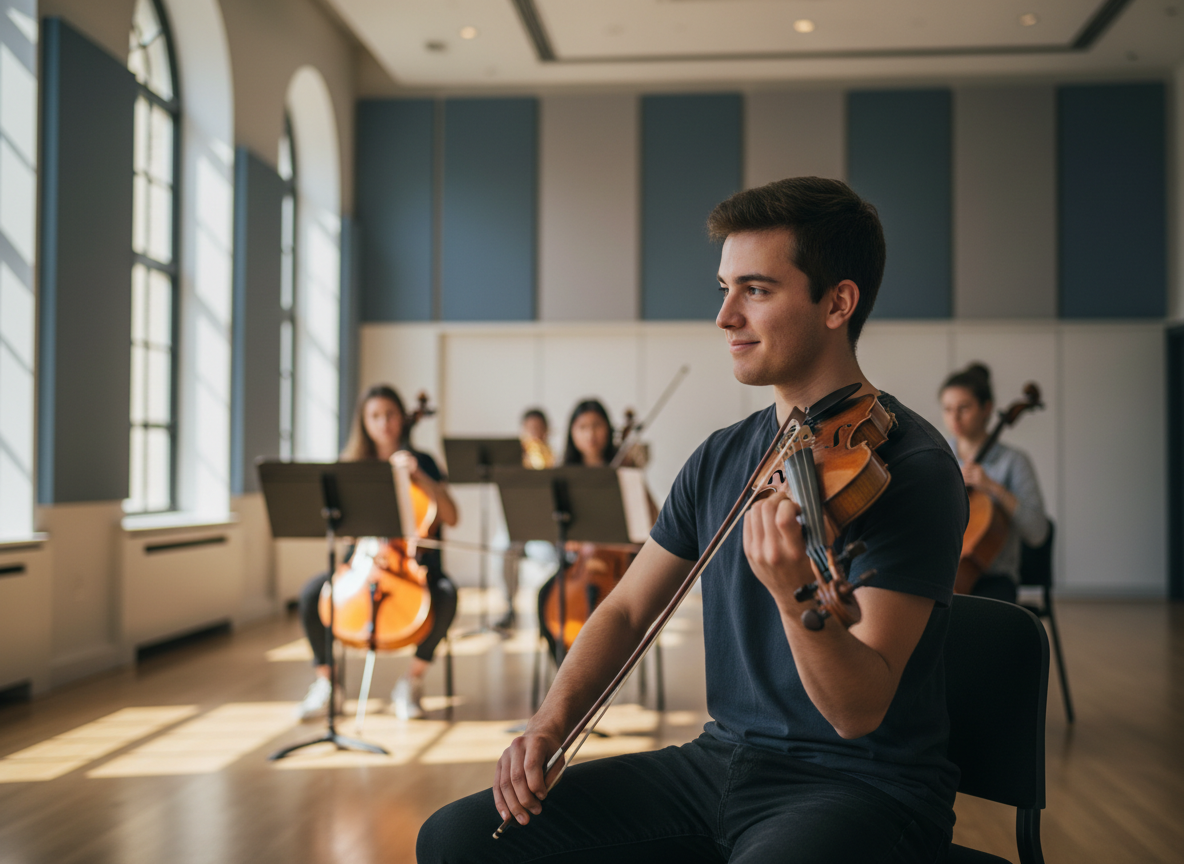
Making a mistake in a rehearsal is unusually public. A missed entrance, an uncertain interpretation or a passage that falls apart can be heard immediately by teachers and peers. New longitudinal research suggests that how safe students feel in those moments may matter well beyond the quality of a single performance.
A study of 341 university music students found that those who initially felt more able to ask questions, admit mistakes, seek help and express different artistic views reported stronger social connection about six weeks later. That stronger sense of connection was then associated with greater flourishing at a third measurement roughly another six weeks later.
The pattern is important because it was not simply a direct link between feeling psychologically safe and later well-being. Instead, the statistical evidence pointed to social connection as the pathway linking the two. At the same time, the researchers found evidence that connection may also feed back into later perceptions of safety, making the relationship more nuanced than a simple one-way chain.
Following students across three points in time
The research, published in Frontiers in Psychology on 25 September 2026, followed students participating in collaborative music activities at three Chinese universities. The sample covered 23 groups and included choirs, orchestras, Chinese instrumental ensembles, chamber groups, bands, group vocal and instrumental classes, music-pedagogy groups, and collective improvisation or composition groups.
Rather than asking students once about their experience, the study used three survey waves separated by approximately six weeks. The average interval from the first to second wave was 42.0 days, while the second to third averaged 42.2 days. All 341 participants completed surveys within a 28 to 56 day interval.
The researchers measured three central ideas. Perceived psychological safety captured whether an individual student believed that interpersonal risks such as acknowledging errors or disagreeing could be taken without humiliation, exclusion or punishment. State social connection measured feelings of closeness, acceptance and belonging in the particular collaborative activity. Flourishing captured broader positive functioning, including meaning, supportive relationships, competence, engagement, optimism and positive self-regard.
This distinction matters. Psychological safety was analysed as each student’s perception, not as proof that an entire choir or ensemble possessed a shared team climate. The study therefore asks whether differences in how students experience a group are related to what happens to their connection and flourishing over time.
A clear indirect pathway emerged
After accounting for students’ earlier levels of social connection and other baseline factors, psychological safety at the first wave predicted stronger social connection at the second. The standardised coefficient was 0.350, with p below 0.001. In practical terms, students who felt safer taking interpersonal risks at the beginning tended to feel more connected to their collaborative group around six weeks later.
That later connection, in turn, predicted flourishing at the third wave even after prior flourishing was taken into account. The standardised coefficient was 0.274, again with p below 0.001.
When the two paths were combined, the longitudinal indirect effect was B = 0.0949 and β = 0.096, with p below 0.001. A 5,000-sample bootstrap analysis produced a bias-corrected 95% confidence interval from 0.054 to 0.142. Because that interval did not include zero, the indirect association remained statistically supported under the additional test.
The direct path from initial psychological safety to later flourishing told a very different story. It was essentially zero, with β = -0.004 and p = 0.941. The total effect was small, β = 0.092, and only just beyond the conventional significance threshold at p = 0.046 in the primary model.
That combination is more informative than a simple claim that safer students were happier. The more consistent statistical signal ran through students’ subsequent sense of connection. Feeling able to expose uncertainty may matter because it allows more genuine interaction, feedback and reciprocal participation, which can strengthen belonging before broader flourishing changes.
But connection may help create safety too
The authors tested competing explanations rather than assuming their proposed sequence was the only plausible one. Reverse and alternative-ordering models fit substantially worse than the hypothesised model, but a reciprocal model complicated the picture.
The Akaike information criterion favoured the reciprocal model by 3.5 points, while the Bayesian information criterion favoured the simpler hypothesised model by 4.1 points. Earlier social connection also significantly predicted later perceived psychological safety, with β = 0.134 and p = 0.004.
This suggests a possible reinforcing process. A student who believes mistakes and disagreement will not lead to humiliation may participate more openly and become more connected. Positive experiences of acceptance and belonging may then make the same environment feel safer later. The data are compatible with that feedback loop, although they cannot establish it causally.
A random-intercept cross-lagged panel model provided another robustness check by separating stable differences between students from changes occurring within the same student over time. The within-person indirect effect remained significant at B = 0.1697, β = 0.177 and p below 0.001. The within-person total effect, however, was not significant. The authors appropriately treat this analysis as exploratory because three waves are the minimum for this type of model and leave relatively limited room for identifying complex within-person processes.
High standards do not require interpersonal threat
The findings have a practical implication for music education that is easy to misread. Psychological safety does not mean lowering artistic standards or avoiding critical feedback. Collaborative performance depends on correction, precision and the willingness to identify problems. The issue is whether students experience those interactions as opportunities to improve or as interpersonal threats that encourage silence and concealment.
The authors suggest that teachers and conductors can model openness about uncertainty, respond to mistakes with specific guidance rather than humiliation, invite students to explain difficulties and take different artistic interpretations seriously. Structured peer feedback, rotating leadership and small-group discussion are also plausible ways to create more opportunities for genuine participation.
These are implications to test, not interventions proven by the study. The research did not manipulate teaching behaviour or psychological safety. It therefore cannot show that introducing any particular rehearsal practice will cause flourishing to rise.
Why the limits matter
The longitudinal design is stronger than a one-off survey for examining temporal patterns, but it remains observational. All central variables were self-reported, and the study cannot establish causal priority. Psychological safety was measured at the individual level, so the results should not be interpreted as evidence that particular ensembles had objectively safe or unsafe cultures.
The 341 students were also drawn from three universities in China and from a wide range of musical activities. Choirs, orchestras, bands, chamber groups and improvisation groups can differ substantially in hierarchy, leadership and interaction demands. Pooling them increased breadth but did not allow the researchers to estimate separate pathways for every activity type.
Nor did the study directly measure musical synchrony, shared emotion or collective expression. It therefore cannot claim that music itself produced the observed pathway. The evidence is better understood as a test of a broader interpersonal process inside a music-education setting.
Missing data were handled with full-information maximum likelihood, and complete-case, weighted and cluster-robust sensitivity analyses produced similar estimates for the central indirect pathway. Even so, unobserved factors associated with missingness cannot be ruled out. Only 23 music-group clusters were available, and no full multilevel group mechanism was tested.
The lesson is about belonging, not simply comfort
The strongest message from the study is not that collaborative music automatically improves well-being. Students can occupy the same rehearsal room while experiencing it very differently. What appears to matter is whether they feel able to participate without excessive interpersonal risk and whether that experience develops into genuine connection.
For universities, the distinction is useful beyond music. Collaborative learning often requires students to reveal incomplete thinking, accept correction and disagree in front of others. The present evidence does not prove that psychological safety causes flourishing, but it shows a robust longitudinal association in which connection repeatedly sits at the centre.
Source Information
Study Title: Perceived psychological safety, state social connection, and student flourishing in collaborative music activities: a three-wave longitudinal study
Author: Shihao Zhang
Journal: Frontiers in Psychology
Year: 2026
DOI: 10.3389/fpsyg.2026.1956682