




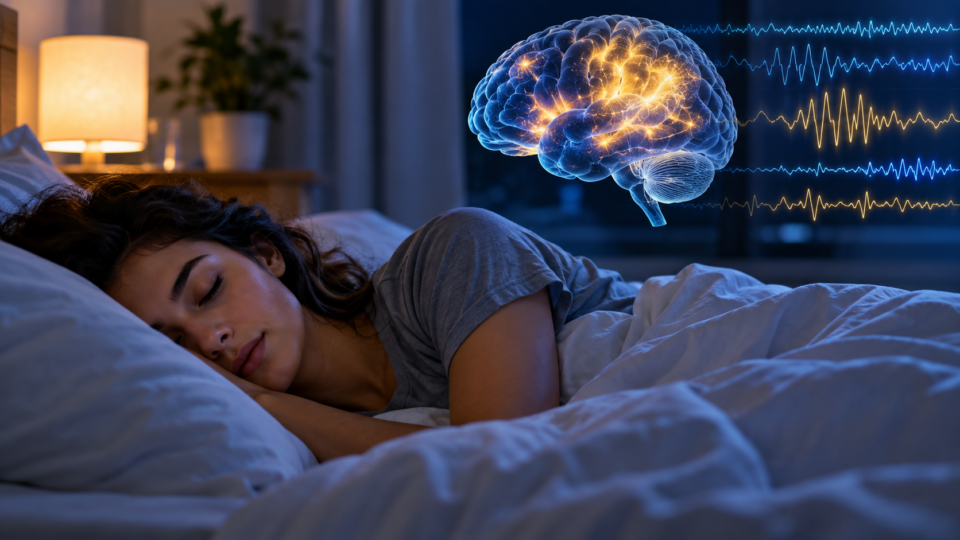
A night without sleep does more than leave people tired and unfocused. It may also weaken the brain systems used to stop unwanted memories from repeatedly entering awareness.
In a controlled neuroimaging study published in Proceedings of the National Academy of Sciences, researchers compared healthy adults who had slept normally with participants kept awake overnight. The following morning, participants tried to prevent previously learned scenes from coming to mind while undergoing functional magnetic resonance imaging.
The sleep-deprived group was less able to reduce memory intrusions over repeated attempts. Their brain activity also showed a specific disruption in the control system normally recruited to suppress unwanted retrieval: weaker engagement of the right dorsolateral prefrontal cortex and weaker disengagement of the right hippocampus.
The findings offer a plausible neural mechanism linking sleep loss with intrusive memories. They do not show that a single sleepless night causes a psychiatric disorder, nor do they establish that every unwanted thought is a memory-control failure. Instead, the experiment demonstrates that acute total sleep deprivation can impair a measurable cognitive process that helps healthy people keep unwanted memories out of awareness.
Testing whether the brain can stop a memory
The study used a well-established memory-control paradigm. Participants first learned associations between faces and scenes, including emotionally negative and neutral scenes. Later, a face served as a reminder. On some trials participants were instructed to retrieve the associated scene. On others they were instructed to prevent the scene from entering awareness.
After each suppression attempt, participants reported whether the associated memory had intruded into consciousness. Repeating the procedure allowed the researchers to measure whether people became progressively better at keeping unwanted material out of mind.
The overnight manipulation created the central comparison. One group received restful sleep, which was recorded using polysomnography, while another underwent total sleep deprivation. Participants then completed the memory-suppression task during fMRI, allowing behaviour and brain activity to be examined together.
This design is important because an association between poor sleep and intrusive thinking does not by itself establish what is happening in the brain. People who experience distress may sleep poorly, poor sleep may worsen distress, and both can be influenced by other factors. Experimentally depriving healthy participants of sleep provides a cleaner test of whether sleep loss itself can disrupt memory control.
The prefrontal control signal weakened after sleep deprivation
The right dorsolateral prefrontal cortex, or rDLPFC, is strongly implicated in inhibitory control. During memory suppression it is thought to exert top-down control over brain regions involved in retrieval, including the hippocampus.
Across participants, the rDLPFC was substantially more active during suppression than retrieval, with F(1,66) = 55.69, P < 0.001 and partial eta squared of 0.46. The critical result was that this suppression-related engagement was significantly weaker after sleep deprivation than after restful sleep. The interaction was F(1,66) = 5.68, P = 0.020, with partial eta squared of 0.08.
Sleep deprivation was also associated with a broader reduction in rDLPFC activity, F(1,66) = 11.58, P = 0.001. The pattern suggests that the sleep-deprived brain had more difficulty recruiting a region needed to exert control when unwanted memories were triggered.
The hippocampus was harder to shut down
The researchers found the complementary pattern in the right hippocampus, a region central to memory retrieval.
Normally, hippocampal activity was lower during memory suppression than during deliberate retrieval. That effect was strong, F(1,66) = 29.42, P < 0.001, with partial eta squared of 0.31.
But the sleep-deprived group showed significantly weaker suppression-related disengagement of the right hippocampus. The interaction reached F(1,66) = 17.02, P < 0.001, with partial eta squared of 0.21.
Taken together, the prefrontal and hippocampal findings fit a coherent control model. Well-rested participants were better able to recruit prefrontal control while reducing retrieval-related activity in the hippocampus. Sleep deprivation weakened both sides of that process.
Unwanted memories also became harder to control with repetition
The imaging findings were accompanied by behavioural differences. Well-rested participants became progressively better at preventing unwanted memories from intruding across repeated suppression attempts. Sleep-deprived participants showed a weaker improvement, leaving the target memories more persistently intrusive.
This distinction matters. The experiment was not simply measuring whether an unwanted memory appeared once. It tested adaptive suppression, or whether repeated efforts to control retrieval made later intrusions less likely.
Among rested participants, greater suppression-related rDLPFC activity was associated with a stronger reduction in intrusions over time. The reported skipped correlation was r = -0.40, with a confidence interval from -0.63 to -0.11. The equivalent relationship was not evident in the sleep-deprived group.
The result suggests that sleep loss did not merely make participants feel less capable. It disrupted the relationship between a neural control mechanism and successful adaptation to repeated unwanted retrieval.
REM sleep was linked with stronger next-day control
The participants who slept were monitored using polysomnography, allowing the researchers to examine whether particular components of sleep related to next-day brain function.
More time spent in rapid-eye-movement sleep was associated with stronger suppression-related engagement of the rDLPFC the following day. The authors interpret this association cautiously, but it raises the possibility that REM sleep contributes to restoring the prefrontal mechanisms used to control unwanted memories.
That does not mean REM sleep has been proven to be the sole restorative ingredient. Sleep stages are interdependent, and an observational correlation within the rested group cannot establish that increasing REM sleep would directly improve memory suppression. The experiment establishes the effect of total sleep deprivation more strongly than it establishes the causal role of a particular sleep stage.
Sleep loss changed wider brain networks too
The study went beyond the prefrontal cortex and hippocampus. Resting-state scans indicated that sleep deprivation altered communication between large-scale networks involved in internally generated thought and cognitive control.
Sleep deprivation increased functional connectivity between the default mode network and areas of the cognitive control network, while reducing connectivity between the default mode network and the thalamus. Participants also showed less deliberate, on-task thinking after being deprived of sleep.
These findings support a broader interpretation: the problem may not be confined to one memory circuit. Prolonged wakefulness appears to destabilise the systems that help people regulate the boundary between internally generated content and goal-directed thought.
Why intrusive memories matter
Intrusive memories are common and are not inherently pathological. A song, image, embarrassing moment or unpleasant experience can enter awareness without invitation in healthy people. The ability to redirect attention and suppress unwanted retrieval is one of several mechanisms that can keep such experiences manageable.
Intrusive memories are also prominent in conditions such as post-traumatic stress disorder, depression and anxiety disorders. Sleep disturbance is common in many of the same conditions. This overlap has encouraged researchers to ask whether impaired sleep and impaired memory control may reinforce one another.
The present experiment provides evidence for one direction of that relationship: depriving otherwise healthy adults of sleep weakened neural and behavioural markers of memory suppression. It does not establish that this mechanism explains intrusive thinking in people with psychiatric conditions, but it gives researchers a specific circuit to investigate.
The study should not be read as a diagnosis
The experiment involved acute total sleep deprivation under controlled conditions. That is different from chronic insomnia, fragmented sleep, shift work, repeatedly shortened nights or the sleep disturbances associated with mental illness.
The task was also deliberately artificial. Participants learned face-scene associations and later tried to suppress them when prompted. Real intrusive memories can be autobiographical, emotionally complex and linked to years of experience. Laboratory control makes the neural mechanism easier to isolate, but it reduces the complexity of the memories being studied.
Functional MRI is another limitation. It measures blood-oxygen-level-dependent signals rather than directly recording individual neurons. Differences in activation and connectivity are therefore indirect indicators of neural processing.
The REM finding is correlational within the rested group and should not be interpreted as evidence that manipulating REM sleep would necessarily improve intrusive-thought control. Likewise, the study does not show that sleeping longer is a treatment for trauma-related intrusive memories.
A biological cost of staying awake
The study adds a mechanistic explanation to a familiar experience: after too little sleep, controlling the contents of one’s own mind can feel more difficult.
Following total sleep deprivation, participants showed weaker recruitment of the prefrontal region associated with stopping retrieval, less suppression of hippocampal activity and poorer adaptation to repeated unwanted memories. In rested participants, more REM sleep was associated with stronger next-day engagement of the same prefrontal control system.
The broader implication is not that every intrusive thought signals sleep deprivation. It is that sleep appears to support the neural machinery people use to decide which memories are allowed back into awareness and which are kept out.
Source Information
Study: Harrington, M. O., Karapanagiotidis, T., Phillips, L. et al. “Memory control deficits in the sleep-deprived human brain.”
Journal: Proceedings of the National Academy of Sciences.
Published: 31 December 2024, in PNAS volume 122, issue 1.
Study design: Controlled overnight sleep versus total sleep-deprivation experiment combining a Think/No-Think memory-suppression task, functional MRI, resting-state fMRI, behavioural thought measures and polysomnography in the rested group.