

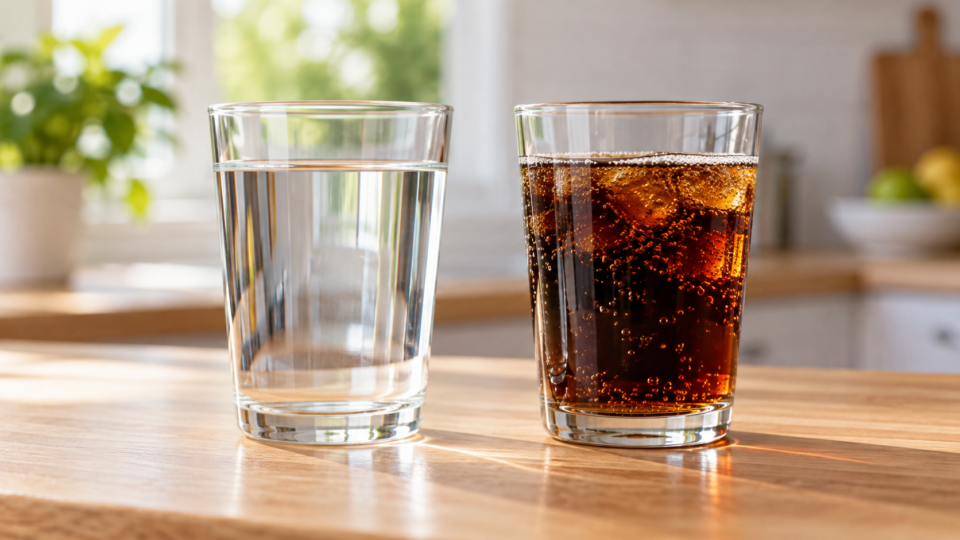


Are diet soft drinks an obstacle to lasting weight loss, or can they fit into a healthier routine? A two-year clinical trial offers a more informative answer than a simple yes or no. Its findings suggest that adults receiving behavioural weight-management support maintained similar weight reductions whether they were assigned water or low- and no-calorie sweetened beverages.
The findings come from the SWITCH randomised controlled trial, published in the British Journal of Nutrition. The study enrolled 493 adults and followed an optional extension to 104 weeks. The central result is encouraging for people who prefer diet beverages, but the trial’s limitations make it important not to confuse comparable outcomes with proof that the drinks are risk-free or promote weight loss on their own.
What the two-year trial found
A two-year randomised trial has added an important piece of evidence to the debate over whether low- and no-calorie sweetened drinks help or hinder weight management. Researchers assigned 493 adults to drink either water or beverages containing non-nutritive sweeteners while participating in a structured weight-management programme. At 104 weeks, both groups had maintained weight loss, and the difference between them was not statistically significant. The results challenge the simple claim that diet drinks necessarily undermine attempts to lose weight. They do not establish that diet drinks are healthier than water, nor that drinking them alone produces weight loss. The common behavioural programme was an essential part of the study.
The numbers behind the headline
Participants assigned to water lost an average of 3.7 kilograms from baseline over the 104-week study. Those assigned to non-nutritive sweetened beverages lost 4.8 kilograms. The numerical difference of 1.1 kilograms favoured the sweetened-beverage group, but it was not statistically significant at the two-year endpoint. A difference in the observed averages should not be confused with evidence that one drink was superior. The authors reported comparable long-term weight outcomes under the trial conditions. These are group averages, not predictions of what any particular individual will lose. Weight responses vary with food intake, physical activity, health, medication, and adherence to a programme.
Who participated
The SWITCH trial recruited adults aged 18 to 65 years in the Liverpool region of England. Eligible participants had a body mass index between 27 and 35 kilograms per square metre and regularly consumed cold drinks. Of the 493 people randomised, 246 were assigned to water and 247 to non-nutritive sweetened beverages. The study was not a population survey of everyone who consumes artificial sweeteners. Its eligibility criteria excluded several groups, including people with certain major health conditions. This matters when interpreting the results for children, older adults, people with diabetes, or those outside the trial’s BMI range.
What participants were asked to drink
The beverage intervention was specific rather than an unrestricted instruction to drink whatever participants preferred. People were asked to consume at least two 330-millilitre servings each day of their assigned beverage type. Those in the water group were asked to avoid non-nutritive sweetened beverages, including sweeteners added to hot drinks. The other group consumed commercially available drinks sweetened with low- or no-calorie substitutes. Researchers monitored adherence through online logs, packaging returns, and dietary questionnaires. The comparison therefore concerned a defined daily beverage habit alongside weight-management support, not a direct experiment on every sweetener or every quantity that people might consume.
Why the behavioural programme matters
Both groups attended a structured programme during the first year. There were weekly sessions over the initial 12-week weight-loss phase, followed by monthly sessions during a 40-week assisted maintenance phase. Participants then had the option to continue for another 52 weeks without those assisted sessions. This structure makes the final year particularly interesting: the researchers could examine whether earlier weight reductions were sustained after regular support ended. It also limits what can be claimed. Because everyone received dietary and behavioural support, the observed weight loss cannot be attributed to the beverage assignment alone. The study tested how the two drink choices performed within a broader intervention.
A substantial drop in follow-up participation
Although 493 people entered the trial, only 220 completed the final 104-week assessment: 117 in the water group and 103 in the sweetened-beverage group. That is less than half of those initially randomised. Long-term trials commonly struggle with retention, but the extent of missing follow-up data is consequential. People who remain engaged for two years may differ from those who leave, including in motivation, health, drinking habits, and weight trajectory. The researchers used statistical sensitivity analyses and approaches to missing data, but those methods cannot make uncertainty disappear. Readers should therefore distinguish the strength of the randomised starting design from the smaller group with observed final measurements.
Why the trial is stronger than a simple diet survey
Observational studies can detect associations between beverage habits and body weight, but interpreting them is difficult. People who already have concerns about their weight may deliberately switch from sugary drinks to diet versions. This can create a misleading association between diet drinks and higher weight, even when the drinks themselves are not causing the weight difference. Random assignment helps balance measured and unmeasured characteristics at the beginning of a trial. Here, participants were allocated to different beverage strategies, making the comparison more informative about the effects of the assigned drinking pattern. Randomisation is not a guarantee of perfect evidence, particularly when many participants do not complete follow-up.
What the researchers measured
Body weight at week 104 was the central endpoint of the extension study. The investigators also assessed waist and hip circumference, body composition, appetite-related measures, and markers of metabolic health, including blood glucose and blood lipids. Some outcomes depended on smaller subsets of participants who were available for additional testing. This range of measurements is useful because body weight alone does not describe every aspect of health. However, a trial designed around weight management cannot settle all questions about long-term cardiovascular events, cancer, or other health outcomes that may take many years to develop. The authors’ conclusions should be read within the scope of what they actually measured.
Metabolic results require careful reading
University summaries of the trial highlighted improvements in several body measurements and metabolic indicators across both groups, without broad evidence of clinically meaningful disadvantages for the sweetened-beverage strategy. Yet the publicly available trial results also identify differences in some secondary markers at particular time points, including total cholesterol and glycated haemoglobin at 104 weeks. These should not be ignored or exaggerated. A secondary biomarker result is not the same as a demonstrated change in disease risk. The overall pattern is compatible with similar weight-management performance, while leaving room for more detailed investigation of specific metabolic effects and individual responses.
Why the results do not mean diet drinks cause weight loss
Imagine two people who both attend the same weight-management classes, adjust their food choices, and become more physically active. If one chooses water and the other chooses a low-calorie sweetened drink, both may lose weight because of the broader changes they make. That is close to the practical question examined here. The researchers did not include an otherwise identical group receiving no behavioural intervention to isolate the beverage’s independent effect. Nor did they directly compare diet drinks with unrestricted consumption of sugary soft drinks throughout the two-year programme. Claims that a diet drink automatically makes someone lose weight would go beyond the evidence.
What about appetite and sweetness?
One concern about non-nutritive sweeteners is that a sweet taste without substantial calories might influence hunger, food cravings, or later eating. Another is that maintaining a preference for sweet flavours could make dietary change more difficult. These are plausible questions, but they are not answered simply by assuming one direction of effect. The trial’s long-term weight outcomes did not reveal a clear weight-management disadvantage for the assigned sweetened beverages. That observation is relevant to theories predicting large, consistent compensatory overeating. It does not prove that appetite mechanisms never change or that every person responds in the same way. Different sweeteners, foods, and contexts may produce different results.
How this fits into public-health advice
Guidance on non-sugar sweeteners has often been cautious because evidence comes from different kinds of studies asking different questions. The World Health Organization’s guidance has discouraged relying on non-sugar sweeteners as a long-term strategy for weight control in the general population, while acknowledging uncertainty in the evidence base. The SWITCH trial contributes a longer randomised comparison of two drink choices in adults participating in weight management. It does not automatically overturn wider guidance, which considers multiple health outcomes and broader populations. A sensible reading is that this trial reduces one specific uncertainty: within this intervention, choosing a low- or no-calorie sweetened drink did not produce worse average two-year weight outcomes than choosing water.
Funding and interpretation
The research was funded by the American Beverage Association, an industry organisation with an obvious interest in findings about commercially available drinks. The universities involved stated that the investigators retained independence and control over analysis and reporting. Both facts are relevant. Funding does not by itself invalidate a randomised trial, but financial relationships are important context when evaluating the evidence. Readers should assess the published methods, prespecified outcomes, missing data, and consistency with independent studies rather than accepting or rejecting the findings solely because of the sponsor. Replication by independent research groups would strengthen confidence in how widely these results apply.
Important limitations
The trial was open-label, meaning participants knew which beverages they were drinking. That could influence expectations and other behaviours. The study was conducted in one UK region among adults with a defined BMI range, which restricts generalisability. The optional second-year extension and loss to follow-up are significant challenges for causal interpretation at 104 weeks. The study also focused on beverages rather than sweeteners added to a wide variety of foods. Finally, it assessed weight and selected metabolic measures, not every possible long-term health consequence. These limitations do not erase the findings, but they explain why a narrow, evidence-based conclusion is preferable to a sweeping statement about sweetener safety.
What the findings mean for everyday choices
For someone already following a weight-management programme, the results suggest that a low- or no-calorie sweetened beverage can be compatible with maintaining weight loss over two years. Water remains a straightforward drink choice that provides hydration without added sweetness. A person who enjoys diet drinks need not infer from this trial that the drinks inevitably sabotage weight management. Equally, someone who prefers water has no reason to switch in pursuit of superior weight loss. Overall eating patterns, sustainable habits, and personal medical circumstances remain more important than declaring a universal winner between the two beverages.
Why the study matters beyond a single drink
Nutrition debates often compress complex evidence into absolute messages: one ingredient is either good or bad, and one product either helps or harms everyone. This trial offers a more useful question. What happens when real people are assigned a practical choice and followed over a meaningful period? The answer here was that both beverage strategies were compatible with sustained average weight reductions in the context of behavioural support. The result may help clinicians and public-health communicators discuss substitutions without overstating certainty. It also shows why the design, participants, follow-up rate, and outcome definition matter as much as the headline number.
The bottom line
After 104 weeks, participants assigned to non-nutritive sweetened drinks and those assigned to water had maintained similar average weight loss in a structured behavioural programme. The results provide useful randomised evidence against the claim that diet beverages necessarily prevent successful weight management. They do not show that such drinks are superior to water or that they independently cause weight loss. The most defensible conclusion is one of practical flexibility, tempered by important uncertainty from attrition, population selection, industry funding, and the limits of a two-year trial.
Related Research Today coverage
For related reporting on food policy and health behaviours, see our coverage of public attitudes to sugary-drink taxes and a controlled trial examining changes in lean tissue. These address distinct questions and should not be treated as direct evidence about diet beverages.
Source Information
Study title: Effect of non-nutritive sweetened beverages versus water on body weight: long-term results of a randomised controlled trial
Authors: Joanne A. Harrold, Scott Hill, Cristina Radu, Paul Thomas, Paula Thorp, Charlotte A. Hardman, Paul Christiansen, Una Masic, Lauren McGale, Daniel J. Cuthbertson, and Jason C. G. Halford
Journal: British Journal of Nutrition
Publication date: 4 August 2026 (online)
Study design: Open-label, parallel-group randomised controlled trial with a voluntary unassisted second-year extension
Sample or scope: 493 adults randomised (246 water; 247 non-nutritive sweetened beverages); 220 completed week 104
Key finding: Average two-year weight loss was 3.7 kg with water and 4.8 kg with non-nutritive sweetened beverages; the between-group difference was not statistically significant