








The front of a melting glacier does not immediately look like somewhere marine life should gather.
It is cold, unstable and filled with cloudy meltwater carrying sediment from beneath the ice.
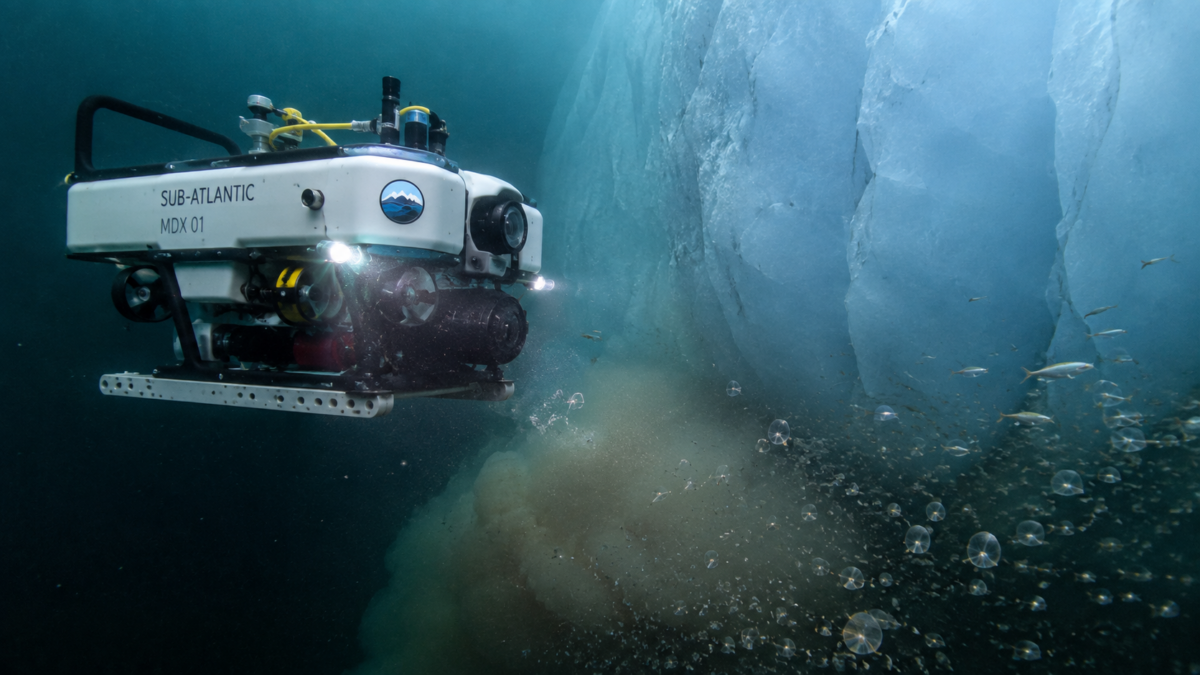
Yet when researchers sent a remotely operated underwater vehicle directly towards the boundary where a glacier in South Greenland meets the ocean, they found something unexpected.
Large quantities of zooplankton, fish and other organisms were gathering almost against the glacier itself.
The observations, published in Communications Earth & Environment, suggest that marine-terminating glaciers may create previously overlooked biological hotspots at the exact point where ice, freshwater and ocean collide.
More surprisingly, the animals did not appear to be gathering only because glacier-driven currents were pulling nutrient-rich deep water upwards, which has traditionally been an important explanation for productive waters around glaciers.
The researchers instead found evidence suggesting that some of the organisms were responding much more directly to material emerging from the glacier.
That changes how scientists may need to think about what disappears when a glacier eventually retreats out of the ocean and onto land.
Getting close enough to see this is difficult
Scientists already know that Greenland’s glaciers can influence the marine ecosystems surrounding them.
What has been much harder to observe is what happens at the glacier-ocean boundary itself.
Marine-terminating glaciers are constantly moving, fracturing and releasing ice.
Large pieces can calve from the glacier front without warning, while meltwater and suspended sediment pour into the fjord.
These conditions make placing researchers or boats directly beside the ice potentially dangerous.
As a result, many previous studies have had to infer what happens at the glacier front from measurements taken farther away.
The new research took a more direct approach.
At Naajat Sermiat, a marine-terminating glacier in South Greenland, the team deployed a remotely operated underwater vehicle to observe the glacier boundary itself.
The vehicle allowed the researchers to examine the underwater shape of the glacier, the release of meltwater and suspended material, and the organisms occupying this unusual environment.
They found life gathering right at the ice
The biological activity stood out.
The researchers observed large concentrations of zooplankton, fish and other organisms close to the glacier boundary.
Importantly, this was not simply a brief observation made on one unusually productive day.
High biological activity was documented during observations in both May and August.
This means the phenomenon appeared during two different parts of the melt season.
The glacier front was therefore functioning as more than an outlet where ice became water.
It appeared to be creating a local environment attractive enough for organisms from several levels of the marine food web to gather there.
The traditional explanation may not tell the whole story
There is a well-established reason why the ocean around some glaciers can become biologically productive.
Fresh meltwater emerging beneath a glacier is buoyant.
As it rises through the ocean, it can pull deeper water upwards with it.
That deeper water can contain nutrients needed by phytoplankton, which form the base of marine food webs.
This process, known as entrainment, can effectively bring nutrients from deeper parts of the fjord towards the sunlit surface.
More nutrients can support more phytoplankton, which can support zooplankton, fish and eventually larger marine predators.
The new observations suggest that this mechanism is not the entire explanation for the activity at Naajat Sermiat.
The organisms appeared to be responding directly to glacier-associated material at the boundary rather than simply gathering around deeper nutrient-rich water that had been transported upwards.
The researchers describe the glacier front as a previously unrecognised ecological hotspot.
The cloudy water itself may be important
Anyone looking at water flowing from underneath a glacier may notice that it is often far from clear.
Glaciers grind against the rock beneath them as enormous masses of ice move across the landscape.
This process produces extremely fine material that can be transported into the ocean with meltwater.
The researchers directly observed this suspended material emerging at the glacier-ocean boundary.
Aerial measurements also revealed the structure of the resulting turbid plumes within metres of the glacier front.
The team then used observations from boats farther down the fjord to see how those plumes evolved after leaving the immediate glacier environment.
Together, the underwater, aerial and boat-based measurements provided a rare view of the same system at several different scales.
Instead of treating the glacier simply as a wall of melting ice, the observations show it as an active interface moving freshwater, particles and other material into the marine environment.
A glacier can shape an ecosystem without being alive
The finding highlights an interesting feature of ecology.
Some of the most important components of an ecosystem are not organisms at all.
Temperature, water movement, sediment, nutrients and physical structures determine where living things can survive and where food becomes concentrated.
A glacier can therefore influence an ecosystem simply through the physical processes it creates.
Water emerging from beneath the ice changes circulation.
Particles alter the character of the water.
The enormous glacier front creates a unique boundary between land ice and the ocean.
The result can be a habitat that exists because the glacier is still touching the sea.
This matters because Greenland’s glaciers are retreating
Marine-terminating glaciers do not necessarily remain marine-terminating forever.
As glaciers lose ice and retreat, their fronts can eventually move away from the coastline and onto land.
When that happens, the direct glacier-ocean boundary disappears.
The freshwater may still reach the sea through rivers, but the physical system is no longer the same.
If marine organisms rely on processes occurring immediately beside a submerged glacier front, retreat can therefore change more than the position of the ice.
It can remove an ecological environment.
The researchers argue that accelerated melting and glacier retreat could consequently alter food webs, carbon movement and nutrient cycling within Greenland’s coastal ecosystems.
The effects could travel up the food chain
Zooplankton may be tiny, but they occupy a crucial position in marine ecosystems.
Many feed on microscopic organisms such as phytoplankton and are then eaten by fish.
Those fish can in turn become prey for larger fish, seabirds and marine mammals.
A location that concentrates food near the bottom of this network can therefore influence animals much larger than the organisms visible to the underwater vehicle.
This does not mean every glacier front is automatically a major feeding ground.
But it raises the possibility that some marine-terminating glaciers play an ecological role that is easy to miss when scientists examine them mainly through the amount of ice they are losing.
The geometry of the glacier, the way meltwater exits beneath it and local ocean conditions are all likely to influence what develops at an individual site.
There is an important limitation
The study provides unusually direct observations, but they come from one glacier in South Greenland.
That means scientists cannot assume that every marine-terminating glacier around Greenland produces the same biological hotspot.
The direct biological observations were also made during field periods in May and August rather than continuously throughout the year.
Seasonal changes in sunlight, meltwater discharge, ocean circulation and animal behaviour could substantially alter what occurs at the glacier front at other times.
The study also identifies a close relationship between glacier material and the organisms gathering around it, but further work will be needed to determine precisely which components of the glacier discharge attract or sustain different species.
That distinction matters.
Finding animals concentrated around a plume does not by itself reveal the complete biological mechanism behind why they are there.
The underwater robot opened a window into a difficult environment
What makes the study particularly valuable is not only what the researchers found.
It is where they were able to look.
The few metres separating the ocean from a glacier front can represent an enormous practical barrier for scientists.
Remote vehicles make it possible to enter environments that are too unstable or dangerous for researchers to observe directly.
In this case, that technology revealed an ecosystem operating almost against the ice.
It also demonstrates why direct observations can change established explanations.
From farther down the fjord, high biological productivity could reasonably be attributed mainly to nutrient-rich water being pulled upwards by glacier discharge.
At the boundary itself, the picture became more complicated.
A melting glacier can be both disappearing habitat and active ecosystem
Glaciers are usually discussed as indicators of climate change.
Scientists measure how quickly they retreat, how much ice they lose and how their melting contributes to changes in sea level.
Those measurements remain essential.
But the new research adds another dimension.
The boundary of a glacier can also be an ecological feature in its own right.
While the ice remains connected to the ocean, it creates physical and chemical conditions capable of concentrating marine life.
When the glacier retreats onto land, that particular boundary disappears with it.
Understanding what is lost therefore requires scientists to know what was living there before the ice moved away.
At Naajat Sermiat, sending a robot into one of Greenland’s least accessible environments revealed that the answer was unexpectedly lively.
Source Information
Study Title: Biological hotspot at a glacier ocean boundary in South Greenland
Authors: Fleur Rooijakkers, Lars Ostenfeld, Ebbe Poulsen, Antoine Drancey, Nanna B. Karlsson et al.
Journal: Communications Earth & Environment
Published: 28 August 2026
Study site: Naajat Sermiat, South Greenland
Methods: Remotely operated underwater vehicle, aerial observations and boat-based measurements
DOI: 10.1038/s43247-026-04003-y