









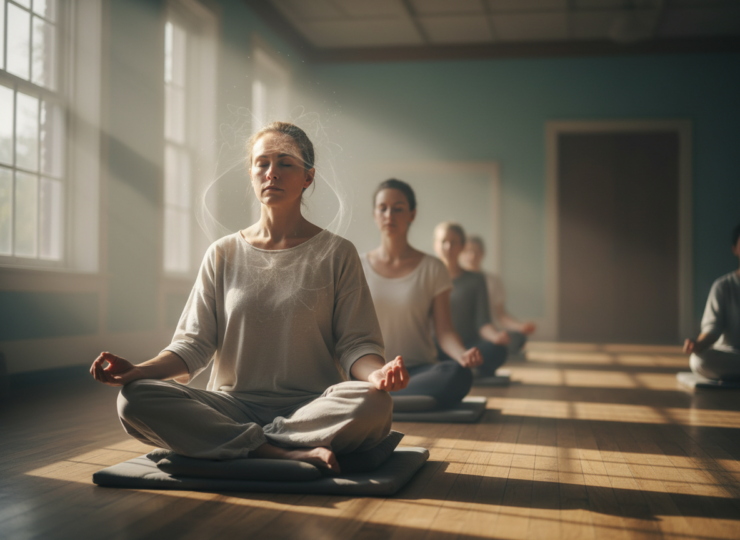
Intensive meditation retreats can involve many hours of practice each day, raising an important safety question: are people with depression or anxiety symptoms especially vulnerable to distressing experiences during this kind of training?
A new preregistered study suggests the answer may be more complicated than commonly assumed. Researchers comparing participants on six-day residential insight meditation retreats with matched people continuing their ordinary daily lives found that higher pre-retreat depression and anxiety symptoms did not predict a greater burden of unpleasant experiences specifically attributable to meditation. In some analyses, the unexpected pattern ran in the opposite direction, with retreat participants who had lower baseline symptoms reporting more unpleasant peak experiences than comparable controls.
The findings do not establish that intensive meditation is risk-free, nor do they show that people with severe psychiatric disorders can safely attend retreats without individual assessment. Instead, they address a narrower and clinically important question: whether elevated symptoms of depression and anxiety, by themselves, identify people who are more likely to experience distress during intensive meditation than they would during ordinary life.
Why meditation safety is difficult to study
Meditation is used in healthcare, psychotherapy, education and workplaces, but researchers have increasingly examined unwanted experiences that can accompany practice. These can include anxiety, physical discomfort, traumatic re-experiencing and, in rarer reports, more serious psychological difficulties.
One problem is attribution. A person who meditates and later reports anxiety or distress has not necessarily experienced that distress because of meditation. Depression and anxiety are themselves associated with unpleasant experiences in everyday life. Studies that ask experienced meditators to recall events from months or years earlier can therefore identify an association without showing that meditation caused the experience.
The new study, published in Mindfulness on 30 September 2026, was designed to improve on that problem by using a prospective matched-control approach. The analysis drew on a preregistered study of intensive insight meditation and compared retreat participants with people from the same meditation community who continued daily life over an equivalent period.
Six days of retreat compared with six days of daily life
The retreat group included 89 people enrolled in one of five six-day residential insight meditation retreats in Israel. Their average age was 33.18 years. The comparison group included 44 participants with an average age of 34.70 years. Controls were selected from the same meditation community and matched on relevant characteristics, including age and lifetime meditation experience.
The sample was not composed mainly of meditation novices. Across participants, 65.4% reported more than 100 lifetime hours of meditation, while 65.2% had previously attended a residential meditation retreat. The median lifetime meditation exposure was 156.7 hours, although experience varied widely.
There was also meaningful variation in mental health symptoms. Depression scores ranged from 0 to 23 on the PHQ-9 and anxiety scores ranged from 0 to 14 on the OASIS measure. Most participants, however, were below commonly used clinical screening thresholds. About 70.4% had PHQ-9 scores below 10, while 80% had OASIS scores below 8.
The researchers assessed unpleasant peak experiences during the retreat or corresponding period of daily life, then examined whether baseline depression and anxiety altered the relationship between being on retreat and reporting these experiences. Retreat participants were also asked two weeks later about the perceived positive and negative impact of the unpleasant experiences they had reported.
Distressing experiences were common in both groups
Unpleasant experiences were not unusual. Among retreat participants, 79.8% endorsed more than one unpleasant experience, compared with 70.5% of matched controls. Retreat participants reported an average of 2.44 unpleasant experiences, while controls averaged 2.02.
The central question, however, was not simply whether distress occurred. It was whether people entering the retreat with more depression or anxiety symptoms showed a disproportionate increase in unpleasant experiences compared with similarly symptomatic people living normally.
They did not. Baseline depression significantly interacted with study group, but in the opposite direction to the researchers’ prediction. The interaction coefficient was B = -0.19, with a 95% confidence interval from -0.34 to -0.04 and p = 0.016. The interaction accounted for an additional 4% of variance in the outcome.
Follow-up analyses showed that retreat participants with depression scores one standard deviation below the sample mean reported significantly more unpleasant peak experiences than matched controls with similarly low symptoms. The estimated difference was B = 1.34, with a 95% confidence interval from 0.31 to 2.36. At average depression levels, and at one standard deviation above the mean, retreat participants and controls did not differ significantly.
A similar pattern appeared for anxiety. Retreat participants one standard deviation below the mean anxiety score reported more unpleasant peak experiences than comparable controls, with B = 1.07 and a 95% confidence interval from 0.06 to 2.08. No significant retreat-control difference emerged at average anxiety levels or one standard deviation above the mean.
Exploratory analyses examining the frequency, duration and negative valence of unpleasant experiences did not reveal evidence that elevated symptoms created a distinctive retreat-related risk. The main conclusions also remained unchanged after the researchers controlled for lifetime meditation hours, previous retreat days and gender.
Higher symptoms may signal distress generally, not meditation-specific distress
There was an important nuance. Greater depression and anxiety symptoms were associated with greater incidence of unpleasant experiences across the study more generally. What the results challenge is the inference that meditation itself explains that association.
In other words, people experiencing more psychological symptoms may also experience more distress in ordinary life. Without a non-meditating comparison group, that background rate can be mistaken for an adverse effect caused by meditation. This is why the matched-control design matters.
The counterintuitive finding among people with lower symptoms is also notable. The researchers suggest that intensive practice can involve unfamiliar anxiety, physical sensations and discomfort that may be especially salient for otherwise relatively healthy participants. That explanation remains speculative, but it illustrates why unpleasantness and harm should not automatically be treated as equivalent concepts.
Unpleasant experiences were not necessarily viewed as harmful
The two-week follow-up added another layer. The researchers found a curved relationship between baseline anxiety and how retreat participants later evaluated their unpleasant experiences. Participants with relatively low and relatively high baseline anxiety tended to report a net positive impact, meaning perceived positive consequences outweighed negative ones. Participants around moderate anxiety levels showed approximately no net difference between positive and negative impact.
This does not mean distress should be dismissed as beneficial. It instead shows that a difficult experience during meditation can be evaluated differently after the event. Some challenging experiences may be processed as constructive, while others may be harmful. Safety research therefore needs to distinguish the occurrence of discomfort from persistent adverse effects and functional impairment.
What the findings can and cannot tell us
The study provides a stronger test than retrospective surveys because symptoms were measured before the retreat and retreat participants were compared with a matched group observed over the same period. The preregistration also reduces the scope for changing hypotheses after seeing the data.
There are nevertheless substantial limits. Participants were not randomly assigned to retreat and control conditions, so the design cannot provide the causal certainty of a randomized trial. The sample was also relatively small for detecting interaction effects, and the authors describe the significant interaction as small.
Most importantly, the sample should not be treated as representative of people with severe psychiatric illness. Most participants scored below screening cutoffs for probable major depression or anxiety disorder. The findings therefore cannot establish safety for people with severe depression, severe anxiety, psychosis, post-traumatic stress or other conditions that were not directly studied.
The study also relied heavily on self-report and examined a specific six-day insight meditation format. Longer retreats, different contemplative traditions, different cultural settings and programs with different levels of teacher support may produce different outcomes.
For clinicians, retreat organizers and participants, the practical message is consequently cautious rather than permissive. Depression and anxiety symptom scores alone may not be sufficient evidence that someone faces unusually high meditation-specific distress risk. Individual history, symptom severity, retreat intensity, support structures and other psychiatric vulnerabilities still matter. Larger randomized and clinically diverse studies are needed before stronger screening recommendations can be made.
Source Information
Study: Mental Health Symptoms Do Not Increase Risk for Distressing Experiences During Intensive Mindfulness Meditation Training: Evidence from a Prospective Matched-Control Intervention Study
Authors: Yoel A. Behar, Yuval Hadash, Omer Dar and colleagues, including Amit Bernstein
Journal: Mindfulness
Published: 30 September 2026
DOI: 10.1007/s12671-026-02982-9
Study design: Preregistered prospective matched-control secondary analysis
Sample: 89 six-day meditation retreat participants and 44 matched controls