









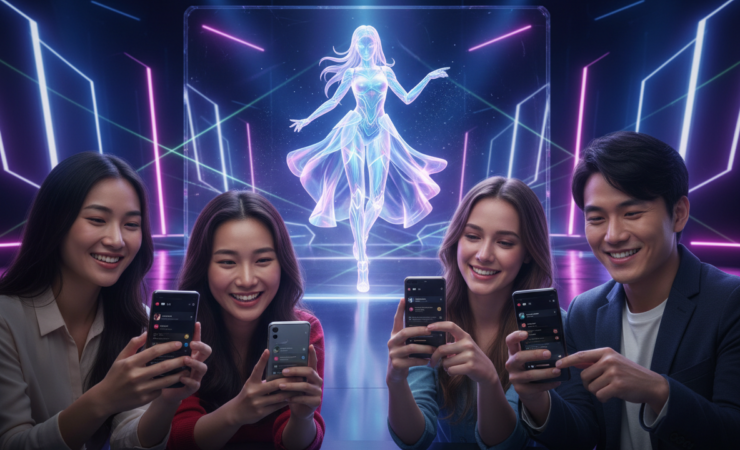
As artificial intelligence moves from backstage production tool to on-screen performer, entertainment companies face an unusual question: what makes audiences treat a virtual celebrity as socially real enough to trust, recommend and follow?
A new peer-reviewed study of K-pop fans suggests that the answer may depend less on visual perfection than on the stories and content built around a digital persona. Researchers found that narrative openness and content-driven engagement were the strongest predictors of whether fans perceived virtual idols as realistic, while visual appeal did not significantly predict that perception in the main regression model.
The findings offer a useful counterpoint to the assumption that ever more lifelike graphics are the main route to acceptance of AI-mediated performers. They also raise a broader issue for entertainment and marketing: audiences may respond to virtual figures using many of the same social and relational processes that shape attachments to human celebrities.
Testing why fans accept virtual performers
The researchers integrated the stimulus-organism-response framework with parasocial interaction theory. In simple terms, they tested whether several characteristics of virtual idols shape an internal sense that the idol is socially real, and whether that perception is then associated with trust and adoption intention.
Five characteristics were examined: visual appeal, narrative openness, socially present conversational style, content-driven engagement and institutional trust. Adoption did not mean downloading a piece of software. It referred to fans’ willingness to recommend virtual idols, speak positively about them and incorporate them into their social world.
The online survey initially received 404 responses. After incomplete responses were excluded, the final analytical sample contained 259 participants aged 18 to 46, with an average age of 24.47 years. The sample was predominantly female at 84.6% and heavily European at 80.3%. Most respondents, 93.8%, identified as K-pop fans, while 69.5% were already familiar with virtual idols.
Participants completed multi-item measures using five-point response scales. The researchers then used reliability tests, factor analysis, correlations, hierarchical regression and mediation analysis. Mediation tests used 5,000 bootstrap samples.
Narrative and content emerged as the strongest signals
When demographic and fandom variables were controlled, narrative openness was positively associated with realistic perception with a standardized coefficient of β = 0.32 and p < 0.001. Content-driven engagement was similarly strong at β = 0.35 and p < 0.001. Institutional trust also contributed significantly at β = 0.18 and p < 0.01.
Together, the predictors explained about 47% of the variance in how realistically participants perceived virtual idols. By contrast, socially present conversational style was not significant in that simultaneous regression, with β = -0.02 and p = 0.82, and visual appeal was also non-significant at β = -0.05 and p = 0.28.
The pattern became even stronger when the researchers examined trust and adoption intention. The model explained about 62% of the variance in trust. Narrative openness and content-driven engagement showed comparatively stronger associations with trust than conversational style or institutional trust.
For adoption intention, three of the five virtual-idol experience components were significantly related to the outcome after controls were included. Content-driven engagement and narrative openness again showed stronger associations than conversational style. The model explained about 65% of the variance in adoption intention.
Feeling socially real may be part of the bridge
The mediation analyses added an important layer. Narrative openness, conversational style and content-driven engagement showed both direct associations with adoption intention and indirect associations through realistic perception. For trust, narrative openness, conversational style, content-driven engagement and institutional trust showed significant direct and indirect paths, indicating partial mediation.
Visual appeal behaved differently. Its indirect effect through realistic perception was not statistically significant. Institutional trust also did not show a significant direct or indirect association with adoption intention, even though it played a role in trust-related analyses.
This distinction matters. A company may be able to make a virtual performer visually impressive and reassure audiences about the organisation behind it, but those factors alone may not create the relational experience that encourages fans to advocate for the performer. In this sample, the digital persona’s story and the desire to engage with its content were more consistently connected with acceptance.
What this could mean for virtual entertainment
The study suggests that developers and entertainment companies should not treat virtual idols simply as graphics projects. Building a coherent character, creating emotionally engaging content and maintaining a sense of narrative openness may be at least as important as visual fidelity.
That conclusion has implications beyond K-pop. AI-generated influencers, branded virtual characters and interactive entertainment increasingly rely on audiences forming relationships with entities they know are artificial. If perceived social reality helps convert exposure into trust and advocacy, design choices around storytelling and interaction become commercially significant.
There is also an ethical dimension. The authors warn that increasingly convincing virtual personas can create manufactured parasocial intimacy. Because such characters can be designed to remain available, responsive and consistent, companies need to consider emotional dependency and transparent disclosure of AI involvement, particularly where younger or vulnerable audiences are concerned.
Important limits on the findings
The study should not be interpreted as proof that particular design choices cause fans to trust or adopt virtual idols. It was cross-sectional, so the statistical relationships cannot establish causal direction or show how attachments develop over time.
The sample also limits generalisation. More than four in five participants were female and roughly four in five were based in Europe, despite K-pop’s major Asian audience. Recruitment through social-media fan communities produced a convenience sample rather than a population-representative one.
Measurement is another consideration. The visual-appeal scale had low internal reliability, with Cronbach’s alpha of 0.37. The authors therefore caution against reading its non-significant results as evidence that appearance is irrelevant. Future research could separate human-likeness, attractiveness and uniqueness into better-defined measures.
The model also treated realistic perception as the central mediator without separately measuring parasocial relationships. Longitudinal studies that track actual following, spending and engagement behaviour would be valuable for testing whether the same pathways predict sustained fan loyalty rather than stated intentions.
A social challenge, not only a technical one
Virtual idols are often framed as a technological race toward better animation, synthetic voices and more convincing human likeness. This study points to a different challenge. The success of a digital performer may depend on whether audiences can build a coherent social interpretation around it.
For the 259 fans studied, narrative openness and engaging content were more consistently associated with realistic perception, trust and willingness to advocate for virtual idols than appearance alone. The finding does not mean visuals are unimportant. It suggests that the pixels may attract attention, while the perceived person behind them may determine whether audiences stay.
Source Information
Study: The emerging charisma of 0s and 1s: unraveling the intricacies of virtual idol adoption
Authors: Andrea Kecić, Amanda Duarte Gonzalez Rodrigues and Sun Kyong Lee
Journal: Communication and Change, Volume 2, Article 21
Published: 2 October 2026
DOI: 10.1007/s44382-026-00041-4