









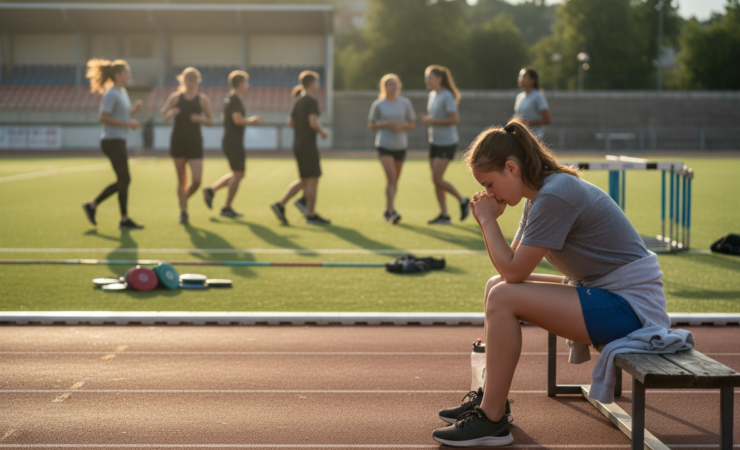
Adolescent athletes who simultaneously reported high burnout, low motivation and competitive anxiety were substantially more likely to leave organised sport over the following year, according to new research involving 864 competitive athletes in China.
The study, published in Frontiers in Psychology, identified three distinct psychological profiles rather than examining burnout, motivation or anxiety in isolation. Only 13.8% of athletes belonged to the highest-risk group, but 35.3% of them had stopped organised competitive sport 12 months later. The corresponding dropout rate was 19.4% in the moderate-risk group and 8.6% in the low-risk group.
Why adolescent athletes leave sport
Participation in organised sport can support physical health, psychological wellbeing and social development during adolescence. Yet withdrawal is common, particularly as young athletes face heavier training demands, stronger performance pressure and competing academic or personal priorities.
Previous research has linked several psychological factors to dropout. Burnout can involve physical and emotional exhaustion, a declining sense of accomplishment and devaluation of the sport itself. Amotivation describes a lack of meaningful intention to continue participating. Competitive anxiety can appear as physical tension, persistent worry and difficulty concentrating.
The researchers argued that these experiences may be especially informative when considered together. A young athlete who is exhausted, no longer feels successful, questions why they continue and experiences substantial anxiety may face a different situation from an athlete showing only one elevated symptom.
Following 864 competitive athletes for a year
The study included 864 athletes aged 12 to 17 from 21 sports schools and competitive clubs in Jiangsu Province, China. Their average age was 14.6 years, 46.5% were girls and the athletes trained for an average of 12.4 hours per week.
Participants competed in eight sports: athletics, basketball, soccer, volleyball, table tennis, badminton, swimming and tennis. All were training systematically for regional or provincial competition.
At baseline, athletes completed established questionnaires measuring three dimensions of burnout, amotivation and three dimensions of competitive anxiety. The seven indicators were emotional and physical exhaustion, reduced sense of accomplishment, sport devaluation, amotivation, somatic anxiety, worry and concentration disruption.
The researchers then used latent profile analysis, a statistical method designed to identify subgroups of people who share similar patterns across multiple measures. They compared solutions containing between one and five profiles. The three-profile model was retained because it combined strong statistical fit, high classification quality and interpretable group sizes. Its entropy was 0.91, indicating relatively clear separation among the profiles.
Dropout was not based simply on participants saying that they intended to quit. Twelve months later, the researchers checked registration and training-enrolment records from the participating schools and clubs. An athlete was classified as having dropped out if they had stopped organised training and competition in their primary sport and had not enrolled in another organised sport in the regional system.
Three psychological profiles emerged
The largest group was the low-risk profile, containing 456 athletes, or 52.8% of the sample. These athletes scored below the sample average across all seven psychological indicators, with especially low sport devaluation and amotivation.
A further 289 athletes, or 33.4%, formed a moderate-risk profile. Their scores were slightly above average across the seven indicators.
The remaining 119 athletes, representing 13.8% of the sample, formed the high-risk profile. Their scores were elevated across every indicator. Sport devaluation was 1.64 standard deviations above the sample mean, emotional and physical exhaustion was 1.52 standard deviations above the mean, and amotivation was 1.41 standard deviations above the mean. Somatic anxiety, worry, reduced accomplishment and concentration disruption were also more than one standard deviation above average.
This pattern matters because the risks did not separate into specialised subgroups. Instead, burnout, amotivation and anxiety tended to rise together. The finding supports the idea that psychological strain in competitive youth sport may accumulate across several connected dimensions rather than appearing as one isolated problem.
Dropout climbed from 8.6% to 35.3%
Across the entire sample, 137 of the 864 athletes, or 15.9%, had dropped out after 12 months. The distribution across the psychological profiles was striking.
Among the 456 low-risk athletes, 39 dropped out, a rate of 8.6%. In the moderate-risk group, 56 of 289 athletes dropped out, or 19.4%. Among the 119 high-risk athletes, 42 dropped out, producing a rate of 35.3%.
The relationship between profile membership and dropout was statistically significant, with a chi-square value of 45.87 and p below 0.001. The progression was also orderly: dropout became more common as the combined psychological-risk profile became more severe.
The researchers additionally used an R3STEP multinomial regression, which accounts for uncertainty when people are assigned to latent profiles. After controlling for age, sex and weekly training hours, athletes who later dropped out were 3.86 times more likely than those who persisted to have belonged to the high-risk rather than low-risk profile at baseline. The 95% confidence interval ranged from 2.31 to 6.44.
Dropouts were also 1.94 times more likely to have belonged to the moderate-risk rather than low-risk profile, with a 95% confidence interval from 1.22 to 3.09.
Age and training hours added another layer
Older age was associated with greater odds of belonging to the high-risk profile. Each additional year of age corresponded to an odds ratio of 1.21 for high-risk versus low-risk membership.
Training volume was also associated with psychological profile. Each additional weekly training hour was associated with an odds ratio of 1.14 for high-risk versus low-risk membership and 1.09 for moderate-risk versus low-risk membership. Sex was not significantly associated with profile membership.
These associations do not show that heavier training caused psychological strain or dropout. Training hours were self-reported, and athletes facing other pressures may both train differently and experience greater psychological difficulty. Still, the pattern suggests that psychological monitoring and training-load monitoring may be useful to consider together.
What the findings could mean for youth sport
The results suggest that coaches and sport organisations may gain more useful information by considering clusters of psychological experiences rather than relying on a single warning sign. An athlete experiencing exhaustion, devaluation, amotivation and anxiety at the same time may warrant particular attention.
Importantly, the researchers do not present their profiles as a validated screening test. The model identified patterns in this sample and showed that those patterns were prospectively associated with later dropout, but its ability to predict dropout in new athletes still requires independent validation.
The moderate-risk group may also be important. Its 19.4% dropout rate was more than twice the 8.6% observed in the low-risk group, suggesting that support strategies should not necessarily be restricted to the relatively small group showing the most severe combination of difficulties.
Potential responses proposed by the researchers include supportive monitoring, adjusting training loads where appropriate, strengthening athletes’ sense of competence and autonomy, and helping athletes manage competitive worry. These possibilities are implications for future intervention research, not interventions proven effective by this study.
Important limitations
The study was observational, so it cannot establish that the psychological profiles caused athletes to quit. Psychological measures were collected only once, preventing the researchers from examining how burnout, motivation and anxiety changed during the year.
The institutional records established whether athletes stopped participating but not why. Injury, academic demands, deselection, family relocation or other circumstances could have contributed to withdrawal. Variables such as coach behaviour and family support were also not included.
The sample came from one Chinese province and a competitive sport system that may differ from recreational programmes or sport structures elsewhere. Athletes were also clustered within 21 schools and clubs, but this institutional clustering was not modelled statistically, which the authors note may have modestly underestimated standard errors.
Sport type and competitive level were not included as covariates because subdividing the sample across eight sports, several competitive levels and three profiles would have produced sparse statistical cells. The study therefore cannot determine whether the observed profiles operate identically across different sports or competitive levels.
Even with these limitations, the prospective use of objective enrolment records strengthens the evidence that a combined pattern of burnout, amotivation and anxiety is associated with later withdrawal from organised competitive sport. The findings shift attention away from searching for one psychological reason that adolescents quit and toward understanding how several pressures can accumulate within the same athlete.
Source Information
Study: Psychological predictors of sport dropout in adolescents: a latent profile analysis of risk profiles and R3STEP auxiliary regression
Authors: Tianzhi Zhan and Lu Liu
Journal: Frontiers in Psychology
Published: 2 October 2026
DOI: 10.3389/fpsyg.2026.1972994