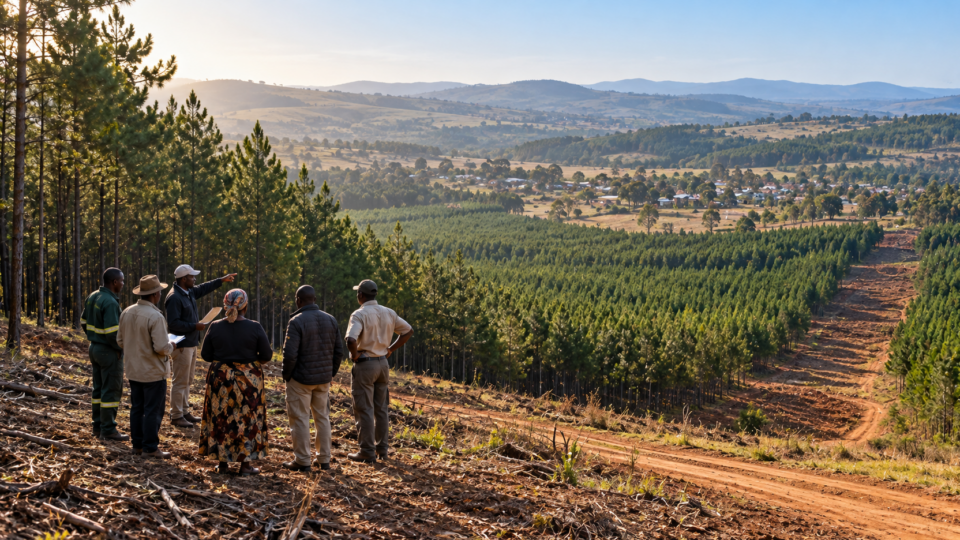
South Africa’s land restitution programme can return productive land to communities, but ownership alone does not guarantee that benefits reach households. A new study of two forest-based restitution projects in Mpumalanga found that unequal benefit sharing ranked above a lack of funding among obstacles to revitalising the plantations.
The research, published on 14 October 2026 in Frontiers in Sustainable Resource Management, surveyed 180 households in the Thuthukani and Jabulani communities. It also included focus groups with 75 participants, whose accounts described the financial and practical difficulties of managing collectively owned forestry land.
Lack of benefit sharing received the highest mean rank, at 5.82, followed almost equally by elitism at 5.81. Lack of transparency ranked third at 5.59 and internal conflict fourth at 5.34. These are rankings of perceived challenges, not percentages of respondents or measurements of financial losses.
The study offers a more complicated picture than a simple judgment on land reform. It raises questions about what happens after ownership is restored: how collective decisions are made, whether beneficiaries trust their representatives, and whether the plantations can support livelihoods over time.
Two communities with different arrangements
Researchers Ratsodo Phillip Tshidzumba, Fridar Bathobile Ntshingila and Paxie Wanangwa Chirwa examined communities in the Gert Sibande District of Mpumalanga. Both had received forest land through restitution claims and both were represented by communal property associations, or CPAs.
Thuthukani’s land covered 230.6 hectares, while Jabulani’s covered 325 hectares. Together, the two projects involved 555.6 hectares. The research did not independently measure commercial timber production across the sites; it focused on household experiences of access, governance and management challenges.
Jabulani was linked to an agricultural village project in which 110 Reconstruction and Development Programme houses were constructed and 500 beneficiaries were settled, according to the researchers’ background account. Thuthukani had previously entered a management partnership with the former landowner.
These histories matter because forestry requires technical knowledge, long investment horizons and continuing maintenance. A plantation can be owned by a community yet still lack fire protection, working capital, market access or agreed rules for distributing returns.
How the researchers collected evidence
The study used a mixed-method design, combining household surveys with focus-group discussions. Researchers surveyed 105 households in Jabulani and 75 in Thuthukani. They selected the two communities purposively because both had received forest plantations after successful restitution claims.
Within each community, household beneficiaries were selected from association lists using a random procedure. The focus groups involved 39 participants in Jabulani and 36 in Thuthukani, including committee members, adults and younger beneficiaries.
The researchers analysed survey responses with descriptive statistics and cross-tabulations. A Friedman test compared the relative rankings of eight challenges, while qualitative content analysis was used to interpret discussion-group accounts. The combination allowed numerical results to be examined alongside explanations from beneficiaries.
This design can describe local experiences in depth, but it cannot establish that a particular governance problem directly caused lower timber output. The findings are not representative of every restitution project in South Africa, and they are not an independent audit of either association’s accounts.
Governance problems dominated the ranking
Four governance-related concerns led the ranking: lack of benefit sharing at 5.82, elitism at 5.81, lack of transparency at 5.59 and infighting at 5.34. The closeness of the two highest values is important. The evidence does not support treating them as dramatically different problems.
The remaining challenges were lack of funding at 3.68, lack of technical expertise at 3.42, inadequate evaluation and monitoring at 3.19, and lack of mentorship at 3.15. All figures are mean ranks on the study’s comparative scale, not ratings out of ten.
The Friedman test reported a chi-square statistic of 501.141 with seven degrees of freedom and a statistically significant difference across the ranked concerns. This supports the conclusion that respondents assigned different relative importance to the problems.
It does not mean funding was unimportant. Focus-group participants repeatedly described the difficulty of raising money to rehabilitate plantations and secure firefighting resources. A financial shortage and an accountability problem can coexist, with each making the other harder to solve.
The ranking is valuable because land restitution discussions often focus on transferring assets and financing production. Beneficiaries’ answers suggest that how proceeds and opportunities are shared can be equally central to whether a collective enterprise earns their confidence.
Why a communal property association matters
A CPA provides a legal structure through which beneficiaries can hold property collectively and organise decisions about it. In a commercial forestry project, this can include negotiations with operators, management of beneficiary records, budgeting and rules about access to products or income.
The authors discuss tensions over transparency, beneficiary lists and decision-making. Where members cannot easily establish who is entitled to what, or how representatives reached a decision, disagreements may deepen even before a project produces substantial revenue.
The study identifies elitism and unequal benefit sharing as reported concerns. It does not prove misconduct by any named individual, and its findings should not be used to make allegations about particular committee members.
A more defensible interpretation is that members need processes they can understand and challenge. Clear records, accessible meetings and consistent benefit-sharing rules are possible responses, although the research did not test whether any specific reform would improve outcomes.
Government engagement was rarely reported
The survey also found very low reported contact with government institutions after land claims were settled. The researchers describe an absence of engagement with the Regional Land Claims Commission in respondents’ accounts.
In Jabulani, about 1% reported meetings with the rural development and land reform department or local municipality, and 1.9% reported engagement with the forestry and environment department. In Thuthukani, 2.7% mentioned annual engagement with the land reform department.
These numbers reflect what surveyed households recalled or knew about, not a comprehensive record of official visits or support. They nevertheless raise a practical question: how accessible is post-settlement assistance to ordinary beneficiaries?
The study argues that transferring land is only one stage of restitution. Communities also need the capacity to manage an asset that can require specialised forestry expertise and expensive protection against environmental risks.
Access to forest resources varied sharply
The two communities reported strikingly different access to resources. Grazing was accessible to 97.1% of Jabulani respondents, compared with 32% in Thuthukani. Firewood access ran in the opposite direction: 45.7% in Jabulani and 97.3% in Thuthukani.
Building materials were accessible to 43.8% of respondents in Jabulani and 65.3% in Thuthukani. Crafting materials were reported by 58.1% in Jabulani but just 1.3% in Thuthukani, showing that even non-commercial benefits can be distributed very differently.
Access to food sources was reported by 55.2% of Jabulani households and only 2.7% of Thuthukani households. Water-source access was reported by 99% in Jabulani and 52% in Thuthukani.
All surveyed Jabulani households reported access to commercial timber, whereas none of the Thuthukani respondents did. That is a measure of reported access, not proof that timber was sold or that households received a particular income.
More than 80% of respondents in both communities reported no access to medicinal plants. The broader pattern illustrates why community ownership cannot be reduced to a single economic measure: the practical value of a forest includes several kinds of resources.
Fire protection remained a serious constraint
Plantations face seasonal fire risks, and preparedness depends on equipment, trained personnel, maintenance and rapid response. Respondents largely described fires as occurring during the fire season, with 97.1% in Jabulani and 89.4% in Thuthukani selecting that pattern.
When asked about firefighting resources, 46.7% in Jabulani said access was fairly difficult and 0.9% said very difficult. In Thuthukani, 18.7% selected fairly difficult and 40% selected very difficult.
The severity difference is important. Both communities described barriers, but Thuthukani households were much more likely to report the most severe difficulty category. Focus-group participants linked the problem partly to the loss of a previous private-sector partner that had provided support.
Participants also raised concerns about neglected plantations and combustible material. The study did not independently quantify burned hectares, financial fire losses or the effectiveness of existing prevention plans, so the results are strongest as evidence of perceived preparedness problems.
Household finances add pressure
In Thuthukani, 51.4% of surveyed household heads reported monthly income below R1,000. In Jabulani, 63.8% reported income in the R1,000 to R2,000 category. These figures show why households may have little capacity to contribute to costly plantation rehabilitation.
The survey recorded unemployment among 40% of Thuthukani household heads and 25.7% in Jabulani. Pensioners accounted for 25.3% and 38.1%, respectively. These are characteristics of the surveyed household heads, not unemployment rates for the full local populations.
Commercial forestry often requires expenditure well before harvests generate returns. For low-income beneficiaries, waiting years for benefits may be difficult, making clear explanations of investment choices and expected returns particularly important.
Financial constraints also affect fire management. Equipment, training and maintenance may be unaffordable without partnerships or outside support, while a serious fire can destroy an asset that took years to establish.
Education and representation deserve attention
The researchers found that 33.3% of Jabulani household heads and 14.7% of those in Thuthukani were classified as illiterate. Fewer than 3% in either community reported tertiary education.
These findings may matter for interpreting contracts, financial statements and technical forestry plans. Yet formal education is not the same as the ability to contribute local knowledge or participate in collective decisions, and a governance system must be accessible to members with different backgrounds.
Women headed 55.2% of surveyed Jabulani households and 64% in Thuthukani. People aged 18 to 35 accounted for 32.4% and 41.3% of household heads, respectively. A representative system should therefore consider the voices of women and younger beneficiaries.
The authors recommend strengthening governance and technical capacity, but the study did not test a training programme. Its contribution is to identify needs that future interventions could address and evaluate.
What policymakers could learn
The main lesson is that a restitution settlement and a functioning enterprise are different achievements. Restoring ownership can address historical dispossession without automatically creating the finance, trust and skills required to operate a plantation sustainably.
The researchers propose stronger CPA governance, fairer benefit-sharing mechanisms, technical support and collaboration with institutions and private partners. These are policy recommendations informed by the two cases, not experimentally proven solutions.
One implication is that support programmes should assess organisational and financial readiness together. Providing equipment without transparent decision-making may leave disputes unresolved; improving meetings and records without fire protection may still leave the asset at risk.
Partnerships can offer forestry expertise and resources, but agreements also need to preserve beneficiary participation and accountability. The loss of support reported in Thuthukani illustrates the vulnerability that can arise when essential capabilities depend heavily on an outside partner.
Transparent registers, clear distribution rules and understandable financial reporting could be evaluated as practical interventions. Researchers would need to measure whether such measures actually improve trust, participation and material outcomes over time.
Why the evidence has limits
The study concerns two purposively selected communities. Their plantation sizes, histories and available resources differ, and their experiences cannot be generalised automatically to all forest-based land restitution projects in South Africa.
The survey is cross-sectional and relies heavily on reported experiences. It does not establish whether a governance problem preceded poor plantation performance or resulted from it, and it does not independently verify household access with transaction records.
The challenge rankings identify relative priorities, not the monetary cost of each obstacle. A lower rank for funding should not be interpreted as evidence that financial support is unnecessary.
The qualitative focus groups add context, but they also reflect the perspectives of participants selected for discussion. The research is better suited to identifying mechanisms and questions for further study than to making national prevalence claims.
What future studies should test
A wider longitudinal study could follow multiple CPAs, combining beneficiary surveys with audited financial records, timber-production measures, plantation-condition assessments and fire-incident data.
Researchers could then examine whether transparent governance rules, technical partnerships or post-settlement support are associated with more equitable benefits and more resilient forestry operations.
Future work should also ask beneficiaries what counts as a fair return. Some may prioritise direct payments, while others value employment, grazing, firewood, community infrastructure or preserving the forest for future generations.
The Mpumalanga findings show why those preferences should not be presumed identical. Two communities with forest restitution claims reported sharply different access to the resources around them.
For South Africa, the broader challenge is to make restitution meaningful beyond the transfer of a title. These cases suggest that accountability, inclusive representation and continuing practical support deserve as much attention as the initial settlement.
Source Information
Study title: Challenges affecting revitalization and sustainability in forest-based land reform projects: lessons from the Thuthukani and Jabulani communities, South Africa.
Authors: Ratsodo Phillip Tshidzumba, Fridar Bathobile Ntshingila and Paxie Wanangwa Chirwa.
Journal: Frontiers in Sustainable Resource Management, volume 5, Natural Resources.
Publication date: 14 October 2026.
Research design: Mixed-method case study with household surveys, focus-group discussions, descriptive statistics, a Friedman ranking test and qualitative content analysis.
Sample: 180 households (105 Jabulani and 75 Thuthukani), plus 75 focus-group participants.
Key findings: Benefit sharing ranked first at 5.82, followed by elitism at 5.81 and lack of transparency at 5.59; 40% in Thuthukani described firefighting resource access as very difficult.