






For people with severe physical disabilities, the tongue can become an unusually powerful interface with technology. Tongue-drive systems are designed to translate deliberate tongue movements into commands for wheelchairs, computers and other assistive devices. Yet putting wireless electronics inside the mouth creates an engineering problem that is far harder than shrinking an ordinary antenna.
Human tissue absorbs electromagnetic energy, saliva and changing mouth geometry can detune radio systems, and the available space is measured in millimetres. At the same time, an assistive interface needs a dependable connection because a dropped or distorted command can have practical consequences for the person using it.
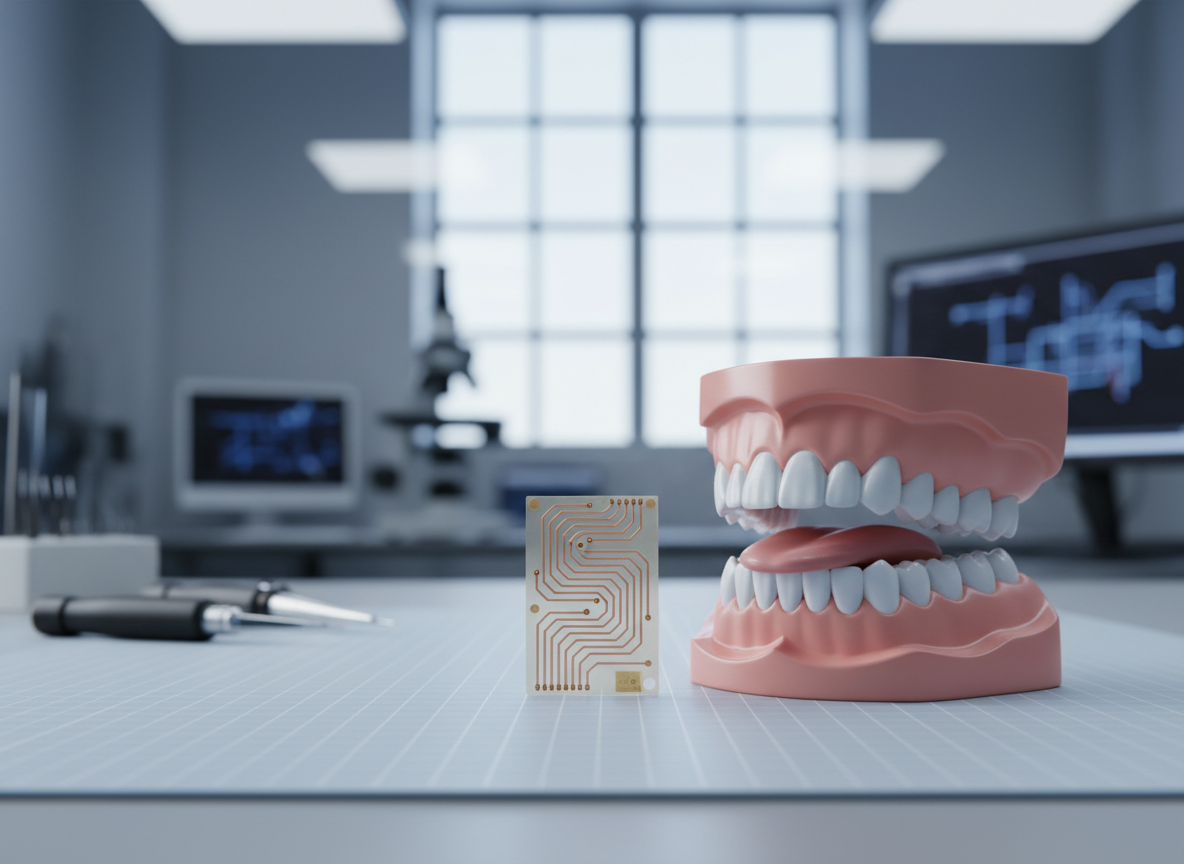
A new peer-reviewed study in Scientific Reports tackles that problem with a compact dual-band multiple-input multiple-output antenna designed specifically for intraoral tongue-drive systems. The device measures just 8 mm by 4.5 mm by 0.254 mm, yet operates around both the 1.4 GHz Wireless Medical Telemetry Service band and the 2.45 GHz Industrial, Scientific and Medical band.
The headline result is not simply that the antenna is small. In ex vivo testing using minced pork to approximate the electromagnetic environment of biological tissue, the design maintained bandwidths of 528 MHz around 1.4 GHz and 720 MHz around 2.45 GHz, while isolation between its two antenna elements remained below -40 dB in both bands.
Why two antennas have to coexist in a very small space
Researchers Archana Mohan and Niraj Kumar of Vellore Institute of Technology built the system as a MIMO antenna. MIMO technology uses multiple radiating elements to improve communication reliability and data capacity. It is common in modern wireless systems, but the geometry becomes difficult when the elements must sit only fractions of a millimetre apart.
The proposed antenna contains two probe-fed radiating elements on a shared ground plane. Their edge-to-edge separation is only 0.4 mm. Ordinarily, putting radiators this close together risks strong mutual coupling, meaning energy intended for one element influences the other. That can reduce efficiency, disturb the radiation pattern and undermine the independent signal paths that make MIMO useful.
To manage this, the researchers combined a meander-line radiator with an improved fence-strip isolation structure. A meander line effectively folds the electrical path into a compact physical footprint. This is especially valuable in an intraoral device, where increasing antenna dimensions is not a realistic solution.
In the reported design, mutual coupling was suppressed below -30 dB during the broader evaluation. In the ex vivo tissue experiment, isolation fell below -40 dB in both operating bands. Because more negative isolation values indicate less unwanted coupling, this suggests the two elements remained strongly separated electromagnetically despite their close physical spacing.
The mouth is part of the radio system
Implantable and intraoral antennas cannot be evaluated as though the surrounding body were empty space. Biological tissues have electrical properties that change how radio waves propagate. The antenna can shift away from its intended resonant frequency, lose energy into surrounding tissue or behave differently as its environment changes.
That is why the ex vivo portion of the study matters. The researchers tested the antenna with minced pork rather than relying only on an idealised free-space simulation. This does not reproduce every feature of a living human mouth, but it creates a tissue-rich electromagnetic environment that can expose detuning and performance problems missed by simpler tests.
Under these conditions, the antenna retained a 528 MHz bandwidth at the 1.4 GHz operating region and 720 MHz at 2.45 GHz. Wide operating bandwidth is useful because it gives a system more tolerance to frequency shifts caused by manufacturing variation, placement and changes in the surrounding environment.
The researchers also recorded omnidirectional radiation patterns. Peak realised gain was -18.8 dBi at 1.4 GHz and -17.2 dBi at 2.45 GHz. Those negative gains may look poor beside an antenna mounted on a router or phone, but that comparison would be misleading. An intraoral antenna operates in a highly lossy environment where severe size constraints and tissue absorption fundamentally change the engineering trade-off.
A communication problem, not merely an antenna benchmark
The researchers went beyond reporting resonance and isolation. They also considered link-budget and MIMO-channel performance, because an assistive device ultimately has to move information reliably from inside the mouth to an external receiver.
This distinction is important. A compact antenna can produce attractive laboratory measurements yet still be unsuitable for a complete communication system if its signal cannot maintain an adequate link under realistic losses. The study’s communication analysis was intended to test whether the proposed geometry could support dependable high-rate transmission rather than functioning only as a miniature resonator.
The dual-band architecture also gives designers flexibility. The 1.4 GHz region falls within spectrum used for wireless medical telemetry, while the 2.4 GHz ISM band is widely used by wireless technologies. A system able to operate across both regions may support different communication functions or design requirements, although the study does not demonstrate a finished commercial tongue-control platform.
Safety has to be designed alongside performance
Wireless hardware positioned in or near the body must also account for the energy absorbed by tissue. The study therefore examined specific absorption rate and allowable input power alongside the radio-frequency performance.
The authors report that these analyses supported the safety of the proposed design under the evaluated operating conditions. That is an essential engineering checkpoint, but it should not be read as clinical clearance. A simulation and laboratory safety assessment is different from demonstrating long-term safety in people using a complete intraoral device day after day.
That difference is especially relevant for tongue-drive systems because the device would occupy a warm, wet and mechanically active environment. Real use introduces saliva, swallowing, speech, eating, movement, cleaning, changing device orientation and differences in oral anatomy. Each can matter for both communication and practical tolerability.
What the experiment does and does not establish
The work is best understood as an antenna-engineering study rather than a clinical trial of an assistive technology. Its strongest evidence concerns the compact radio design itself: dual-band operation, element isolation, bandwidth, radiation behaviour and safety-related electromagnetic modelling.
The ex vivo tissue test strengthens the case that the design can tolerate a biologically relevant environment, but minced pork is still only a proxy. It cannot reproduce the full layered anatomy of the oral cavity, the changing position of the tongue, saliva distribution or the continuous movement of a living user.
The study also does not show that people with severe motor impairments could control a wheelchair or computer more accurately with this antenna. Those outcomes depend on the complete tongue-drive system, including sensors, command recognition, electronics, software, receiver design and user training.
Future work therefore has a different question to answer. The researchers have shown that two radio elements can be compressed into a remarkably small intraoral footprint while remaining strongly isolated in tissue-like testing. The next stage is to establish how that radio performance survives integration into a complete device and, eventually, realistic human use.
Why this matters for assistive technology
For many assistive technologies, miniaturisation is not cosmetic. A smaller component can determine whether a system is wearable, tolerable and discreet enough to use in daily life. In an intraoral interface, every millimetre competes with comfort, tongue movement and the space needed for other electronics.
The study therefore illustrates a broader engineering challenge. The goal is not to maximise a single antenna metric. Designers must balance size, bandwidth, coupling, gain, tissue absorption and communication reliability at the same time. Improving one can easily make another worse.
Here, the combination of a meander-line radiator and isolation structure allowed two closely spaced elements to remain operational across two useful frequency regions. The ex vivo bandwidth and isolation results suggest that aggressive miniaturisation does not automatically make robust intraoral MIMO communication impossible.
That is still several steps away from a finished assistive product. But for tongue-driven interfaces, the radio link is one of the pieces that has to disappear into the background before the user’s intentions can take centre stage.
Source Information
Study Title: A compact dual-band meander line-based MIMO antenna for intra oral tongue drive system applications
Authors: Archana Mohan and Niraj Kumar
Journal: Scientific Reports
Published: 26 September 2026
Institution: School of Electronics Engineering, Vellore Institute of Technology, Chennai, India
Method: Design, simulation and fabrication of an 8 mm × 4.5 mm × 0.254 mm dual-band two-element MIMO antenna on Rogers RO3010 substrate, followed by electromagnetic performance assessment, ex vivo minced-pork testing, link-budget and MIMO-channel analysis, and specific absorption rate evaluation.
Main finding: The antenna operated around 1.4 GHz and 2.45 GHz despite its miniature intraoral footprint. Ex vivo testing produced bandwidths of 528 MHz and 720 MHz respectively, with isolation below -40 dB in both bands and peak realised gains of -18.8 dBi and -17.2 dBi.
DOI: 10.1038/s41598-026-67848-5