








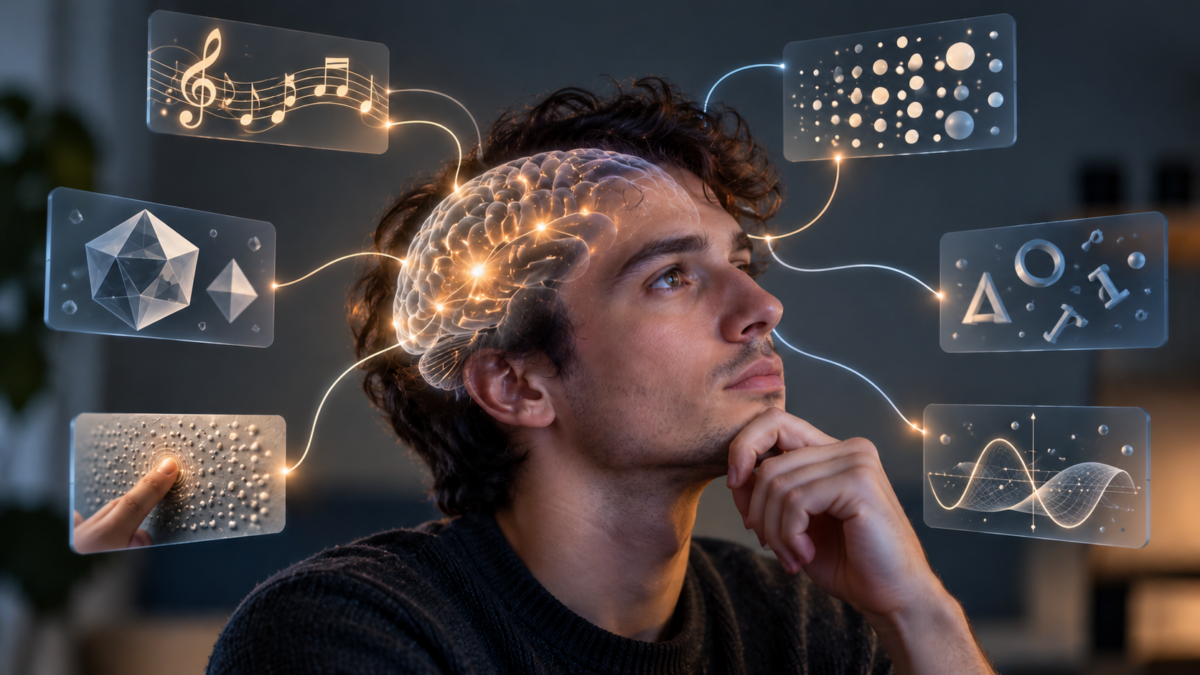
A complicated melody and a complicated shape seem to have very little in common.
One is heard. The other is seen. A mathematical expression is different again, while a textured object explored by touch belongs to another sensory world entirely.
Yet new research suggests the human mind may represent the complexity of all these things using a shared underlying code.
A study published in Nature Human Behaviour on 15 September 2026 reports 11 experiments involving 1,500 participants. Across visual patterns, dot arrays, melodies, letter strings, mathematical expressions and tactile objects, people behaved as though “simple” and “complex” were not separate properties learned independently in each domain.
Instead, complexity appeared to transfer across them.
The findings suggest that the brain may represent information density in a domain-general way, allowing a preference or association learned from one kind of stimulus to influence responses to a completely different kind.
The researchers asked whether complexity has a common mental currency
Complexity is everywhere.
A picture can contain many details. A melody can have many notes and changes. A word sequence can be repetitive or irregular. A mathematical expression can be easy to parse or densely structured.
Psychologists have long studied how people respond to complexity, but there is a deeper question underneath those observations.
Does the mind separately calculate visual complexity, musical complexity, linguistic complexity and mathematical complexity?
Or does it reduce these very different experiences to something more general, such as a common estimate of how much information they contain?
Tal Boger and Chaz Firestone of Johns Hopkins University designed a series of experiments to distinguish between these possibilities.
Participants first learned that either simplicity or complexity was rewarding
The core experiments used a reward-transfer task.
Participants were exposed to stimuli that differed in complexity and learned that one end of that spectrum was associated with better outcomes.
For example, a participant could learn that relatively simple visual shapes were associated with reward while more complex shapes were not.
The important test came afterwards.
Participants were shown a different type of stimulus and asked to make choices involving complexity again.
If complexity is represented separately in each domain, learning that simple shapes are rewarding should tell a person very little about whether to prefer a simple melody.
But if the mind has a shared representation of complexity, the learned preference should carry over.
A preference learned from shapes carried over to melodies
That is what the researchers found.
Associations formed using one type of stimulus influenced decisions involving another.
The effect appeared across combinations involving shapes, dot arrays, melodies, letter strings and mathematical expressions.
Someone who learned that a particular level of complexity was valuable in one domain behaved as if the lesson remained relevant when the sensory material changed.
This is difficult to explain if the brain treats each kind of complexity as an entirely unrelated property.
The results instead suggest that people can extract something more abstract from the stimulus: not merely what the pattern is, but how complex it is.
The effect even crossed from vision into touch
One experiment pushed the idea beyond the usual visual and auditory tests.
Participants interacted with tactile forms, allowing the researchers to examine whether the same transfer could occur when complexity was experienced through touch.
The transfer still appeared.
That matters because it makes a simple explanation based only on visual similarity much less plausible.
A melody, a mathematical expression and a tactile object do not share obvious physical features.
If people nevertheless treat their complexity as comparable, the common representation is likely to be relatively abstract.
The researchers tested whether another visual feature could explain the result
Complex stimuli can differ from simple ones in more ways than complexity alone.
A denser visual pattern might also appear darker, larger or more saturated, for example.
The researchers therefore included control experiments designed to test whether features such as colour saturation, brightness or size could account for the transfer.
The pattern continued to support complexity itself as the relevant dimension.
This strengthens the interpretation that participants were not merely learning to favour a superficial visual feature and then applying that feature elsewhere.
Complexity also interfered with decisions when it was irrelevant
A later experiment tested whether the transfer required deliberate reasoning.
If people consciously notice complexity and then decide to use it, the effect might disappear when complexity is irrelevant to the task they are performing.
Instead, the researchers found evidence that complexity could intrude automatically on judgements even when participants were supposed to focus on something else.
This suggests that complexity is not only an abstract concept people can deliberately compare.
The brain may extract it routinely as part of processing information.
People’s aesthetic preferences were also consistent across domains
The final part of the study moved from learned rewards to personal preferences.
Some people naturally prefer relatively simple patterns, while others are more attracted to complexity.
The researchers found that these individual differences were not confined to one type of stimulus.
Participants who tended to prefer simple shapes also tended to prefer simple melodies.
That cross-domain consistency is important because it suggests that preferences for complexity may reflect something broader about how an individual responds to information rather than a narrow taste for one particular type of object.
The brain may be tracking information density
The researchers interpret the findings as evidence for a type-independent representation of information density.
In practical terms, the brain may have a way of estimating how much structure or information a stimulus contains without needing a completely separate scale for every sensory domain.
That would be useful because organisms constantly encounter unfamiliar information.
If the mind can recognise that two very different things are similar in complexity, learning in one context can be reused in another.
A general measure could therefore make cognition more efficient.
This may help explain why some environments feel mentally overwhelming
The findings also offer a useful way to think about everyday experience.
A cluttered webpage, a dense spreadsheet, an unfamiliar piece of music and a complicated diagram can all create a similar subjective impression: there is a lot to process.
The new research suggests that this similarity may not be purely metaphorical.
Different kinds of information may genuinely converge on a shared mental representation of complexity.
That does not mean the brain processes a symphony and an equation in the same way.
The content and sensory processing remain different. What may be shared is an abstract property describing how complex the input is.
Simple does not automatically mean better
The study should not be interpreted as evidence that people universally prefer simple things.
Some participants preferred greater complexity, and preferences differed between individuals.
The important result is that these preferences showed consistency across different forms of information.
That is different from claiming that simplicity is inherently easier, more beautiful or more desirable in every situation.
Context, expertise, familiarity and goals can all change how much complexity a person wants or can comfortably process.
The finding could matter for design and communication
If complexity is represented in a domain-general way, designers may need to think about the total complexity of an experience rather than treating each element separately.
A presentation can have complex language, crowded charts and visually dense slides at the same time.
An educational platform can combine difficult text, complicated navigation and unfamiliar graphics.
Each component may be manageable on its own, but their complexity could accumulate into a broader sense of cognitive load.
The current experiments were not designed to establish a rule for interface or educational design, so that implication remains speculative.
But the idea of a shared complexity representation provides a useful framework for future research on why some information environments feel coherent and manageable while others feel overwhelming.
The experiments do not reveal one single “complexity centre” in the brain
The study is behavioural.
It shows that people respond to complexity in ways that transfer across domains, but it does not identify a specific brain region where all forms of complexity are calculated.
A shared representation could arise from one neural system, several interacting systems or higher-level cognitive processes that integrate information from different senses.
Neuroimaging and other methods would be needed to determine how this general representation is implemented biologically.
The study also leaves open how learning and expertise change complexity
What feels complex to a beginner may feel simple to an expert.
A musician can hear structure in a composition that sounds chaotic to someone without musical training. A mathematician may immediately recognise a pattern that appears dense and confusing to another person.
The new study demonstrates a general representation of complexity, but it does not imply that this representation is fixed.
Experience may change how much information a person detects, compresses or treats as predictable.
Understanding that relationship between objective structure and perceived complexity is an important next question.
What this means for everyday life
The study points to an unusually broad feature of human cognition.
We do not only recognise objects, sounds, words and numbers.
We may also automatically register a more abstract property shared by all of them: how much information they seem to contain.
That could help explain why preferences for simplicity or complexity can appear across very different parts of a person’s life, from music and visual design to patterns and problem solving.
The content changes, but the mind may be using the same internal scale.
Source Information
Study Title: Complexity is a unified cognitive kind
Authors: Tal Boger and Chaz Firestone
Journal: Nature Human Behaviour
Published: 15 September 2026
Sample: 1,500 participants across 11 experiments.
Method: Participants judged or expressed preferences for complexity across multiple domains, including shapes, dot arrays, melodies, letter strings, mathematical expressions and tactile forms, allowing the researchers to test whether complexity associations transferred between different kinds of stimuli.
Main finding: Associations and preferences related to complexity transferred across visual, auditory, symbolic and tactile domains, supporting the idea that people represent complexity in a domain-general way rather than as entirely separate concepts for each type of stimulus.
DOI: 10.1038/s41562-026-02502-8