








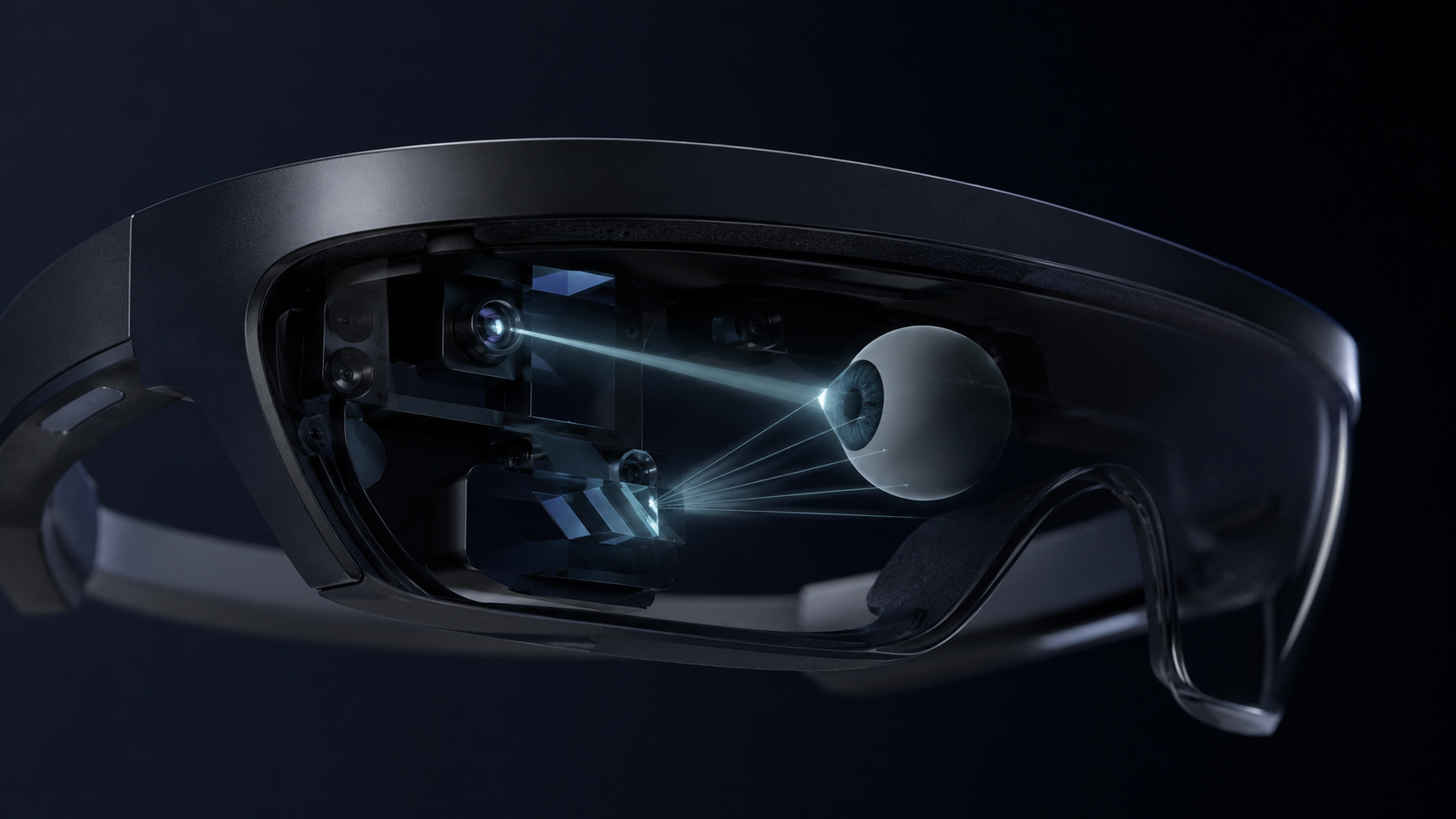
Eye tracking sounds simple until a device actually has to do it.
A headset needs to know where your eyes are pointing while you blink, move slightly inside the device, change the distance between your face and its cameras or simply look towards the edge of your vision.
Those small changes can make the job surprisingly difficult.
Researchers at Meta Reality Labs have now tested a different approach. Instead of relying only on the brightness of infrared light reflected from the eye, their system also measures something conventional eye-tracking cameras largely ignore: the polarisation of that light.
Tested across 346 people, the approach reduced one measure of high-end gaze-tracking error by around 10% to 16% compared with otherwise comparable intensity-based systems. The improvement remained under conditions including partially covered eyes, changes in headset position and differences in pupil size.
It is a relatively small change in how a camera observes the eye.
But for wearable technology, small improvements in reliability can matter considerably.
Current eye tracking has a visibility problem
Modern eye-tracking systems typically illuminate the eye with near-infrared light and use cameras to identify features that reveal where the user is looking.
The underlying challenge is not simply locating the pupil.
A wearable device has to continue making accurate estimates while the eye and camera move relative to one another.
An eyelid may obscure part of the eye.
The headset can shift on the user’s face.
Pupil size changes.
Different people’s eyes also reflect light differently.
The new research asks whether cameras could extract another layer of information from the same basic interaction between light and the eye.
The answer appears to be yes.
The camera is looking at more than brightness
Light has properties beyond simply being bright or dark.
One of them is polarisation, which describes the orientation of the light’s electromagnetic waves.
When polarised light interacts with different materials and surfaces, that polarisation can change in ways that contain information about what the light encountered.
The researchers built what they call a polarisation-enabled eye-tracking system.
It combines a near-infrared light source with a camera containing a polarisation filter array. Instead of recording only a conventional image, the system can observe differences in the polarisation of light reflected by parts of the eye.
Those differences revealed features across the white of the eye, or sclera, as well as gaze-related patterns on the cornea that were far less visible in ordinary intensity images.
In practical terms, the camera receives more clues.
And better clues can make the software’s job easier.
The improvement appeared when tracking became difficult
The researchers trained machine-learning models using the new polarisation information and compared them with capacity-matched models using conventional intensity images.
Across the 346 participants, the polarisation system reduced the median 95th-percentile absolute gaze error by 10% to 16%.
That statistical measure deserves explanation.
Average performance can hide the moments when a system performs particularly badly.
The 95th percentile concentrates more attention on the poorer end of the tracking distribution — the kinds of errors that can become especially noticeable when someone is actually using a device.
The improvements were observed not only under normal testing conditions but when the researchers introduced several problems wearable devices have to handle.
These included eyelid occlusion, changes in eye relief — essentially the position of the eye relative to the optical system — and variation in pupil size.
That makes the result more interesting than simply producing a slightly better number under ideal laboratory conditions.
The technology appears to provide additional visual information precisely when conventional tracking becomes harder.
Why better eye tracking matters
For wearable computing, the eyes can become an input device.
A headset that reliably knows where someone is looking could use gaze as part of navigation and interaction rather than requiring every action to begin with a controller, touchscreen or hand gesture.
Eye position can also help a device understand which part of the user’s visual field deserves the greatest attention.
But these applications depend on tracking that remains dependable across different faces, eyes and ways of wearing a device.
A feature that works perfectly while a headset sits in exactly the correct position is less useful if performance deteriorates whenever the device moves a few millimetres.
That is why the researchers frame polarisation imaging as a potentially more robust sensing method for future wearable systems.
The technology is not about giving a headset another spectacular feature.
It is about making an existing one less fragile.
The hardware change is relatively contained
There is another reason the research is technologically interesting.
The approach does not require an entirely new method of observing the eye.
The experimental system uses a polarisation-filter-array camera paired with linearly polarised near-infrared illumination.
That means the innovation lies partly in extracting additional information from light already being used for optical sensing.
For consumer technology, that distinction can matter.
A laboratory technique requiring a large optical bench may demonstrate an interesting scientific effect while remaining impractical for a headset.
A sensing method designed around compact cameras and illumination is much closer conceptually to the constraints wearable devices already face.
That does not mean the system is ready to appear in a consumer product.
It means the researchers are addressing the problem using components and principles compatible with wearable-device design.
There is an important commercial context
The study is not independent academic research into a technology with no commercial stakeholder.
All of the authors are employees of Meta Platforms, working across Meta Reality Labs facilities in the United States, and they may own company shares or stock options. Meta also holds patents and patent applications relating to polarisation-enabled eye tracking and related sensing technologies.
That does not invalidate the findings.
But it is important context.
Meta has a direct commercial interest in technologies that could improve wearable computing, and readers should know that the researchers and intellectual property are connected to the company that could potentially benefit from the technology.
The paper has nevertheless been published as an open-access research article in Communications Engineering. The version currently available is an early, unedited manuscript that Springer Nature says will undergo further production before final publication.
What the study does not show
A 10% to 16% improvement in the reported tracking metric does not mean future headsets will suddenly feel 16% better.
The research evaluated a sensing technique.
It did not test whether consumers preferred devices using it, whether it reduces discomfort, whether it materially improves complete commercial applications or what adding the required optical hardware would do to cost, battery consumption or product design.
Those questions sit further down the development path.
The results also come from models and hardware developed within the same company proposing the approach.
Independent replication would increase confidence that the advantages transfer across different eye-tracking architectures and wearable platforms.
And while 346 participants provide a meaningful evaluation cohort, consumer hardware ultimately needs to operate reliably across extraordinarily diverse users and conditions.
What comes next
The most interesting part of the research may be the broader principle behind it.
Camera systems have spent decades becoming better at recording more pixels, higher resolutions and greater brightness ranges.
But future sensing may depend just as much on capturing properties of light that ordinary cameras discard.
Polarisation provides one of those additional channels.
In this experiment, information hidden in reflected infrared light exposed features of the eye that were difficult to see conventionally.
The software could then use those features to make more reliable estimates of where someone was looking.
For South African consumers, there is no particular reason to expect the underlying physics to matter differently than elsewhere, and the study does not contain South African participants or test local users.
The relevance is therefore technological rather than geographical.
Wearable devices sold into markets such as South Africa increasingly depend on sensors being able to understand their users reliably without requiring perfect conditions.
The less effort the wearer has to make to accommodate the technology, the more invisible that technology becomes.
That may ultimately be what separates an impressive headset demonstration from a device people are comfortable using every day.
The next improvement in wearable computing may therefore not come from seeing more.
It may come from learning to see what conventional cameras have been throwing away.
Source Information
Study Title: Polarization-resolved imaging improves eye tracking
Authors: Mantas Žurauskas et al.
Journal: Communications Engineering
Published: 23 July 2026
DOI: 10.1038/s44172-026-00727-z
Publication note: Springer Nature currently labels the available paper as an early unedited version that will undergo further editorial production.