









A diabetic eye examination can detect signs of retinal damage before changes in vision become obvious. For children and young adults living with diabetes, however, getting that examination can require another appointment, a separate journey and time away from school or work for the family.
New research suggests that moving the examination into a routine diabetes clinic visit could remove some of those obstacles. Among 397 young people with diabetes in a United States study, an autonomous artificial-intelligence screening system enabled examination completion of 99.5% among White participants and 98% among non-White participants.
Those near-identical completion rates contrasted with a substantial historical difference. Before the point-of-care examination, 79.8% of White participants and 61.8% of non-White participants had previously completed a diabetic eye examination. The study, published in Nature Communications on 23 October 2026, suggests that screening offered during an existing appointment could help narrow inequalities in preventive care.
The findings are promising, but their meaning requires precision. Participants were not randomly assigned to an AI service versus conventional referral care. The research therefore shows what happened when screening was offered in this cohort, not proof that artificial intelligence alone eliminated a population-wide disparity.
Why diabetic eye screening matters
Diabetes can damage small blood vessels throughout the body, including those supplying the retina at the back of the eye. This complication, diabetic retinopathy, may develop before a patient notices changes in vision. Screening is intended to identify retinal abnormalities early enough for appropriate assessment and care.
A retinal examination is different from simply reading an eye chart. It involves inspecting or photographing the retina to look for changes associated with diabetes. Depending on the findings, patients may need further examinations, treatment or regular monitoring.
For a young patient managing diabetes, an additional specialist appointment can be difficult to arrange. Transport, caregiver availability, time and access to services may all influence attendance, although the study did not measure the individual effect of each possible barrier.
The practical question was straightforward: could the necessary retinal screening be delivered while young people were already receiving diabetes care, rather than relying solely on another appointment elsewhere?
What the autonomous AI did in the clinic
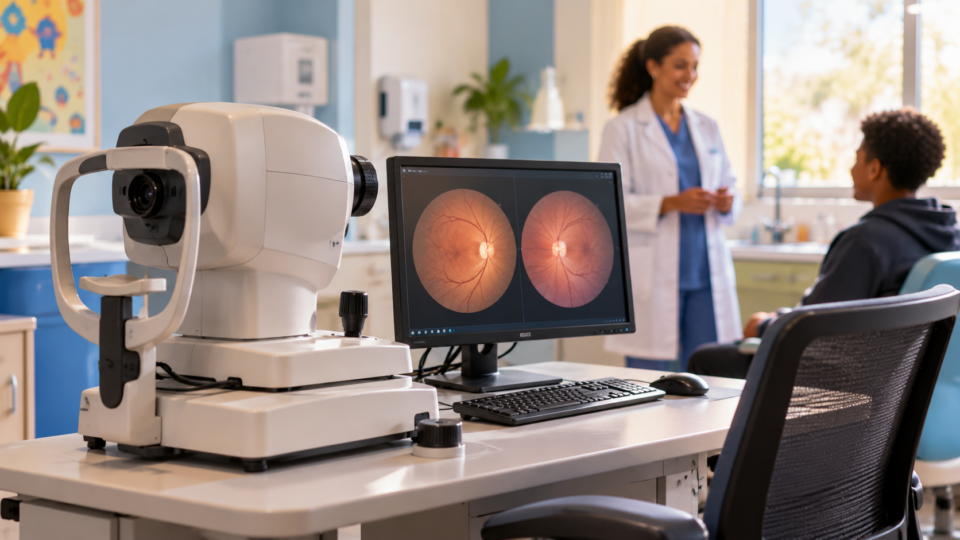
The ACCESS2 study used a point-of-care retinal examination. A non-mydriatic camera, designed to take retinal images without routinely dilating the pupils, captured photographs that autonomous AI software interpreted for signs meeting its referral threshold.
Autonomous means that the software was designed to produce an initial examination result without a specialist manually reading every image. That is different from an AI system that merely highlights possible abnormalities for a clinician to assess before issuing a result.
The examination was conducted during the diabetes care visit, and the research protocol also included optical coherence tomography imaging in its clinical assessment.
Importantly, the AI performed a specific screening task. It was not a substitute for a comprehensive eye examination or a system for diagnosing every retinal condition. Patients with concerning results still require appropriate clinical follow-up.
Inside the prospective study of 397 youth
Researchers led by Risa M. Wolf enrolled 397 White and non-White young people receiving care for diabetes. Approximately 72% had type 1 diabetes and 28% had type 2 diabetes. Both conditions can be associated with retinal complications, although their causes and management differ.
The prospective ACCESS2 investigation, registered as NCT05463289, asked two questions: whether AI-enabled screening completion could be equivalent across the two racial groups, and how accurately AI detected more than mild diabetic retinopathy relative to standard grading.
All enrolled participants received the point-of-care examination. This allowed the researchers to assess screening completion across groups with different prior screening histories, but did not provide a randomized comparison against usual referral arrangements.
That distinction matters. Offering a screening service inside a scheduled appointment involves clinical staff, equipment and convenient access alongside the AI interpretation. The study could not isolate the independent contribution of each part of this service model.
From an 18-point historical gap to near-universal completion
Before implementation, the researchers found a pronounced difference in prior eye-screening completion. The figure was 79.8% among White youth, compared with 61.8% among non-White youth, an 18-percentage-point gap.
The historical difference was statistically significant (p < 0.0001). It highlighted unequal prior experiences with preventive eye care within this group of young diabetes patients.
When the autonomous examination was offered at the point of care, completion rose to 99.5% among White participants and 98% among non-White participants. The difference in completion was then approximately 1.5 percentage points.
The researchers concluded that equivalent screening completion had been achieved across the groups. The result is striking because a screening task that previously could have required another visit was now incorporated into care that the patient was already attending.
However, the prior-screening percentages and the new examination-completion rates describe related but distinct circumstances. They cannot be treated as a randomized before-and-after estimate of what the software itself changed, nor can they establish that the same improvement will occur in every healthcare system.
The strongest supported conclusion is that nearly all enrolled youth completed an AI-enabled diabetic eye examination during their clinic visit, despite different histories of prior screening.
How accurate was the eye-screening algorithm?
Access alone is not sufficient. A screening examination also needs to identify clinically important disease while avoiding unnecessary referrals. The researchers compared the AI’s interpretations against standard grading for detecting more than mild diabetic retinopathy.
Reported sensitivity was 100%, with a 95% confidence interval from 67.6% to 100%. Sensitivity describes how often a test correctly identifies people who actually have the target condition.
In the observed comparison, the AI did not miss a case meeting that reference threshold. But the confidence interval is wide, indicating substantial uncertainty about performance in larger groups. The observed 100% does not guarantee that the software would detect every case in ordinary clinical practice.
Reported specificity was 76%, with a 95% confidence interval of 71.4% to 79.9%. Specificity describes how often the system correctly reports a negative result when the target condition is absent.
That estimate means some participants without more than mild retinopathy were flagged as positive. False-positive results can create additional appointments, anxiety and demands on specialist services. Such trade-offs must be assessed in light of the consequences of missing clinically important disease.
The combination of high observed sensitivity and more modest specificity may be useful for a screening pathway, but it cannot alone establish the right balance for every clinic. Disease prevalence, patient needs, referral capacity and follow-up arrangements all matter.
Screening completion is different from a diagnosis
The two headline results address different kinds of effectiveness. Completion rates show whether patients received the initial examination. Sensitivity and specificity address how the AI classified retinal findings relative to a reference standard.
An accessible test that performs poorly would be unsafe, while an accurate test that people cannot reach would leave gaps in preventive care. Both dimensions matter, along with whether a person with a concerning result receives appropriate follow-up.
The ACCESS2 results suggest that integrating the screening examination into an existing diabetes appointment could make it easier to reach patients across groups with different prior access. They do not show that all subsequent barriers to specialist assessment or treatment disappeared.
Previous Research Today coverage of an AI-assisted lung-nodule programme similarly considered how technology can influence the delivery of clinical services. The condition and intervention were different, but the underlying question was whether an AI-enabled pathway helped patients reach appropriate care.
Could this approach help close healthcare disparities?
Preventive screening disparities can arise from overlapping practical and social barriers. Appointment availability, transport, work responsibilities, health coverage and specialist capacity may all shape the experience of patients and families.
Incorporating eye screening into an existing appointment could eliminate the need to schedule a separate screening visit for some patients. That is a potentially valuable service-design change, particularly for people who have difficulty travelling repeatedly to healthcare facilities.
Within ACCESS2, the contrast was clear: White and non-White youth had substantially different rates of previous examination completion, but both groups completed the newly offered point-of-care test at very high rates.
The authors therefore argue that autonomous AI has the potential to mitigate disparities in diabetic retinopathy screening. This is a more careful claim than saying the study proved that AI removed racial inequalities in eye disease outcomes.
Another Research Today report on community cancer-screening education described a different attempt to improve preventive care. Both examples reinforce the importance of judging interventions by whether people can actually use the services they are offered.
The ACCESS2 pathway could be adapted elsewhere, but direct transfer should not be assumed. Clinics in South Africa and other countries have different resources, patient flows, equipment budgets and access to specialist ophthalmology services.
Making an AI examination work beyond a study
A retinal camera and an algorithm are not the whole healthcare pathway. Clinics need staff who can obtain suitable images, processes for communicating results, and clear procedures when an examination is positive or cannot be completed.
Appropriate follow-up is particularly important. A flagged result may require a specialist examination, while an uninterpretable image may need repeat screening. A service can appear successful on initial completion yet still fail patients if those subsequent steps are inaccessible.
Health planners would also need to understand equipment costs, staff training, software licensing, maintenance, referral volumes and the demands on specialist services. ACCESS2 was not presented as a full health-economic evaluation.
Future comparisons between AI-enabled screening clinics and conventional referral pathways could clarify how much of the benefit comes from integrating screening into routine care, and whether those gains persist outside a research setting.
The limitations deserve as much attention as the result
The study was prospective and included nearly 400 young people with both type 1 and type 2 diabetes. Its comparison between White and non-White participants addressed an important inequality, and diagnostic performance was assessed rather than simply assumed.
Yet there was no randomized usual-care control group. The study cannot separate the effect of autonomous AI from the effect of making any appropriate eye examination available during an existing clinic visit.
The participants were youth receiving care in participating U.S. settings. The findings do not establish equally high completion for older adults, people who do not attend diabetes clinics, or health systems facing different resource constraints.
Diagnostic accuracy also remains uncertain. The sensitivity estimate’s confidence interval extended down to 67.6%, while the specificity estimate implies meaningful numbers of positive referrals among patients without the target level of disease.
The paper disclosed industry-related competing interests. One author reported an investment and intellectual-property relationships involving a diagnostic-AI company, and AI interpretations were supplied in kind. These disclosures make transparent, independent replication especially valuable.
Finally, completion of a retinal examination is not the same as preventing vision loss. The study did not establish that the intervention improved long-term eye health, ensured attendance at specialist visits or eliminated inequalities across the full treatment pathway.
What researchers should investigate next
Further studies could examine point-of-care screening in a wider variety of clinics, with participants facing different barriers to care. Randomized or otherwise well-controlled comparisons could help distinguish the role of convenience, clinical staff and the AI technology itself.
Larger groups of patients with confirmed diabetic retinopathy would help narrow uncertainty around diagnostic sensitivity. Long-term follow-up could assess whether patients with positive results receive timely specialist care and whether earlier detection ultimately improves clinical outcomes.
Related Research Today reporting on a cardiovascular screening pilot illustrates how a screening encounter may influence subsequent care planning in a different medical context. The central question is not only whether a test can be delivered, but whether its results lead to appropriate action.
A promising step toward accessible eye care
ACCESS2 does not show that artificial intelligence has solved diabetic eye disease. It demonstrates that an AI-enabled retinal screening examination was completed by almost every enrolled young diabetes patient when incorporated into an existing care visit.
The near-equal completion rates are particularly notable because White and non-White participants entered with markedly different histories of screening. The diagnostic findings also remind readers that access and accuracy must be evaluated separately.
For digital health, the lesson is practical: a useful algorithm is only part of a successful service. The greater opportunity may come from arranging care so that more patients can receive a clinically appropriate examination without facing another avoidable barrier.
Looking for studies on this topic? Use the Research Today Research Paper Finder to search scholarly research by topic, question, author or keyword.
Source Information
Study title: ACCESS2 study: the potential for autonomous AI to mitigate disparities in diabetic retinopathy screening in youth
Authors: Risa M. Wolf, Roomasa Channa, T. Y. Alvin Liu, Elizabeth A. Brown, Lee Bromberger, Neha Parimi, Anum Zehra, Dhruva Patel, Bernard Pan, Yoohee Claire Kim, Aliyah Shehadeh, Harold P. Lehmann and Michael D. Abramoff
Journal: Nature Communications
Publication date: 23 October 2026
Study design: Prospective point-of-care clinical implementation and diagnostic accuracy study comparing screening-completion equivalence across White and non-White youth and AI classification against standard grading; registered as NCT05463289
Sample or scope: 397 young people receiving diabetes care in the United States, approximately 72% with type 1 and 28% with type 2 diabetes, assessed using autonomous AI retinal screening and optical coherence tomography imaging
Key finding: AI eye-exam completion reached 99.5% among White and 98% among non-White youth, versus prior screening completion of 79.8% and 61.8%; observed sensitivity for more than mild retinopathy was 100% (95% CI 67.6%–100%), and specificity was 76%