








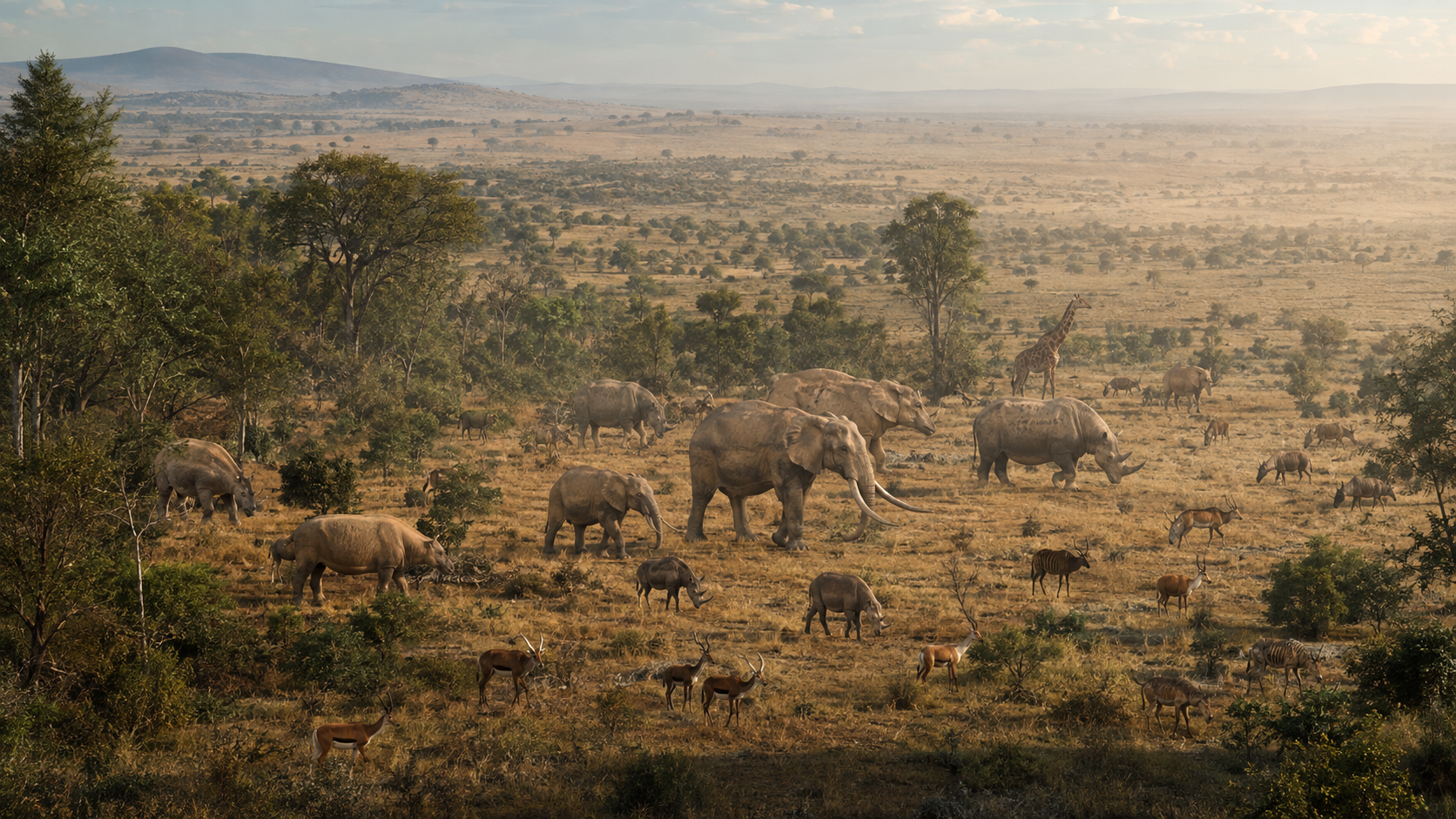
Africa’s giant herbivores did not lose their ancient diversity simply because large animals were unusually easy to drive into extinction.
Instead, new research suggests that the largest species were creating new evolutionary branches far more slowly than smaller herbivores. Once environmental change caused extinction rates to rise across the continent, those lost giants were not replaced quickly enough.
The finding challenges a familiar explanation for the disappearance of Africa’s once much richer collection of animals weighing more than one tonne.
Published in Nature Communications, the study reconstructed 23 million years of African ungulate evolution. The researchers analysed 3,327 fossil occurrences representing 396 species, using Bayesian neural-network models to estimate how rates of speciation and extinction changed through time.
Speciation is the evolutionary process through which new species emerge. Extinction removes species; speciation adds them.
Biodiversity declines when that balance remains negative.
A Slow-Moving Evolutionary Imbalance
The researchers found that African herbivore evolution began changing significantly around 7.2 million years ago, when both speciation and extinction accelerated.
After approximately 3.6 million years ago, however, the creation of new species began to level off. At the start of the Pleistocene, around 2.58 million years ago, extinction rates rose sharply, reaching roughly three times their earlier Miocene levels.
This produced widespread losses across African herbivore groups.
Yet the largest animals were not experiencing the highest inherent extinction rates. The modelling indicated that larger species generally both evolved and disappeared more slowly than smaller species.
During peak aridification, species weighing less than 45 kilograms had estimated extinction rates only around 15% higher than animals exceeding one tonne. Their estimated speciation rates, however, were approximately 2.2 times faster.
The problem facing megaherbivores was therefore not simply that they died out more easily.
They were less able to replace what had been lost.
Why Size Could Slow the Formation of Species
Very large herbivores usually require broad geographical ranges, substantial food supplies and relatively low population densities.
Those wide ranges can help populations survive local disruptions. If food or water becomes scarce in one area, animals occupying larger territories may have access to alternatives elsewhere.
The same characteristics can make speciation more difficult.
New species often emerge when populations become separated and develop independently. In megaherbivores, small isolated populations may be too vulnerable to survive long enough to establish a distinct evolutionary lineage.
Large animals can therefore be relatively resistant to some long-term environmental disturbances while still producing new species slowly.
Climate Changed the Evolutionary Balance
The researchers tested body mass alongside tooth structure, evolutionary relationships and two indicators of environmental change: increasing aridity and the expansion of grass-dominated landscapes.
Their models suggest that aridification was the strongest predictor of extinction dynamics. As African environments became drier, extinction increased broadly rather than selectively targeting only the largest animals.
The effect on speciation was more uneven.
Environmental change was associated with faster speciation among many smaller herbivores, while suppressing it in some megaherbivore lineages. Species weighing less than 180 kilograms showed an estimated increase of around 50% in speciation under changing conditions, compared with an estimated decline of roughly 20% among megaherbivores.
Teeth also mattered.
Herbivores with high-crowned teeth were better equipped to process hard, abrasive vegetation. This dental durability was associated with lower extinction and, in some groups, greater evolutionary diversification.
As African landscapes became drier and grassier, the ability to consume increasingly abrasive food may have helped certain lineages persist and expand.
What This Means for Africa’s Remaining Giants
Southern Africa still supports some of the world’s most important populations of elephants, rhinoceroses, hippopotamuses and other large herbivores.
The new study does not assess the present-day conservation status of these animals. Modern pressures—including habitat loss, exploitation, infrastructure and human-wildlife conflict, operate over far shorter periods than the evolutionary changes examined in the fossil record.
The findings nevertheless reveal an important form of vulnerability.
When a lineage naturally generates new species slowly, the loss of an existing species removes a branch of life that may take an exceptionally long time to replace, if replacement occurs at all.
Protecting megaherbivores therefore preserves more than individual populations. It also protects ecological functions and evolutionary histories accumulated over millions of years.
What the Fossils Cannot Show Perfectly
The analysis depends on an incomplete fossil record and statistical models used to reconstruct processes that cannot be observed directly.
Its environmental indicators were largely derived from marine sediment records that capture broad, subcontinental trends. They cannot fully represent the different environmental histories experienced across every African region.
The publisher has also released the paper as an early, unedited manuscript that may receive corrections during final production.
Even with those limitations, the study expands how scientists understand biodiversity collapse.
A group does not need to experience uniquely extreme extinction to disappear.
Sometimes, extinction rises across an entire ecosystem while the slowest-evolving lineages quietly fall behind.
Source Information
Study Title: Lower speciation, not higher extinction, drove African megaherbivore diversity collapse|
Authors: Juan L. Cantalapiedra, Ignacio A. Lazagabaster, Fernando Blanco, Torsten Hauffe, Faysal Bibi, María Ríos, Bastien Mennecart, Juha Saarinen, Daniele Silvestro, Manuel Hernández Fernández and Oscar Sanisidro
Journal: Nature Communications
Published: 31 July 2026
DOI: 10.1038/s41467-026-76105-2