








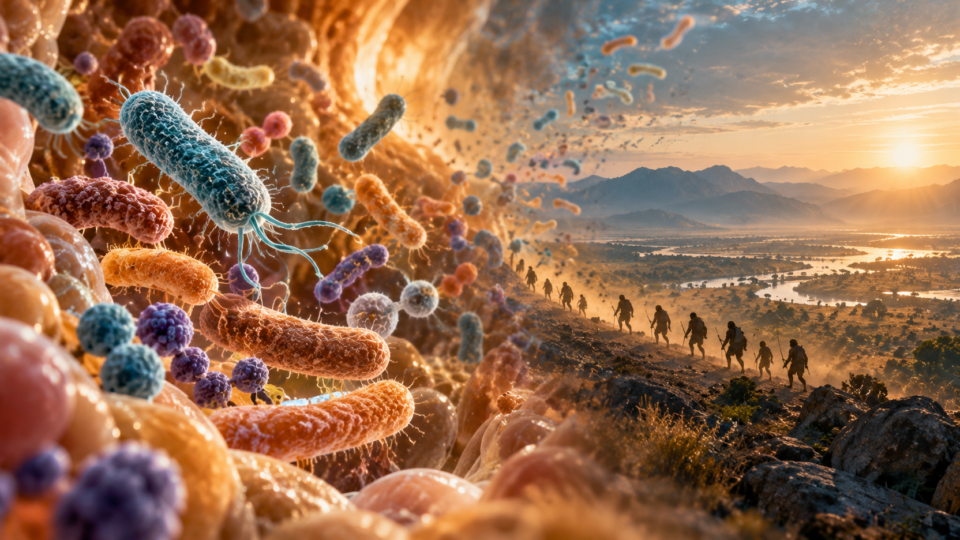
The bacteria living in the human gut may preserve traces of journeys made by our ancestors thousands of years ago. A new study in Nature has found genetic evidence that hundreds of microbial species accompanied people during prehistoric migrations, even though many of those organisms are now uncommon or undetectable in industrialized populations.
Researchers compared the gut microbiomes of Indigenous Tsimane communities in Bolivia with those of Hadza communities in Tanzania. The populations live on different continents and have distinct histories, yet the researchers identified 1,231 microbial species shared between them. Genetic differences within many of those species were consistent with a long history of separation rather than recent exchange.
The results offer a different perspective on the human microbiome. Some organisms often described as unusual inhabitants of non-industrialized populations may actually represent lineages with deep roots in human evolutionary history. Their absence from many modern urban microbiomes could reflect a relatively recent ecological loss.
Crucially, the study did not test whether those missing microbes cause disease, whether restoring them would improve health, or whether one population’s microbiome is inherently healthier than another’s.
A microbial record of human movement
The human gut contains an enormous community of bacteria, archaea and other microorganisms. Their composition is influenced by diet, medication, sanitation, environment, interpersonal contact and numerous other factors. Consequently, two people can have very different microbiomes without having very different genetic ancestries.
That flexibility makes it difficult to reconstruct the history of human-associated microbes. Finding the same bacterial species in two distant populations is not enough to show that their ancestors carried it thousands of years ago. It might instead have spread recently through travel, trade, food, environmental exposure or contact with other people.
Earlier research using ancient faecal material suggested that past human microbiomes resembled those of some contemporary non-industrialized communities more closely than those of industrialized populations. But available ancient samples generally cover the past one or two millennia, not the much longer timescales associated with migrations out of Africa and into the Americas.
The new study addresses that gap by looking at the genetic histories of individual microbial strains. Bacteria accumulate mutations and exchange DNA over time. By examining those patterns, researchers can infer whether populations of the same microbial species have been exchanging genes recently or have remained largely isolated.
How the researchers compared two distant populations
Matthew M. Carter and colleagues performed deep metagenomic sequencing of 133 stool samples from 85 Tsimane adults, collected in 2009 and between 2012 and 2013 from communities in the Bolivian Amazon. Metagenomic sequencing reads genetic material from an entire microbial community rather than examining one bacterial species at a time.
The Tsimane samples yielded 12,746 reconstructed microbial genomes, representing 1,408 bacterial and archaeal species. The researchers compared them with a previously assembled collection of 32,034 microbial genomes from 137 Hadza participants in Tanzania.
The study also drew on 8,855 additional microbial genomes from Europe, Asia and North America to distinguish ancient patterns of separation from the more recent worldwide circulation of some gut bacteria.
For detailed population-genetic analysis, the team concentrated on 636 species with at least four reconstructed genomes in each of the Tsimane and Hadza cohorts. This allowed comparisons within each population and between the two populations at the strain level, not merely a comparison of species lists.
The design was observational and computational. The investigators did not experimentally alter anyone’s microbiome, assign diets or treatments, or follow the same individuals over thousands of years. Instead, they used genetic differences among living microorganisms to reconstruct possible historical relationships.
More than 1,200 species appeared in both groups
The researchers found that 87.4% of the species recovered from the Tsimane cohort, or 1,231 of 1,408, were also present among the Hadza. That overlap is remarkable given the populations’ geographic separation.
Across the Tsimane species catalogue, 848 species, equivalent to 60.2%, were rare or absent in industrialized populations. This result highlights how much microbial diversity can be missed when reference databases and research samples concentrate on urban or industrialized settings.
However, species overlap alone could not establish a prehistoric connection. The decisive question was whether the strains within those shared species showed evidence of long-term separation.
The researchers therefore examined average nucleotide identity, a measure of how similar two microbial genomes are. Across the 636 sufficiently sampled species, typical genome similarity between Tsimane and Hadza strains was approximately 98%. Comparisons involving strains from the same population were, on average, more similar than comparisons between populations, with a reported P value below 0.001.
That difference was statistically detectable, but it did not mean the two populations possessed completely separate bacterial species. Much of the genetic variation overlapped. The authors interpreted this as evidence that substantial strain diversity existed before the populations became geographically isolated.
Most shared species showed little recent strain exchange
To investigate more recent microbial transmission, the researchers searched for pairs of genomes sharing substantial stretches of identical genes. Their operational definition of closely related, or clonal, strains was a pair sharing more than 10% identical genes.
Across the 636 shared species, 78,746 genome pairs, or 7.8% of the comparisons, met that criterion. Of these clonal pairs, 93.8% were comparisons within the same human population, rather than between Tsimane and Hadza strains.
Even more tellingly, 545 of the 636 species, or 85.6%, showed no evidence of recent strain sharing between the two populations using the study’s threshold. The overall pattern was statistically unlikely under the researchers’ permutation-test null model, with P below 0.0001.
In this analysis, the relevant threshold represented genetic relationships consistent with shared ancestry within roughly the past 5,000 years, although the estimated timescale varied across species. A lack of detected recent strain sharing does not prove that no microbial exchange occurred. It indicates that the sampled genomes did not show the genetic signatures expected from substantial recent exchange under the model.
Some bacteria behaved differently. Species including Akkermansia muciniphila and Bacteroides ovatus displayed stronger evidence of recent sharing across populations. These species also appeared more broadly across industrialized microbiomes, consistent with relatively recent global movement of particular microbial lineages.
A genetic clock pointed back about 17,000 years
The researchers next studied shorter stretches of nearly identical DNA that can remain after bacteria exchange genetic material through recombination. These fragments can reveal older connections even when genomes no longer qualify as closely related strains.
They compared the lengths of these shared DNA tracts within and between populations and simulated how mutations would accumulate after gene exchange stopped. From this, they estimated the timing of microbial genetic separation.
The median estimated separation time between Tsimane and Hadza microbial populations was 17,090 years, with a reported standard error of 863 years. By comparison, the corresponding median estimates were 4,637 years for Asia and North America, and 1,109 years for Europe and North America.
The Tsimane-Hadza estimate differed significantly from the industrialized-population comparisons, with P below 0.0001. This pattern suggests that many gut microbial lineages retained distinct regional histories despite the worldwide circulation of humans and microbes.
The figure of 17,090 years is not a direct archaeological date for a single migration. It is a model-derived median across microbial species, dependent on assumptions about bacterial mutation rates, recombination and population structure. The researchers also used a separate demographic method based on genetic variant frequencies for 15 species, which broadly supported ancient population separation.
Importantly, the broader pattern was consistent with human population movements spanning the migration out of Africa and settlement of the Americas. It does not imply that all the bacteria arrived at the same time or followed one route.
What disappeared from industrialized microbiomes?
The authors discuss microbial groups previously described as VANISH taxa, a term referring to microorganisms that are volatile or negatively associated with industrialized human societies. Their analysis suggests that many of these organisms have ancient associations with humans rather than being newly acquired features of particular contemporary communities.
They also distinguish microbes that have spread widely during modernization from organisms that remain common across different lifestyles while retaining deep genetic separation between populations.
This distinction matters. A bacterial species may be found in people worldwide while its strains preserve very different histories. Conversely, an organism that appears rare in industrialized populations may have been widespread among human ancestors.
Modern lifestyle changes offer several possible explanations for microbiome differences, including shifts in diet, sanitation, antibiotic exposure, living environments and social contact. But this particular study did not isolate which of those factors caused the apparent losses.
Research Today has previously examined how antibiotic exposure may leave long-lasting changes in gut microbial communities. The new evolutionary analysis asks a different question: not how an individual’s microbiome changes after one exposure, but how microbial lineages have persisted or disappeared over much longer historical periods.
Why this discovery matters for health research
The findings raise a consequential possibility: industrialized populations may have lost microbial functions that were present throughout much of human history.
Gut microorganisms participate in breaking down dietary compounds, interacting with the immune system and producing biologically active metabolites. Losing particular lineages could therefore matter even when overall bacterial numbers remain high.
Yet it would be premature to assume that restoring any of the missing species would prevent obesity, diabetes, inflammatory disease or another condition. The study measured microbial genetic relationships and geographic distribution. It did not measure the clinical effects of losing the identified species.
Nor is a high-diversity microbiome automatically beneficial in every setting. Microbial effects depend on the organisms involved, their genes, the host’s circumstances and the surrounding community. Some microorganisms can be harmless in one context and problematic in another.
The immediate value of the work is therefore to improve the scientific map of what human-associated microbial diversity looks like, where it may have originated and which lineages deserve closer functional investigation.
Indigenous participation is central to the evidence
The study’s conclusions were possible because researchers examined communities often underrepresented in global microbiome research. The Tsimane and Hadza are not relics of the past. They are contemporary peoples whose microbiomes reflect their own living environments, histories and practices.
The paper describes consent and oversight arrangements involving Tsimane governance structures, community leaders and participants, alongside institutional review and collaborations in Bolivia. It also reports approvals and consent procedures for the previously collected Hadza samples.
The researchers emphasize community autonomy, benefit sharing and careful governance of genetic data. Those issues are especially important when scientific interest in microbial lineages could eventually generate commercial applications. The presence of a microbe in a community does not imply that outside researchers have unrestricted rights to collect, redistribute or commercialize it.
Important limits to the evolutionary reconstruction
The analysis is unusually detailed, but several uncertainties affect its interpretation.
First, the Tsimane and Hadza samples were collected during different periods and the cohorts were relatively small. They cannot represent the full diversity within either population or all non-industrialized communities.
Second, the number of reconstructed genomes depends on sequencing depth, assembly quality and species abundance. Rare organisms may escape detection, so an organism described as absent from a sample or population may simply have been below the method’s detection threshold.
Third, microbial mutation rates are not perfectly known or constant. Bacteria also exchange DNA, making their ancestry more complex than a simple family tree. The researchers used several complementary approaches to address this, but the inferred dates remain estimates.
Fourth, similar microbial histories do not demonstrate continuous direct transmission from parent to child over thousands of years. Organisms may also move through households, wider communities, food and environments.
Finally, the results cannot establish that industrialization caused the disappearance of every missing species, or that restoring ancient lineages would improve health. Those are hypotheses for future research, not conclusions of this genetic study.
A hidden part of human history
Human migrations are usually reconstructed through archaeology, languages and human DNA. This study suggests that the microorganisms living alongside us may preserve another layer of that history.
The most compelling evidence is not merely that distant populations share more than 1,200 microbial species. It is that hundreds of those species carry genetic patterns consistent with ancient separation, while many are now rare or undetected in industrialized populations.
That finding expands the idea of biodiversity loss beyond forests, oceans and endangered animals. Part of humanity’s biological heritage may be disappearing inside the human gut, even as scientists are only beginning to understand what that loss means.
Source Information
Study: Carter, M. M., Liu, Z., Olm, M. R. et al. “Prehistoric global migration of vanishing gut microbes with humans.”
Journal: Nature.
Published: 7 October 2026.
DOI: 10.1038/s41586-026-11106-1.
Study design: Comparative metagenomic sequencing and microbial population-genetic modelling using 133 stool samples from 85 Tsimane adults, previously collected data from 137 Hadza participants, and additional genome comparisons from industrialized regions. The analysis evaluated shared microbial species, strain relatedness, recombination patterns and modelled population separation times.