









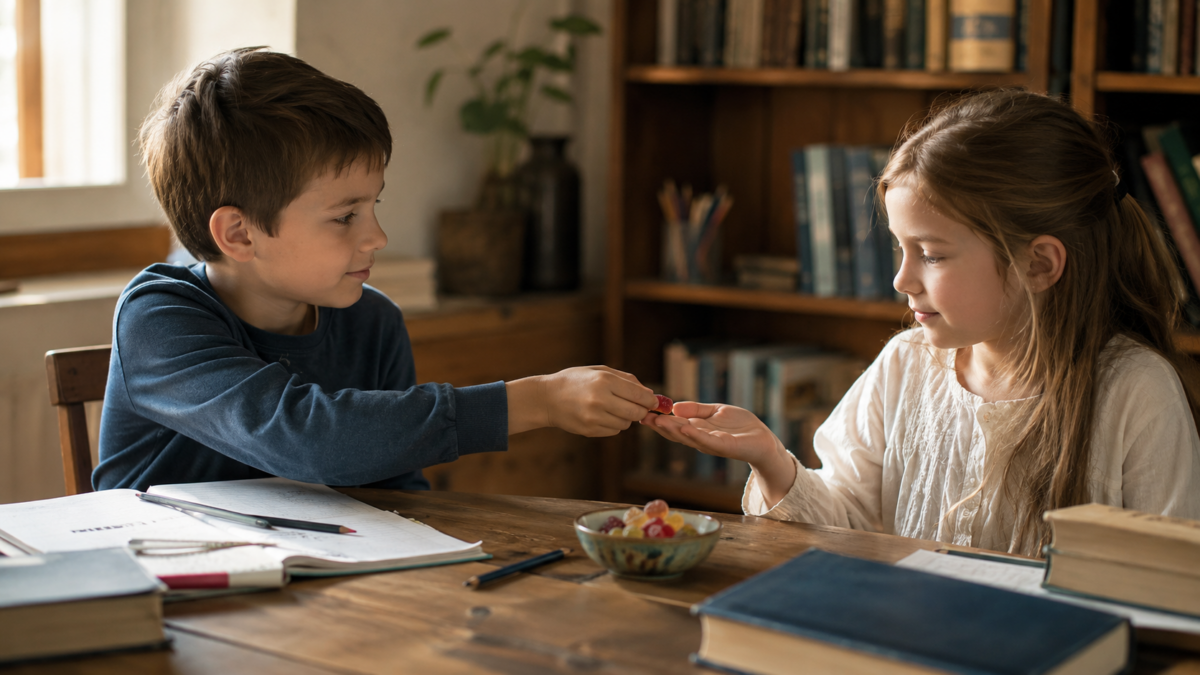
A young child who shares a handful of sweets may not be able to explain why sharing is fair.
They may simply do it.
This creates an old philosophical problem in a surprisingly ordinary setting. If a person acts well before carefully reasoning about what is right, where does morality actually come from? Are people taught to be good through reflection and rules, or does some part of moral behaviour appear before we can properly reason about it?
New research involving 537 children aged three to 10 suggests the answer may involve both.
Researchers found that younger children were more prosocial when they had to respond quickly, while deliberate prosocial behaviour increased with age. By around nine or 10, the difference between fast and considered decisions had largely disappeared.
Asking children to decide quickly, or think first
The study, published in Nature Human Behaviour, involved Italian-speaking children recruited from kindergartens and primary schools in Milan.
Half were randomly assigned to make decisions under time pressure, generally within 10 seconds. The other half were required to wait at least 10 seconds and think before responding.
The children then completed a series of tasks designed to capture different parts of social decision-making.
They decided whether to share sweets, contribute to a common pool, accept fair or unfair divisions, tell the truth when lying could benefit them, and respond to child-friendly versions of moral dilemmas. Each child made 19 decisions in total.
Rather than treating every task separately, the researchers identified broader behavioural tendencies.
One was Prosociality, a pattern combining cooperation, altruism and honesty.
Among younger children, this tendency was stronger when decisions were made quickly than when children were made to stop and deliberate. Yet intuitive prosociality itself showed little evidence of changing with age.
What changed was the slower form.
Deliberation became kinder with age
As children grew older, their prosocial behaviour under deliberate decision-making increased.
The result was a gradual narrowing of the gap between intuition and reflection. Among children aged three to four, fast decisions were significantly more prosocial. By ages nine to 10, the researchers found no significant difference between the fast and slow conditions.
This offers an interesting alternative to the idea that morality develops simply because children learn to suppress selfish impulses.
The youngest children in this experiment were not primarily becoming prosocial because careful thought overruled an unkind instinct.
Their intuitive responses were already comparatively prosocial.
What appeared to develop was the ability of reflective thought to reach similar conclusions.
In that sense, moral development may involve reason gradually catching up with something that initially comes more naturally.
Being good and knowing why may be different things
Philosophy often treats moral reasoning as deeply important.
We expect adults to give reasons for difficult choices. We ask whether an action respects another person’s rights, produces the best consequences or can be justified by a broader principle.
But ordinary moral life does not begin in a philosophy seminar.
Children encounter fairness, honesty and cooperation long before they can explain ethical theories.
The findings therefore raise a distinction between acting prosocially and being able to reason towards prosocial behaviour.
A three-year-old who instinctively cooperates may behave well without possessing anything resembling a developed moral argument. An older child may arrive at similar behaviour after considering fairness, consequences, expectations or the interests of another person.
The outward behaviour can look similar even though the route towards it has changed.
That matters because moral maturity may not require replacing instinct with reason. It may involve bringing the two into closer alignment.
Moral education may need both
There is a practical implication here for how adults think about teaching morality.
Parents and schools often rely on two different approaches.
One tries to establish habits: share, tell the truth, help others and treat people fairly.
The other asks children to reflect: Why was that unfair? How would the other person feel? What would happen if everyone behaved that way?
The study does not test which form of moral education works best. But its findings suggest these approaches need not be competitors.
Early prosocial tendencies may provide part of the foundation, while growing cognitive abilities allow children to incorporate similar behaviour into more reflective decision-making.
In a society such as South Africa, where children encounter different cultural, religious and family traditions concerning right and wrong, the distinction is useful. Shared behaviour does not necessarily require everyone to begin with identical moral explanations.
Learning to reason about why we owe something to other people may be another stage in a process that begins much earlier.
This does not prove children are naturally good
The findings should not be stretched into the claim that children are born morally good.
The children were already between three and 10 years old, meaning every participant had experienced years of family and social influence.
The sample also came exclusively from Northern Italy. The researchers explicitly caution that prosocial development can differ across cultures and that the findings should not automatically be generalised to other populations.
Time pressure is also only an experimental way of encouraging faster, more intuitive decisions. The study did not include a neutral condition in which children could respond entirely at their own pace.
What the research does show is more restrained, and perhaps more interesting.
Reason does not necessarily arrive in childhood to rescue us from an entirely selfish intuition.
Sometimes the instinct to cooperate appears first.
Growing up may partly involve learning how to think our way towards what, earlier in life, we simply felt inclined to do.
Source Information
Study Title: Stable intuition and the rise of deliberative prosociality in childhood
Authors: Francesco Margoni, Francesco Nava, Chiara Sotis, Matthew R. Levy, Valerio Capraro and Elena Nava
Journal: Nature Human Behaviour
Published: 6 July 2026
DOI: 10.1038/s41562-026-02487-4