







Girls are more likely than boys to report several forms of psychological distress during adolescence.
That difference has been documented across many countries, but understanding why it emerges has proved much harder.
New longitudinal research suggests that two social and psychological factors may explain a substantial part of the gap: loneliness and the desire to be thinner.
A study published in Nature Human Behaviour followed 3,171 adolescents in the Tokyo Teen Cohort at ages 12, 14 and 16.
At age 16, depressive symptoms were reported by 15.9% of girls compared with 8.2% of boys. Suicidal ideation was reported by 29.8% of girls compared with 18.1% of boys.
When the researchers examined loneliness and desire for thinness measured two years earlier, they estimated that pathways through these two factors accounted for 34.7% of the sex difference in depressive symptoms and 46.3% of the difference in suicidal ideation.
The findings do not mean that loneliness or body-image pressure alone causes adolescent mental-health problems. But they suggest that part of the higher burden experienced by girls may be linked to social conditions that are potentially modifiable.
The study followed teenagers from age 12 to 16
Zui C. Narita and colleagues analysed data from 3,171 adolescents participating in the Tokyo Teen Cohort.
The group included 1,487 girls and 1,684 boys.
Participants were assessed at approximately ages 12, 14 and 16, giving the researchers an opportunity to examine whether earlier experiences might help explain later differences in mental health.
At age 12, the researchers accounted for a wide range of background characteristics, including body size, physical activity, relationships with parents and friends, bullying victimisation, internet use, pubertal development and existing mental-health symptoms.
At age 14, they focused on two candidate pathways: loneliness and a desire to be thinner.
At age 16, they examined several internalising outcomes, including depressive symptoms, suicidal ideation, self-harm, emotional symptoms and anxiety.
Girls reported substantially more loneliness and desire for thinness
The difference between girls and boys was already visible by age 14.
Loneliness was reported by 13.2% of girls compared with 6.0% of boys.
The gap was even larger for desire for thinness.
At age 14, 41.4% of girls reported wanting to be thinner compared with 11.1% of boys.
These differences mattered because both factors were then associated with later internalising problems at age 16.
The researchers therefore asked whether the higher levels of loneliness and thinness desire among girls could statistically explain part of the later mental-health gap.
The two factors accounted for more than a third of the depression gap
The researchers used a method known as the parametric mediational g-formula.
This approach estimates how much of an observed difference may operate through particular intermediate pathways while adjusting for measured confounding factors over time.
For depressive symptoms at age 16, the pathway through loneliness and desire for thinness at age 14 accounted for an estimated 34.7% of the total effect associated with female sex.
For suicidal ideation, the corresponding estimate was 46.3%.
The researchers also reported mediation estimates of 26.7% for self-harm, 23.5% for emotional symptoms and 7.7% for anxiety.
Nineteen sensitivity analyses produced results that were broadly consistent with the main analysis.
The study started by asking young people what researchers might be missing
An unusual feature of the project was that the potential pathways were not chosen only by researchers.
The team worked with young people through workshops and discussions to identify experiences they believed could contribute to the mental-health gap between girls and boys.
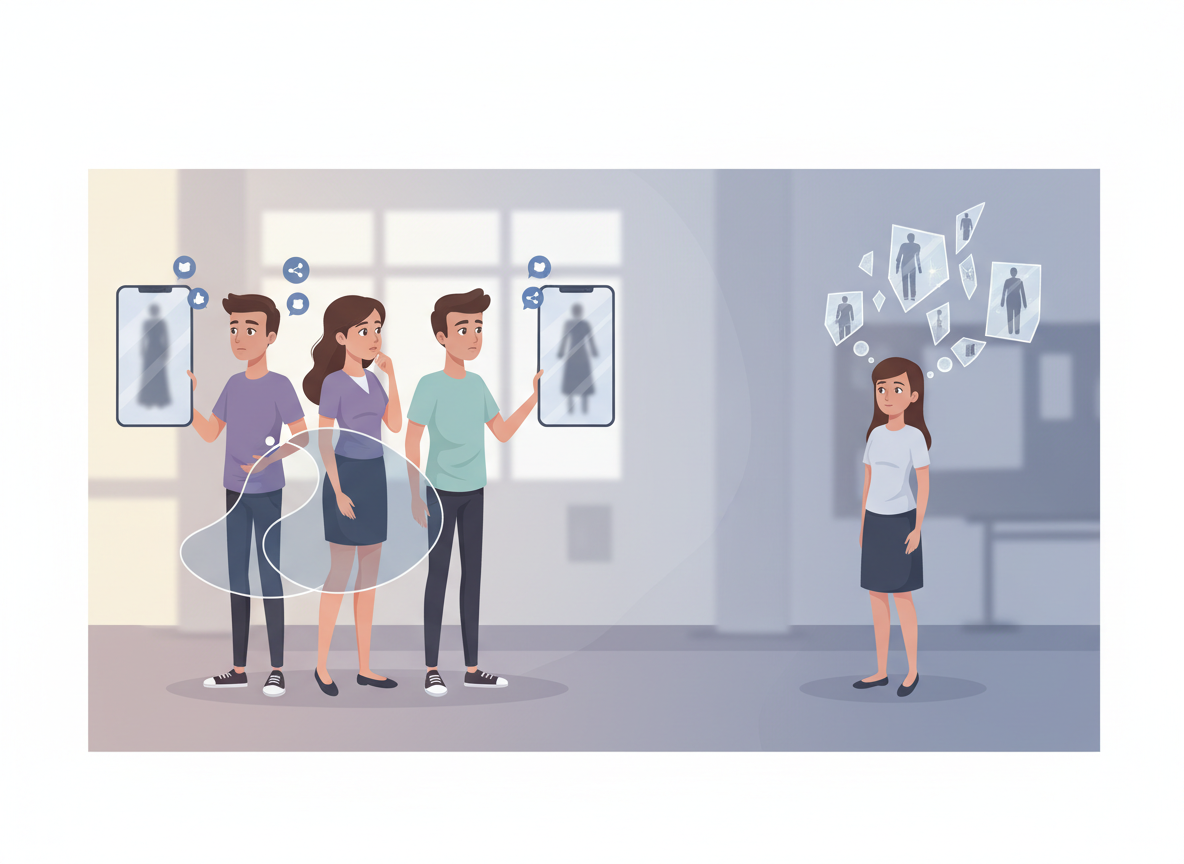
Participants raised issues such as exclusion from social groups, not having friends with whom they felt safe speaking openly, pressure to fit in, teasing about appearance, body comparison through smartphones and broader expectations that girls should be thin.
Loneliness and desire for thinness were selected for analysis because they were among the candidate factors that could be measured in the existing Tokyo Teen Cohort data.
This means the study combined conventional statistical analysis with questions shaped by adolescents’ own experiences.
Loneliness may reflect more than simply being alone
Loneliness is not the same thing as spending time by oneself.
It reflects a perceived gap between the social connection a person wants and the connection they feel they actually have.
A teenager can therefore be surrounded by classmates, family members and online contacts while still feeling profoundly lonely.
Adolescence is also a period in which peer acceptance becomes especially important.
Social exclusion, friendship instability or feeling unable to speak honestly with peers can therefore have a particularly strong emotional impact.
The new study suggests that these experiences may help explain why some internalising problems become more common among girls during the teenage years.
Body-image pressure was an even more common experience among girls
The difference in desire for thinness was one of the largest contrasts in the study.
More than four in ten girls reported wanting to be thinner at age 14, compared with just over one in ten boys.
The measure does not mean that every adolescent who wanted to be thinner had an eating disorder or clinically significant body-image disturbance.
It does show that pressure around body size was far more common among girls in this cohort.
The young people involved in the coproduction process specifically highlighted appearance-related teasing, comparison through smartphones and social expectations around female thinness as relevant experiences.
These influences can come from peers, advertising, entertainment, social media and broader cultural expectations rather than from one single source.
The result shifts some attention away from individual vulnerability
Mental-health differences are often framed in terms of what is happening inside the individual.
Biology, temperament and personal coping all matter.
But the new findings emphasise that social environments may also shape who experiences distress and how strongly.
Loneliness depends partly on the quality of relationships and social inclusion.
Desire for thinness can be reinforced by cultural standards, peer norms and repeated exposure to appearance-based comparison.
These are not purely private characteristics of an adolescent.
They are partly produced by schools, families, peer groups, media and wider social expectations.
The study does not show that removing these factors would eliminate the gap
The percentage estimates can sound more definitive than they are.
Saying that loneliness and desire for thinness accounted for 34.7% of the depression gap does not mean that an intervention eliminating both factors would necessarily reduce the difference by exactly 34.7%.
Mediation analysis depends on assumptions about how variables relate to one another and whether all important confounding factors have been measured adequately.
The researchers adjusted for many known background characteristics, but no observational study can guarantee that every relevant influence has been captured.
The findings should therefore be interpreted as evidence that these pathways may contribute substantially to the observed gap, rather than as proof of a precise intervention effect.
The Tokyo setting is another important limitation
The participants came primarily from an urban Tokyo cohort.
Social expectations around body image, friendship, school pressure and gender can differ substantially across cultures.
The exact prevalence rates and mediation estimates may therefore look different in other countries or communities.
The researchers themselves note that the findings need replication in other populations.
This is especially important before assuming that the same percentages apply to adolescents in South Africa or elsewhere.
The sex difference was not the same for every mental-health outcome
The two mediators were more important for some outcomes than others.
They accounted for nearly half of the observed difference in suicidal ideation and more than a third of the difference in depressive symptoms.
For anxiety, however, the estimated mediated proportion was much smaller at 7.7%.
This suggests that the broader category of “mental health” should not be treated as one single outcome with one explanation.
Different symptoms may be shaped by different combinations of biological, psychological and social factors.
Schools may be one important place to intervene
The findings point toward several areas where prevention efforts could be tested.
Schools can influence social inclusion, bullying, friendship support and appearance-based norms.
Programmes that strengthen peer connection or reduce appearance-based teasing may therefore be relevant to more than general wellbeing.
Media-literacy approaches that help adolescents recognise unrealistic body ideals or understand how social-media comparison affects self-perception may also be worth evaluating.
The current study did not test these interventions, so it cannot establish which approach would work best.
Its contribution is identifying plausible targets that emerged both from young people’s own perspectives and from longitudinal data.
The findings are relevant to how adults talk about teenage distress
Adults sometimes interpret adolescent distress as oversensitivity, moodiness or a phase that will pass on its own.
The new findings offer a different perspective.
Feeling socially excluded or under persistent pressure to change one’s body may be part of the environment in which depressive symptoms and other internalising problems develop.
Taking those pressures seriously does not mean assuming that every lonely adolescent will become depressed or that every teenager who wants to be thinner will experience serious mental-health problems.
It means recognising that repeated social experiences can form part of a broader risk pattern.
What this could mean in South Africa
The study cannot be used to estimate the mental-health gap between South African girls and boys.
South African adolescents live within very different social, economic, educational and cultural conditions from those represented in the Tokyo Teen Cohort.
But the mechanisms highlighted by the study are relevant questions for local research.
Loneliness, peer exclusion, appearance pressure and social-media comparison are not unique to Japan.
Understanding how strongly they contribute to adolescent mental-health differences in South Africa would require locally collected longitudinal data.
The study therefore offers a useful framework without supplying a South African estimate.
The most important contribution may be that the pathways are potentially changeable
Sex itself is not an intervention target.
Loneliness and harmful body-image pressure are.
That distinction is what makes the new research practically important.
The study does not provide a complete explanation for why girls reported more internalising problems than boys.
But it suggests that a meaningful share of the difference may pass through social experiences that schools, families, media environments and communities can potentially influence.
That moves the conversation away from asking only why girls are more vulnerable and toward asking which parts of the environment might be changed.
Source Information
Study Title: Loneliness and desire for thinness explain sex differences in adolescent internalizing problems
Authors: Zui C. Narita, Gemma Knowles, Susan M. Sawyer, Syudo Yamasaki, Darío Moreno-Agostino, Jordan DeVylder and colleagues
Journal: Nature Human Behaviour
Published: 15 September 2026
Sample: 3,171 adolescents in the Tokyo Teen Cohort, including 1,487 girls and 1,684 boys, assessed at approximately ages 12, 14 and 16.
Method: Longitudinal mediation analysis using the parametric mediational g-formula, with baseline adjustment for a broad range of social, behavioural and mental-health characteristics and 19 sensitivity analyses. Loneliness and desire for thinness at age 14 were examined as potential pathways to internalising outcomes at age 16.
Main finding: Loneliness and desire for thinness statistically accounted for an estimated 34.7% of the sex difference in depressive symptoms and 46.3% of the difference in suicidal ideation, with smaller mediated proportions for self-harm, emotional symptoms and anxiety.
DOI: 10.1038/s41562-026-02578-2