





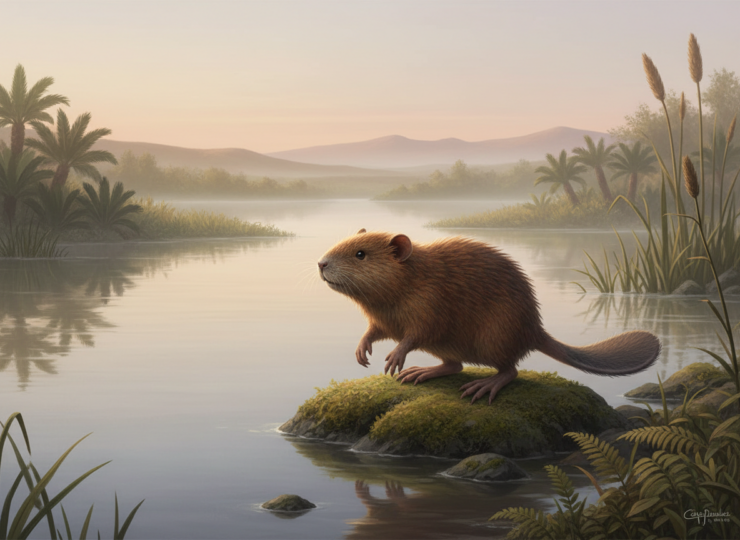

A nearly complete 120-million-year-old mammal skeleton from northeastern China is complicating two familiar stories about early mammal evolution at once. The animal appears to have replaced some of its teeth more than once, a pattern unlike the usual two-generation system of living mammals, while its broad hands, feet and flattened tail point to a semiaquatic lifestyle.
The fossil, described in Nature Communications, belongs to a newly named Early Cretaceous species, Dongoconodon platycauda. Researchers report that it preserves an unusual combination of features: evidence for multiple tooth generations at several tooth positions, a partially reduced bony connection associated with the middle ear, and limb and tail anatomy resembling adaptations seen in living semiaquatic mammals.
That combination matters because tooth replacement and the separation of the middle ear from the jaw are often treated as major milestones in mammalian evolution. The new specimen suggests these traits did not necessarily move together along a simple one-way path. Instead, early mammals could combine ancestral and derived features in unexpected ways while adapting to specialised ecological niches.
A small mammal with an unusually complete evolutionary record
The specimen, catalogued as IMMNH-PV01700, was collected in 2016 from the Jiufotang Formation at Changzigou in Liaoning Province, China. The deposit is approximately 120 million years old. The skeleton is nearly complete and articulated, preserving a well-developed skull and jaws as well as much of the axial and limb skeleton. The main missing elements are the left humerus, ulna and radius.
The researchers identified the animal as a eutriconodontan, a group of extinct Mesozoic mammals. Their phylogenetic analysis placed Dongoconodon in a branch closely associated with gobiconodontids, a group that included some unusually large Mesozoic mammals. Dongoconodon itself was much smaller. The researchers estimate a body mass of roughly 115 to 190 grams, around the size of a water vole.
Its skeleton nevertheless carries a large amount of anatomical information. The axial skeleton includes seven cervical, 21 thoracic, five lumbar and three sacral vertebrae, plus at least 19 tail vertebrae. Twenty-two ribs are preserved. The upper jaw contains 11 tooth positions and the lower jaw ten.
For paleontologists, the value of such preservation is not simply completeness. Different teeth are captured at different stages of eruption and development, allowing the researchers to reconstruct a replacement pattern that is usually difficult to infer from isolated fossil teeth.
The teeth challenge the standard two-generation pattern
Living mammals are generally characterised by diphyodonty, meaning that teeth at relevant positions are produced in two generations. Humans provide a familiar example: deciduous teeth are followed by permanent replacements. Reptiles more commonly show polyphyodonty, with repeated replacement through multiple generations.
The fossil record makes the transition difficult to reconstruct. Growth series are rarely preserved, so researchers often have to infer whether a fossil tooth was replaced from wear, crown form, jaw position and comparisons with related species. Dongoconodon is unusual because unerupted and replacement teeth remain visible inside the jaws.
The right lower jaw is particularly informative. In front of the erupted canine, the researchers identified three unerupted teeth inside the bone. These include a first incisor with another replacement behind it, followed by a second incisor. At the same time, the second and third molariform teeth were already fully erupted.
Interpreting the unerupted incisors as the animal’s first generation would require the posterior molariform teeth to have erupted before two deciduous incisors. The authors note that this sequence is not known in living or extinct mammals. They therefore interpret the delayed incisors as a second generation. Because the first incisor itself has a replacement, that replacement would represent a third generation.
Evidence for a third generation extends beyond the incisors. The study reports replacement teeth at some canine and premolar positions. In the lower right jaw, a primary first molariform had already been shed, a complex replacement was developing in the bone, and a small enamel cap below it appears to represent yet another generation.
This does not mean every tooth was endlessly replaced. Rather, the evidence points to polyphyodonty at some tooth positions across several tooth types. The authors describe Dongoconodon as the only mammal known to them showing multiple generations at some loci across all four broad tooth types. Another eutriconodontan, Gobiconodon borissiaki, has previously been interpreted as having three generations at some molariform positions.
Diet may help explain why replacement reappeared
The finding is especially interesting because diphyodonty is often linked to other mammalian traits, including precise tooth occlusion and determinate growth. A simple evolutionary narrative might therefore predict that once limited tooth replacement appeared, repeated replacement would disappear permanently.
The eutriconodontans do not fit that neat sequence. Dongoconodon and some relatives combine mammal-like dental specialisation with renewed replacement. The researchers suggest ecology may be part of the explanation. Gobiconodontids are generally interpreted as carnivorous based on their jaw form and enlarged anterior teeth. Dongoconodon has similar anterior dentition and jaw anatomy, also pointing toward a carnivorous diet.
Teeth used to seize and tear prey can face substantial mechanical demands. The authors therefore propose that the reappearance of molariform replacement and polyphyodonty in this lineage was probably associated with its carnivorous specialisation and ecological niche. That remains an evolutionary interpretation rather than a directly observed behaviour, but it provides a plausible reason why a lineage might regain or retain more dental replacement than the typical mammalian pattern.
The broader implication is caution. Because the actual eruption sequence remains unknown for many Mesozoic mammals, researchers cannot yet say how many times limited two-generation dentition evolved, or how often lineages subsequently shifted toward additional replacement.
The middle ear records another evolutionary transition
The jaws also preserve evidence relevant to the evolution of the mammalian middle ear. In living mammals, the tiny middle-ear bones are fully separated from the lower jaw and dedicated to hearing. Earlier mammalian relatives retained anatomical connections between structures associated with chewing and hearing.
Dongoconodon preserves an ossified Meckel’s cartilage together with the malleus, incus, stapes and ectotympanic. The ossified cartilage is straight and spindle-shaped, with only a small contact area against the mandible. At its other end it contacts structures of the middle-ear apparatus.
Comparisons among eutriconodontans reveal a useful sequence. In some species, the mandibular attachment extends across nearly 60% of the ossified cartilage. In Dongoconodon, the comparable attachment is about 25%. Other forms lack a mandibular attachment altogether.
The authors interpret these long, short and absent contacts as a transformation series in which separation progressed from the jaw toward the middle ear. Intriguingly, they argue that this resembles what happens during development in living mammals, where Meckel’s cartilage changes as the jaw and hearing structures become anatomically independent.
This evidence supports a model in which the connection first broke down between Meckel’s cartilage and the mandible, rather than beginning at the middle-ear end. Similar combinations of long, short and absent grooves are known in other early mammalian lineages, suggesting that fully detached hearing bones may have arisen multiple times.
Broad feet and a flattened tail point toward life in water
The fossil is not only important for teeth and ears. Its postcranial skeleton suggests an animal adapted to moving through water as well as on land.
The hands and feet are broad and elongated relative to the limbs. Several finger and toe bones are flattened, and the researchers identify flanges comparable with structures that support interdigital webbing in the living platypus. The femur is also dorsoventrally flattened and broad near its lower end.
The tail provides another clue. Nineteen caudal vertebrae are preserved, including four proximal, six transitional and nine distal elements. The proximal tail vertebrae are broad, with flattened centra and expanded transverse processes, indicating a dorsoventrally flattened tail. The authors compare this arrangement with semiaquatic mammals such as the nutria, whose tail contributes to movement in water.
To move beyond visual resemblance, the researchers used canonical variate analysis based on 13 functional indices from limb bones of living mammals representing different locomotor groups. They projected Dongoconodon into this comparative morphospace. The first three canonical variates accounted for 95.5% of the total variance, and the fossil’s position supported the interpretation of semiaquatic adaptation.
That does not make Dongoconodon an ancient platypus. The similarity is functional and anatomical, not evidence of close relationship. Broad feet, likely webbing and a flattened tail can evolve independently when animals face similar demands in aquatic environments.
CT scanning exposed structures hidden inside the fossil
The study combined detailed anatomical description with high-resolution imaging and comparative analysis. The specimen was scanned using a GE Phoenix v|tome|x M system at 180 kilovolts and 100 microamps, producing a voxel size of 21.95 micrometres. Three-dimensional reconstructions were generated in Mimics software.
This was particularly important for the dental interpretation because several replacement teeth remain embedded inside the jaw. CT reconstruction allowed the researchers to examine their positions and developmental states without physically removing them from the specimen.
The team also conducted a parsimony-based phylogenetic analysis to test where the new species fits among early mammals, alongside the locomotor analysis based on living comparative specimens. Together, these approaches connect the anatomy of one exceptional fossil with larger questions about dental evolution, hearing and ecological diversification.
One fossil cannot reveal every stage of the life cycle
The specimen’s completeness is a major strength, but its uniqueness is also the central limitation. The study is built around a single individual. Researchers therefore do not have a growth series showing how tooth eruption changed from juvenile to adult stages in this species.
The interpretation of three tooth generations rests on the relative eruption stages, replacement positions and comparisons with known mammalian patterns. It is well supported anatomically, but the researchers acknowledge that eruption patterns remain poorly documented across many relevant fossil species. New specimens could refine how frequently polyphyodonty occurred and whether the pattern varied with age or among individuals.
Likewise, locomotion is inferred from skeletal form and comparisons with living mammals. Soft tissues, actual swimming behaviour and the proportion of time spent in water cannot be observed directly. The semiaquatic interpretation is therefore an evidence-based functional reconstruction, not a direct behavioural record.
Finally, the proposed link between carnivory and renewed tooth replacement is evolutionary inference. The fossil supports a carnivorous interpretation and documents unusual replacement, but it cannot by itself demonstrate that diet caused the dental pattern.
Early mammal evolution looks increasingly mosaic
The most important lesson from Dongoconodon may be that familiar mammalian features did not necessarily arrive as a tightly coordinated package. Eutriconodontans display different combinations of tooth replacement, precise occlusion and middle-ear attachment. In the new fossil, repeated tooth replacement sits alongside a partially reduced jaw-ear connection and highly specialised locomotor anatomy.
That mosaic weakens the idea of a single linear march toward the anatomy of living mammals. Traits could change independently, be retained, reduced or apparently reappear as lineages entered new ecological niches.
A water-vole-sized animal swimming through Early Cretaceous wetlands may therefore illuminate a much larger evolutionary principle. Mammalian success was not built by simply accumulating modern traits one after another. It also involved experimentation, reversals and new combinations of old and new anatomy.
Source Information
Study: Bi, S., Shi, Y., Li, Z. et al. “A polyphyodont, semiaquatic eutriconodontan mammal from the Early Cretaceous of China.” Nature Communications, volume 17, article 10032 (2026).
Publication date: 28 September 2026.
DOI: 10.1038/s41467-026-77339-w.
Study type: Peer-reviewed, open-access paleontological study of a nearly complete Early Cretaceous mammal skeleton, using CT imaging, anatomical comparison, phylogenetic analysis and multivariate locomotor analysis.