


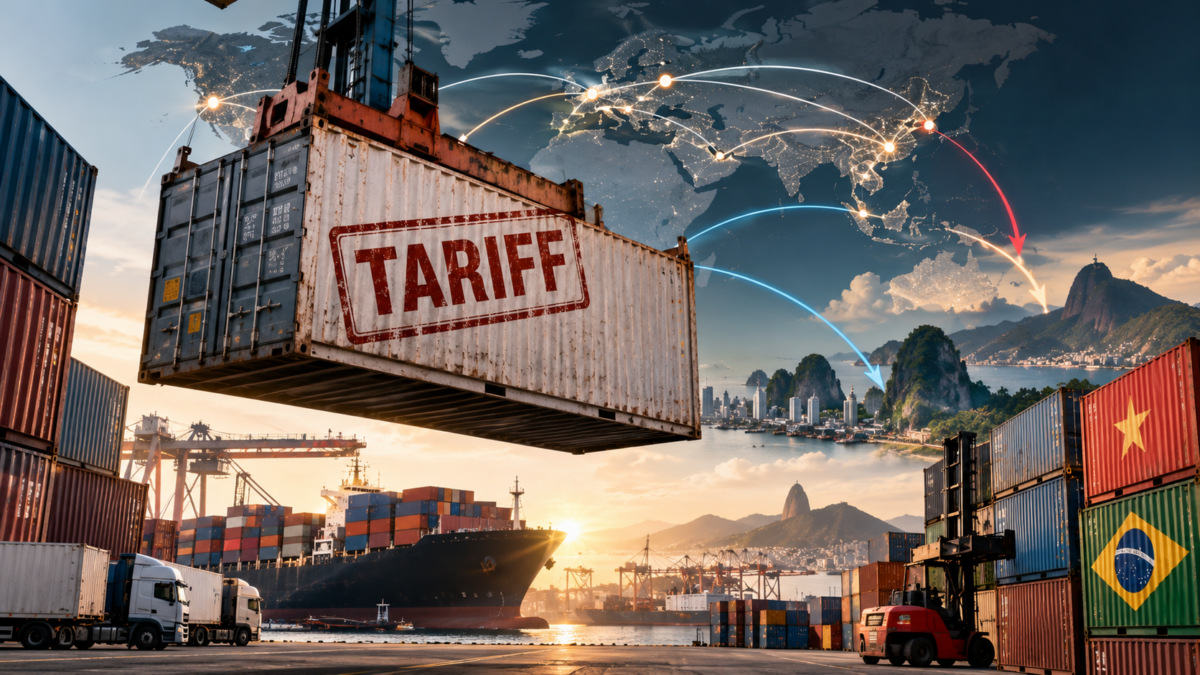
A tariff may be imposed at a country’s border, but its economic consequences rarely stay there.
A manufacturer can absorb part of the cost.
An importer can accept lower margins.
A retailer can raise prices.
A consumer can pay more.
A company can change suppliers.
And thousands of kilometres away, a factory in another country can unexpectedly gain new customers and hire more workers.
Several major economic studies published in 2026 are beginning to show just how widely the effects of modern trade wars spread through the global economy.
One of the most striking findings comes from economists Gita Gopinath and Brent Neiman, who examined the large increase in United States tariffs during 2025.
They found that approximately 92% of the tariff increase passed through into US import prices.
That means foreign exporters did not simply absorb most of the additional cost by cutting their prices.
The United States bore a large share of it.
But that is only the first part of the story.
Other 2026 research shows that earlier US-China tariffs redirected production and employment towards countries such as Vietnam and Brazil.
The broader lesson is surprisingly simple:
A trade war between two countries can change prices, wages, jobs and investment decisions in countries that were never directly involved in the dispute.
A tariff is a tax collected at the border
Tariffs are often described politically as taxes placed on another country.
Economically, that description can be misleading.
When a country imposes a tariff on an imported product, the tariff is normally paid to the importing country’s government by the importer bringing the product across the border.
The more difficult question is who ultimately bears the economic cost.
Suppose an imported machine previously cost $1,000 and a new tariff adds $200.
The foreign manufacturer could reduce its selling price to $800, effectively absorbing the entire tariff.
The importer could instead continue paying $1,000 and accept a lower profit margin.
The importer could raise the price charged to its customer to $1,200.
Or the cost could be divided between all three.
Economists refer to this as the incidence of the tariff.
Knowing the statutory tariff rate therefore tells us surprisingly little about who ultimately pays for it.
The 2025 tariff increase provided an unusually large experiment
Gopinath and Neiman examined what happened after statutory US tariff rates rose sharply during 2025.
According to their study in the Journal of Economic Perspectives, the headline tariff rates reached levels not seen in the United States for more than a century.
But the tariffs written into policy documents were not identical to those actually being collected.
Shipping delays meant that some goods entered the country before new tariffs became effective.
Some products received exemptions.
There were also gaps in enforcement and differences between statutory classifications and actual trade flows.
As a result, the researchers found that implemented tariff rates were only around half as large as the statutory rates.
This significantly reduced the immediate economic effect.
What happened to the tariffs that were actually implemented, however, was revealing.
About 92% passed into US import prices
The researchers estimated that tariff pass-through into US import prices reached approximately 92%.
In practical terms, foreign suppliers generally did not respond to the tariffs by reducing their pre-tariff prices enough to offset the new tax.
The price arriving on the American side of the transaction increased by almost the amount of the tariff.
This does not mean that American consumers personally paid 92% of every tariff.
That distinction is important.
The 92% figure refers to import prices, not final retail prices.
Once the product enters the domestic economy, businesses can still absorb some of that higher cost through margins, pass it to another company or eventually pass it to households.
But the finding does show that the economic burden had largely crossed the border into the importing economy rather than remaining with foreign exporters.
Consumer prices tell another part of the story
Research released by economists Mary Amiti, Sebastian Heise and David Weinstein at the Federal Reserve Bank of New York in August 2026 provides another layer.
They studied how the 2025 tariffs moved from the border through to consumer prices.
Their estimates suggest that about 26% of the tariff increase passed through to consumer prices relative to less-exposed goods.
That effect came through two different channels.
Approximately 64% of the consumer-price effect was direct: imported products became more expensive.
The remaining 36% was indirect.
Tariffs raised the cost of imported materials used by American producers, while domestic companies facing less competition from increasingly expensive imports were also able to increase their mark-ups.
This is one reason tariffs can affect products that were never imported in finished form.
A locally manufactured product can still become more expensive
Modern supply chains make the distinction between a “foreign” and “domestic” product considerably less clear than it first appears.
A car assembled in the United States may contain imported steel, semiconductors, electronics and specialised components.
A European aircraft can contain parts manufactured across dozens of countries.
A smartphone sold by an American company can involve design in one country, chips from another, screens from another and final assembly elsewhere.
A tariff imposed on one stage of that production chain therefore becomes an input cost at another stage.
The New York Fed researchers found that these indirect effects took longer to become visible.
Direct price increases appeared relatively quickly because the tariff immediately raised the cost of imported goods.
Indirect effects through domestic supply chains took approximately nine to twelve months to work their way through the economy.
This delay helps explain why the full inflationary effect of trade policy may not appear immediately after a tariff is announced.
Tariffs can even change the interest rate on a car loan
Another 2026 paper suggests economists may still underestimate these effects if they look only at the sticker price.
Kristine Hankins, Morteza Momeni and David Sovich examined how earlier US tariffs on metals affected the automobile market.
Their study was published in the American Economic Review.
Automobile manufacturers often own financial subsidiaries that provide loans to customers purchasing their vehicles.
This gives a manufacturer two places where it can respond to higher production costs.
It can change the price of the vehicle.
Or it can change the price of financing the vehicle.
The researchers found that customers borrowing from manufacturer-owned lenders received higher interest rates following the metal tariffs compared with borrowers using unaffected independent lenders.
The effect was especially pronounced among lower-income borrowers and in areas where there was less competition between lenders.
The implication is important.
A trade policy can become a credit-market shock.
Looking only at the price printed on the vehicle may therefore understate what the tariff ultimately costs the household.
But the countries imposing tariffs are not the only ones affected
The most interesting global effects may occur elsewhere.
When the United States places a tariff on a Chinese product, American buyers do not necessarily stop importing the product entirely.
They may instead search for another country capable of supplying it.
The same applies when China retaliates against American exports.
This creates what economists call trade diversion.
The two countries involved in the dispute can lose market share while a third country gains it.
Research published in 2026 shows that these effects can become large enough to change employment.
Vietnam unexpectedly gained jobs from the US-China trade war
Lorenzo Rotunno, Sanchari Roy, Anri Sakakibara and Pierre-Louis Vézina examined what happened to Vietnamese firms following the US-China tariff increases of 2018 and 2019.
Their study, published in The World Bank Economic Review in June 2026, used data covering approximately 30,000 Vietnamese firms between 2014 and 2020.
When Chinese goods became more expensive in the United States because of tariffs, Vietnamese companies suddenly had an opportunity to supply some of those products instead.
The researchers found that Vietnam began exporting a wider variety of affected products to the United States.
The employment consequences followed.
Two years after the tariff shock, firms that were highly exposed to the new export opportunities created approximately 5% more jobs than less-exposed firms.
The gains were concentrated in formal employment.
They were also strongest among foreign-owned firms.
Women experienced particularly large employment gains
When the researchers separated employment by gender, the effect became even more interesting.
Female employment at affected firms increased by approximately 8% relative to less-exposed firms two years after the tariff shock.
The results for male employment were less precise.
The jobs created by the trade diversion also tended to be relatively well paid.
In a country where unemployment was already low, the researchers argue that these gains may have represented workers moving from less stable informal work towards more formal employment rather than simply moving from unemployment into employment.
A tariff intended to change the economic relationship between Washington and Beijing had therefore altered labour-market opportunities for workers in Vietnam.
China’s retaliation created jobs in Brazil too
A separate study published in the Journal of International Economics in May 2026 found another example on the opposite side of the world.
Tiago Cavalcanti, Pedro Ogeda and Emanuel Ornelas examined how Brazil responded to the 2018-2019 trade war.
During that period, the average American tariff on Chinese products increased from approximately 2.9% to 24.9%.
China’s average tariff on US products increased from approximately 9.8% to 28.2%.
Brazil was particularly well positioned to benefit from China’s retaliation because many of the products it sold to China were similar to products previously supplied by the United States.
Brazilian regions specialising in industries affected by China’s tariffs subsequently experienced relative increases in formal employment and total wage bills.
The same effect did not appear when the researchers examined US tariffs on Chinese goods.
Brazil was better positioned to replace American exports to China than Chinese exports to the United States.
A trade war therefore creates winners as well as losers
This is where the economics becomes uncomfortable for simple political narratives.
Trade wars can impose substantial costs.
They can raise import prices, disrupt supply chains and reduce welfare.
But those losses are not distributed evenly around the world.
A country that loses access to one supplier may buy from another.
A company whose competitor suddenly faces a 25% tariff can gain a major commercial advantage without changing anything about its own productivity.
Workers in the third country may subsequently receive more jobs and higher wages.
The international economy does not simply shrink when trade barriers rise.
It also reorganises.
This helps explain the rise of “China plus one”
Companies have increasingly tried to avoid concentrating production entirely inside one country.
The strategy is often described as “China plus one”.
A manufacturer may retain significant production in China while adding capacity in Vietnam, India, Mexico or another economy.
Tariffs are not the only reason for this change.
COVID-19 disruptions, geopolitical tensions, shipping problems and concerns about supply-chain resilience have all contributed.
But discriminatory tariffs create a powerful financial incentive.
If an identical component attracts a large tariff when shipped from one country but not another, the location of production becomes part of the company’s tax strategy.
Over time, what begins as an attempt to avoid tariffs can produce real investment, factories and employment elsewhere.
The result may be less globalisation rather than deglobalisation
This distinction matters.
The world is often described as entering an era of deglobalisation.
Some measures certainly show greater fragmentation between major geopolitical blocs.
But the evidence from Vietnam and Brazil demonstrates that a decline in trade between two large countries does not automatically translate into an equivalent decline in world trade.
Some of that trade is rerouted.
New supplier relationships are created.
Production moves.
Goods may even travel through longer and more complicated supply chains than before.
The result can therefore be a different form of globalisation rather than its complete reversal.
There is also an efficiency cost
Trade diversion is not automatically economically efficient.
If a company previously bought a component from the world’s lowest-cost producer and switches to a more expensive supplier purely because of tariffs, resources are being reallocated for political rather than productive reasons.
The new supplier may benefit.
The original supplier loses.
But the global economy may now be producing the same product at a higher real cost.
Businesses may also need to maintain multiple suppliers, duplicate factories or hold additional inventory to reduce political risk.
These strategies improve resilience.
They can also reduce efficiency.
The tension between those two objectives has become one of the defining questions in modern global economics.
Why do tariffs remain politically attractive?
Part of the answer is that their benefits and costs are distributed very differently.
A protected factory is highly visible.
Workers employed there know that the policy may affect their jobs.
A household paying slightly more for hundreds of products experiences the cost much more diffusely.
The same applies internationally.
A new Vietnamese factory created partly because American companies moved sourcing away from China is visible.
The small efficiency loss incorporated into thousands of international transactions is much harder to observe.
Tariffs can also raise government revenue.
Research published in the 2026 Journal of Economic Perspectives estimates that the latest US tariff regime could generate revenue approaching 1% of US GDP.
That makes modern tariffs economically significant not merely as trade policy but increasingly as fiscal policy.
The statutory tariff can also exaggerate the immediate economic shock
There is another lesson from the latest research.
A government announcing a 25% tariff does not necessarily mean the average effective tariff instantly rises by 25 percentage points.
Companies accelerate shipments before implementation.
Some products obtain exemptions.
Trade moves into different tariff classifications.
Suppliers change countries.
Existing inventory can delay price changes.
Gopinath and Neiman’s finding that actual implemented tariff rates were approximately half of statutory rates during the 2025 episode illustrates why economists must study real trade data rather than simply reading policy announcements.
The headline tariff and the tariff experienced by the economy are not always the same thing.
Nor does 92% pass-through mean tariffs always fail
The findings should not be interpreted as proving that tariffs can never achieve strategic objectives.
Governments may impose them for reasons beyond obtaining cheaper consumer goods.
A country may decide that producing semiconductors, medicines, energy equipment or defence technology domestically is worth paying an economic premium for.
Tariffs can also be used in negotiations or as part of wider industrial policy.
The economic question is therefore not whether tariffs produce costs.
They generally do.
The more difficult policy question is whether the strategic benefit is considered large enough to justify those costs and how the costs are distributed.
Economics can measure much of that trade-off.
It cannot decide the political value society should place on national security or strategic independence.
The global economy reacts rather than simply accepts the tariff
Perhaps the clearest message from the 2026 research is that the world economy is adaptive.
A tariff does not hit a static system.
Companies change prices.
Banks change financing terms.
Importers change suppliers.
Factories relocate.
Workers move between sectors.
Countries that were not part of the original dispute gain new export opportunities.
And over several years, the geography of production itself can change.
This is why asking whether the foreign country or the domestic consumer “pays the tariff” ultimately captures only one part of the story.
In the 2025 US episode, approximately 92% of the tariff increase reached US import prices.
Earlier tariffs helped create additional formal jobs in Vietnam and employment gains in parts of Brazil.
Other costs appeared through financing, supply chains and domestic prices.
Trade policy may begin at a customs border.
Its economic consequences do not respect one.
Source Information
Primary Study: The Incidence of Tariffs: Rates and Reality
Authors: Gita Gopinath and Brent Neiman
Journal: Journal of Economic Perspectives
Volume: 40, Issue 3
Published: Summer 2026
Pages: 123–144
Key finding: Approximately 92% tariff pass-through into US import prices during the 2025 tariff episode
DOI: 10.1257/jep.20251486
Supporting Study: Trade Policy and Jobs in Vietnam: The Unintended Consequences of US–China Tariffs
Authors: Lorenzo Rotunno, Sanchari Roy, Anri Sakakibara and Pierre-Louis Vézina
Journal: The World Bank Economic Review
Published: 19 June 2026
Firm dataset: Approximately 30,000 Vietnamese firms, 2014–2020
Key finding: Approximately 5% additional job growth among highly exposed firms two years after the tariff shock, with female employment increasing by around 8%
DOI: 10.1093/wber/lhag011
Supporting Study: The US-China trade war creates jobs (elsewhere)
Authors: Tiago Cavalcanti, Pedro Ogeda and Emanuel Ornelas
Journal: Journal of International Economics
Volume: 161
Published: May 2026
Article: 104249
Finding: Chinese retaliatory tariffs diverted trade towards Brazil and increased formal employment and wage bills in exposed Brazilian regions
DOI: 10.1016/j.jinteco.2026.104249
Supporting Study: Consumer Credit and the Incidence of Tariffs: Evidence from the Auto Industry
Authors: Kristine W. Hankins, Morteza Momeni and David Sovich
Journal: American Economic Review
Volume: 116, Issue 2
Published: February 2026
Pages: 627–673
Finding: Metal tariffs increased borrowing rates through manufacturer-owned automobile lenders, with larger effects among lower-income borrowers
DOI: 10.1257/aer.20230432
Supporting Research: The Anatomy of Tariff Pass-Through into Consumer Prices
Authors: Mary Amiti, Sebastian Heise and David E. Weinstein
Institution: Federal Reserve Bank of New York
Published: August 2026
Staff Report: 1201
Finding: Approximately 26% of the 2025 tariff increase passed through to consumer prices, including both direct import-price effects and indirect effects through domestic producers and supply chains.