





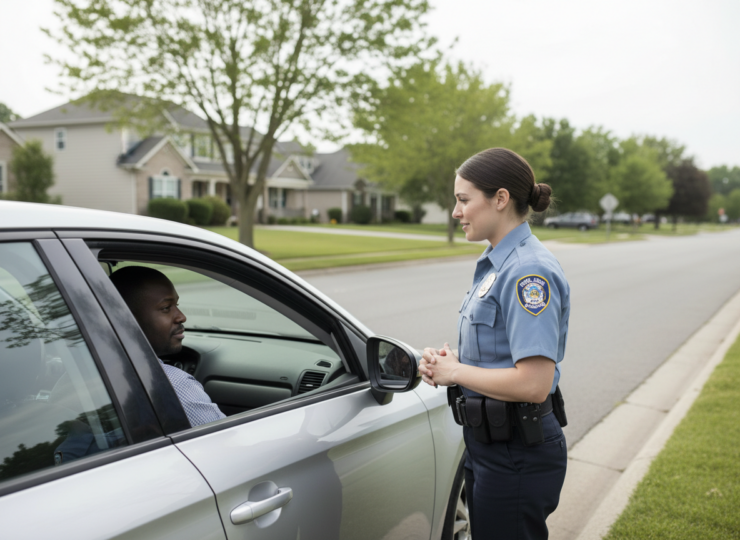


How people judge an encounter with police depends heavily on what the officer does. New experimental evidence suggests that who the citizen is can matter too, but the influence of personality becomes much less visible when police conduct is clearly unjust.
A peer-reviewed study published in the Journal of Experimental Criminology on 28 September 2026 tested how two forms of subclinical narcissism interacted with different styles of police behaviour. In a randomised vignette experiment involving 1,904 adults in the United States, participants evaluated a fictional traffic stop after being assigned to one of five versions of the encounter.
The clearest result was not that personality eclipsed police behaviour. It was the opposite. The experimental manipulation of officer demeanour produced very large differences in how people evaluated the encounter. Participants exposed to procedural injustice gave the encounter an average score of 2.02 on a five-point composite measure, compared with 4.18 under full procedural justice, 4.22 under partial procedural justice and 4.23 when the driver received a favourable instrumental outcome. A business-like neutral encounter sat between these groups at 3.74.
Personality nevertheless added an important layer. Vulnerable narcissism was generally associated with less favourable evaluations, while grandiose narcissism was associated with more favourable evaluations in several positive encounter conditions. Yet under procedural injustice, individual differences mattered comparatively little. The finding suggests that poor police treatment can be so salient that it compresses some of the psychological variation in how citizens respond.
Why procedural justice matters in a traffic stop
Procedural justice refers to fairness in both decision-making and interpersonal treatment. In policing, that includes giving people a voice, explaining decisions, acting neutrally, treating people with dignity and showing trustworthy motives. These principles matter because police encounters are not only enforcement events. They are also moments in which citizens form judgements about whether authority is legitimate and whether cooperation is warranted.
The researchers, Tal Jonathan-Zamir, Gali Perry, Naomi Kaplan-Damary and James J. Willis, asked whether broad personality traits might help explain why two people can experience similar police behaviour yet evaluate it differently. They focused on grandiose and vulnerable narcissism. Both involve heightened sensitivity around self-image and entitlement, but they are psychologically distinct. Grandiose narcissism is more closely associated with self-confidence, status seeking and an inflated self-view. Vulnerable narcissism is more closely associated with insecurity, hypersensitivity to criticism and negative affect.
The study did not examine narcissistic personality disorder. It measured narcissistic tendencies as continuous, subclinical personality traits in a general adult sample. That distinction is important because the findings should not be interpreted as diagnosing participants or suggesting that difficult reactions to police indicate a clinical condition.
A five-condition experiment with 1,904 adults
The experiment was conducted from 3 to 11 November 2025 using Prolific and Qualtrics. From more than 55,000 eligible adult, English-speaking US residents, the researchers obtained a stratified sample designed to resemble the demographic distribution of US adults in age, sex and ethnicity. Two thousand participants successfully completed the study after platform-level exclusions. Following further removal of unusable questionnaires and low-quality responses, 1,904 people remained in the final analytic sample.
Participants were randomly allocated to one of five traffic-stop scenarios. The conditions represented business-like neutral conduct, full procedural justice, partial procedural justice, procedural injustice, or a favourable instrumental outcome. The design allowed the researchers to separate the effect of how the officer behaved from the effect of simply receiving a desirable outcome.
Encounter responses were measured with 12 items covering four related outcomes: perceived legitimacy of the officer, satisfaction with the officer’s handling of the encounter, willingness to obey and willingness to cooperate. A principal component analysis indicated that all 12 items loaded on one factor, so they were averaged into a single encounter-outcomes index ranging from one to five. Across the sample, this index had a mean of 3.70 and a standard deviation of 1.10. Its internal consistency was high, with Cronbach’s alpha of 0.95.
Police conduct produced the largest visible differences
The five experimental conditions generated sharply different evaluations. The favourable-outcome condition produced a mean encounter score of 4.23, partial procedural justice 4.22 and full procedural justice 4.18. The business-like condition averaged 3.74, while procedural injustice fell to 2.02.
A one-way analysis of variance confirmed a strong experimental effect, F(4, 1667) = 569.2, p < 0.001, with eta squared of 0.58. In practical terms, the condition to which participants were assigned accounted for a substantial share of the variation in encounter evaluations. Post hoc comparisons showed that procedural injustice differed significantly from every other condition, while the neutral business-like condition also differed significantly from the others.
There was another revealing result. Full procedural justice, partial procedural justice and the favourable instrumental outcome did not differ significantly from one another in their absolute encounter ratings. This does not mean these approaches are interchangeable. Officers cannot always give citizens the outcome they want, while procedural justice concerns how authority is exercised regardless of the final enforcement decision. It does show, however, that fair treatment produced evaluations comparable with those generated by a favourable outcome in this experimental setting.
Vulnerable and grandiose narcissism moved in opposite directions
When the researchers added the personality measures to their regression models, the two forms of narcissism showed opposite associations. Grandiose narcissism was positively associated with the overall encounter-outcomes index, with an unstandardised coefficient of B = 0.13 and p < 0.001. Vulnerable narcissism was negatively associated with the index, B = -0.15, p < 0.001.
Those overall coefficients conceal meaningful differences across the experimental conditions. Higher vulnerable narcissism was associated with less favourable encounter responses under business-like conduct, partial procedural justice, full procedural justice and the favourable-outcome condition. The association did not follow the same pattern under procedural injustice. In the interaction model, the difference between the vulnerable-narcissism slope under procedural injustice and the business-like reference condition was significant, B = 0.17, p < 0.05.
Grandiose narcissism, meanwhile, was positively associated with encounter outcomes in the three relatively positive conditions: partial procedural justice, full procedural justice and a favourable instrumental outcome. The authors interpret these patterns cautiously. A person high in vulnerable narcissism may be especially sensitive to the unwanted attention, implied criticism and constrained nature of an enforcement encounter, even when the officer behaves fairly. Grandiose traits may interact differently with treatment that communicates respect or produces a desirable result.
Unfair treatment left less room for personality
The procedural-injustice condition is especially important for interpreting the study. It produced by far the lowest average encounter score and relatively little evidence that the measured personality differences changed that judgement. When treatment was clearly poor, participants tended to evaluate the encounter negatively regardless of where they fell on the narcissism measures.
This helps guard against a potentially harmful interpretation of the research. The findings do not support blaming citizens’ personalities for negative police encounters. Officer behaviour had a powerful experimental effect, and procedural injustice was rated poorly across the board. Personality appears to help explain variation in subjective reactions around that behavioural foundation, not to replace the importance of police conduct.
What the findings mean for policing
The study reinforces procedural justice as a useful general standard. Full and partial procedural justice generated more favourable responses than neutral business-like or procedurally unjust conduct. Because police cannot guarantee favourable outcomes, fair process remains one of the elements of an encounter that officers can control.
The personality findings add a practical warning. An officer can behave fairly without receiving an immediately positive response from every citizen. The researchers explicitly reject the idea that officers should try to diagnose personality traits during encounters or tailor treatment on that basis. Instead, they argue that an unfavourable citizen reaction should not automatically be interpreted as evidence that procedural justice has failed.
The results also matter for police performance measurement. Citizen satisfaction surveys are valuable because they capture lived experience, but subjective ratings do not necessarily provide a pure measure of officer behaviour. Evaluations can reflect both what an officer did and characteristics that citizens brought into the encounter. Agencies assessing encounter quality may therefore benefit from combining citizen feedback with direct or observational measures of officer conduct.
Important limitations
The experiment used hypothetical traffic-stop vignettes rather than real police encounters. Random assignment strengthens causal inference about the effect of the scenario conditions, but reading about an encounter is not the same as experiencing the stress, uncertainty and consequences of an actual stop. Behavioural intentions such as willingness to obey or cooperate are also not equivalent to observed behaviour.
The sample was drawn from US adults on Prolific and was stratified on several demographic characteristics, but it should not be treated as a probability sample of every US resident or generalised automatically to other countries. Analytic sample sizes also varied because of item-level missing data.
Finally, the personality measures identify associations within the experimental conditions. Randomisation applied to police demeanour, not to narcissistic traits. The study therefore provides strong evidence that the manipulated encounter style affected evaluations, while claims about why personality traits were associated with those evaluations remain interpretive rather than experimentally established.
A more complete picture of police-public encounters
The study’s broader contribution is to show why police-public encounters should not be understood solely as either officer behaviour or citizen psychology. They are interactions between the two. Fair treatment substantially improved evaluations in the experiment, but people did not respond identically to the same scenarios.
That distinction matters for governance. Procedural justice remains a behavioural standard that institutions can train, monitor and expect from officers. At the same time, immediate public reactions are partly filtered through individual psychology. The fairest conclusion is therefore not that personality excuses poor policing, or that fair policing guarantees approval. It is that institutional behaviour and individual interpretation operate together, and good governance requires keeping those two sources of variation conceptually separate.
Source Information
Study: Personality traits, police demeanor, and encounter outcomes: the roles of grandiose and vulnerable narcissism
Authors: Tal Jonathan-Zamir, Gali Perry, Naomi Kaplan-Damary and James J. Willis
Journal: Journal of Experimental Criminology
Published: 28 September 2026
DOI: 10.1007/s11292-026-09781-1
Study design: Random-allocation five-condition vignette survey experiment involving 1,904 US adults