




Cleaner indoor air may do more than ease the burden on lungs and hearts. A randomized crossover trial involving people living close to major roads found that one month of HEPA filtration sharply reduced particulate pollution inside monitored homes and was associated with faster performance on a test of executive function among participants aged 40 and older.
The result is notable because it comes from an intervention rather than a purely observational comparison. Instead of simply asking whether people exposed to more pollution performed differently, the Home Air Filtration for Traffic-Related Air Pollution trial had the same participants experience both real HEPA filtration and sham filtration at different times. That design allowed each person to serve, in effect, as their own comparison.
A month of cleaner air inside the home
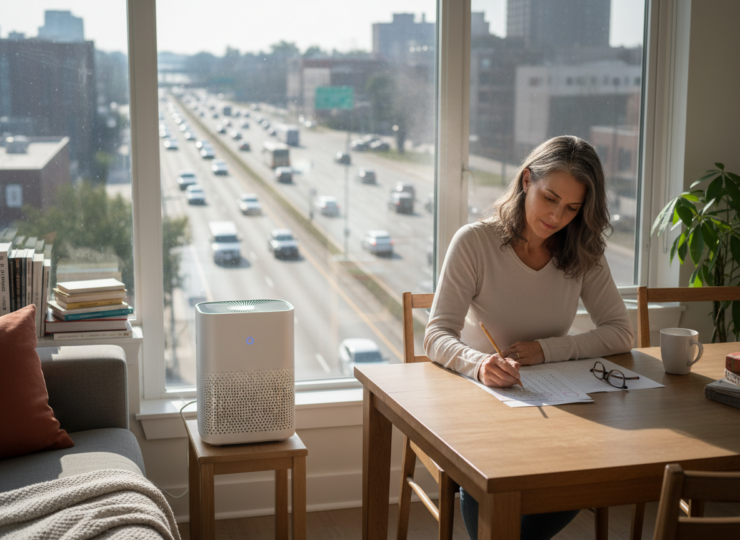
The trial recruited adults aged 30 and older who lived within 200 metres of highways in Somerville, Massachusetts. Participants were enrolled during cooler months between 2020 and 2024, when near-highway concentrations of ultrafine particles tend to be higher. People who smoked or vaped indoors, used antihypertensive medication, had experienced major cardiovascular events, or had substantial traffic-related occupational exposure were excluded.
Homes were randomly assigned, in blinded fashion, to receive either 30 days of HEPA filtration followed by a 30-day washout and then 30 days of sham filtration, or the reverse sequence. Purifiers were placed in both the living room and bedroom and ran almost continuously. The sham units looked like the intervention units but did not provide the same particle filtration.
Among a subset of 19 homes with detailed air monitoring, the environmental effect was substantial. Mean indoor PM2.5 concentrations were 2.5 micrograms per cubic metre during HEPA filtration compared with 5.2 during sham filtration, a 52% reduction. Ultrafine particle concentrations were also 32% lower, averaging 4,706 particles per cubic centimetre under HEPA filtration versus 6,925 under sham conditions.
The cognitive effect depended on age
The cognitive analysis included 119 of the 156 people enrolled in the wider trial who completed the Trail Making Test at all four relevant home visits. Participants completed the assessment in the early morning at the beginning and end of each intervention period.
Part A of the test primarily measures visual scanning and motor speed. Part B is more demanding: participants alternate between numbers and letters in sequence, placing greater demands on executive function and mental flexibility. Faster completion indicates better performance.
Across the full sample, HEPA filtration did not produce a statistically significant improvement in either test component. The more interesting pattern emerged when the researchers examined age as a moderator. The interaction between filtration and age was statistically significant for Part B, with a p-value of 0.02.
Participants aged 40 and older completed Part B in an average of 54.0 seconds after HEPA filtration, compared with 61.4 seconds after sham filtration. That represented a 12% faster completion time, with a ratio of means of 0.88 and a p-value of 0.02. No significant reduction was found among participants younger than 40, and Part A showed no significant benefit in either age group.
The distinction matters. The study does not support the broad claim that an air purifier makes everyone cognitively sharper. Instead, the observed benefit was specific to a more complex executive-function task and to the older half of this relatively young-to-middle-aged sample.
Why the crossover design strengthens the evidence
The researchers analysed completion times using over-dispersed Poisson regression. Models accounted for intervention sequence and period, baseline test performance, time spent at home, perceived stress and outdoor temperature. Because every participant received both the HEPA and sham conditions, stable personal characteristics that often complicate comparisons between different groups were substantially reduced as a source of confounding.
The design also exposed an important complication: practice. Among 67 participants who received sham filtration before HEPA, completion times improved across the first three tests even before the real filtration period could explain the change. Mean Part B times fell from 70.0 to 62.4 and then 57.8 seconds. This confirmed a learning effect from repeating the task.
Randomising the order of real and sham filtration helps protect the main comparison from that practice effect, but it remains an important limitation when interpreting repeated cognitive testing. The researchers also noted that the trial manager administering the tests knew which filtration condition was being used, although participants themselves were blinded and the task was objectively timed.
A plausible signal, not proof of long-term brain protection
Particulate air pollution has been associated in previous research with neurological outcomes and with changes affecting brain white matter. The frontal and temporal regions implicated in some of that work are important for the mental flexibility and executive control assessed by Trail Making Test Part B. The present trial is therefore consistent with a biologically plausible pathway, but it did not measure brain structure or establish the mechanism behind the observed performance difference.
It is also important not to turn the age split into a universal threshold. The decision to examine participants below 40 versus those aged 40 and older was a post-hoc analysis informed by previous literature, rather than the trial’s original primary hypothesis. The cognitive assessment itself was a secondary outcome of a study whose primary aim concerned blood pressure.
The analysed group had a mean age of 40.8 years, and very few participants were over 60. The findings therefore cannot tell us whether the same effect would be larger, smaller or absent in elderly people or in those with cognitive impairment. Thirty-seven enrolled participants also lacked complete cognitive data, including 11 who opted not to complete the test and tended to be older and less educated than those retained in the analysis.
What the result means in practice
The strongest finding may be the simplest one: portable filtration materially changed what people were breathing inside their homes. Cutting measured PM2.5 by roughly half and ultrafine particles by nearly a third demonstrates that the intervention successfully altered exposure in a real residential setting near busy roads.
The cognitive result adds a potentially important signal. A 7.4-second difference on Part B among participants aged 40 and older emerged after only one month, but it should be viewed as evidence for further testing rather than a prescription. The study did not establish whether the improvement persists, whether longer filtration produces additional benefit, or whether similar effects occur in homes with different pollution profiles.
For cities where road traffic is a major source of fine and ultrafine particles, the trial also illustrates the difference between reducing exposure and eliminating the source. Indoor filtration can lower the amount of pollution reaching residents, but it does not replace broader measures that reduce emissions outdoors. What it does offer researchers is a practical way to test whether changing exposure over relatively short periods can produce measurable health or cognitive effects.
For now, the evidence is appropriately narrow: HEPA filtration substantially lowered indoor particle concentrations, and adults aged 40 and older performed faster on one executive-function measure after the real filtration period than after sham filtration. Whether that short-term improvement translates into meaningful long-term cognitive protection remains unanswered.
Source Information
Study title: Effect of HEPA filtration air purifiers on cognitive function from a secondary outcome analysis of a pragmatic randomized crossover trial
Authors: Nicholas Pellegrino, Misha Eliasziw, Richard Fortinsky, Hunter Gates and Doug Brugge
Journal: Scientific Reports
Year: 2026
DOI: 10.1038/s41598-026-48063-8