




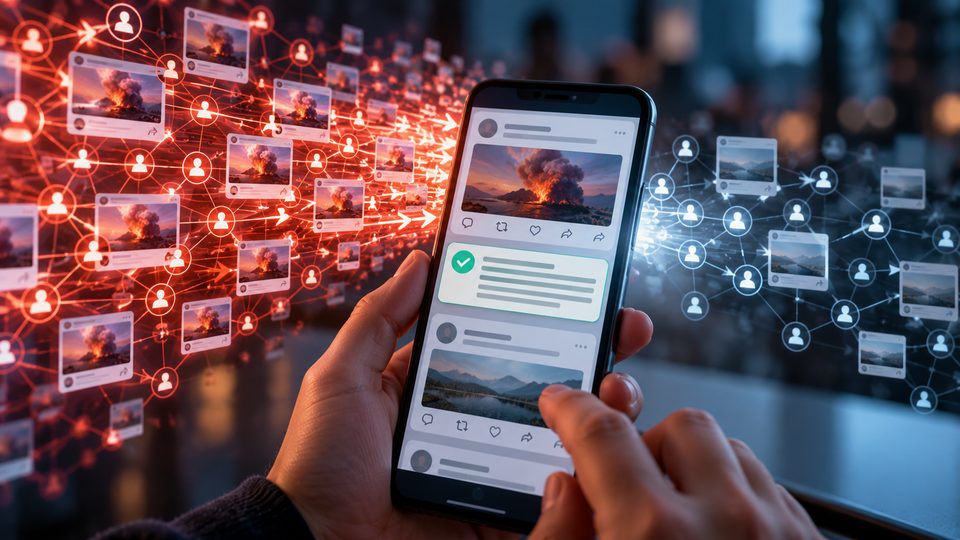





Smartphones in classrooms are often framed as a simple choice between useful learning technology and an irresistible distraction. A year-long study of Chinese high school students suggests the reality is more dynamic: the same positive attitude that makes students receptive to smartphones as learning tools can also be associated with greater digital distraction later.
The strongest pattern was not that liking technology directly improved or damaged engagement. Instead, digital distraction emerged as the key pathway. Students who reported more distraction at one measurement point tended to show lower academic engagement six months later, while students who were already more engaged became slightly less vulnerable to later distraction.
Published in Frontiers in Psychology on 16 September 2026, the research followed 1,020 students across three waves. It offers a useful challenge to policies that treat classroom smartphones as inherently good or bad, because the evidence points toward behaviour and self-regulation as important parts of what happens after a device enters the learning environment.
Following students across three school terms
Xiaogang Li and Liping Chen began with 1,200 students from three public secondary schools in eastern China. By the third wave, 1,020 remained in the study, giving an 85% retention rate. The final sample included 521 males and 499 females, with a mean age of 17.85 years.
The students were in Grades 10 to 12, and every participant owned a smartphone and carried it to school daily. Data were collected in September 2023, March 2024 and September 2024, creating two six-month intervals over which the researchers could examine whether earlier attitudes and behaviours predicted later ones.
Rather than measuring only screen time, the study assessed three related constructs: acceptance of technology, classroom digital distraction and academic engagement. Digital distraction was measured with a 15-item scale covering social-media distraction, gaming and entertainment, and study-related digital interference.
The researchers then used cross-lagged panel models to test the direction of relationships across time. They also used 5,000 bootstrap repetitions to examine whether digital distraction statistically mediated the relationship between technology acceptance and later engagement.
This design is stronger than a one-time survey for examining temporal ordering. It can show whether one variable predicts another at a later wave after accounting for earlier levels. It does not, however, turn an observational survey into a randomised experiment, so the results should not be read as definitive proof that one behaviour causes another.
Distraction was the strongest negative predictor
Across the two six-month intervals, technology acceptance predicted a small increase in later digital distraction. The standardised coefficient was β = 0.14 from the first to second wave and β = 0.12 from the second to third, with both relationships statistically significant.
That result is important because technology acceptance is normally treated as desirable. Students who see smartphones as useful, easy or valuable learning tools may be more willing to use them, but greater access and use also create more opportunities for attention to drift away from the lesson.
Digital distraction, in turn, predicted lower subsequent academic engagement. The coefficients were β = -0.23 from the first to second wave and β = -0.25 from the second to third, both at p < 0.001. These were the strongest cross-lagged relationships in the three-variable model.
The pattern also ran in the opposite direction, although more weakly. Higher academic engagement predicted slightly lower later digital distraction, with coefficients of β = -0.08 and β = -0.09 across the two intervals.
Engaged students also developed more positive technology attitudes over time. Academic engagement predicted later technology acceptance at β = 0.18 and β = 0.20. This matters because it complicates the idea that enthusiasm for technology must come first and engagement follows automatically.
Technology acceptance did not directly translate into engagement
The researchers’ mediation analysis provides the clearest picture of the proposed mechanism. Technology acceptance at the first wave was associated with lower engagement at the third wave indirectly through greater digital distraction at the second wave. The indirect effect was β = -0.032, with a 95% confidence interval from -0.059 to -0.013.
By contrast, the direct path from early technology acceptance to later academic engagement was not statistically significant. In practical terms, seeing smartphones as useful did not itself guarantee that students became more engaged with schoolwork.
The researchers describe digital distraction as a gatekeeper between technological attitudes and learning behaviour. That interpretation fits the observed pattern: positive views of smartphones may encourage use, but whether that use supports learning depends partly on whether students can keep non-learning interruptions under control.
The effect sizes also call for proportion. The acceptance-to-distraction paths were small, while the distraction-to-engagement paths approached a medium magnitude under the benchmarks discussed by the authors. Smartphones were therefore not portrayed as overwhelming determinants of student behaviour, but distraction showed a consistent relationship worth taking seriously.
Why blanket phone policies may miss the mechanism
The findings do not establish that schools should freely allow smartphones, nor do they demonstrate that bans are ineffective. Instead, they suggest that device policy and students’ ability to regulate attention are separate questions.
A school can introduce a device for legitimate educational purposes while still creating conditions in which notifications, entertainment and social media compete with the lesson. Conversely, students who are strongly engaged may be better able to resist those competing cues and use the same technology more deliberately.
This distinction has relevance beyond the three Chinese schools studied. Many education systems are reconsidering classroom smartphone rules, often through a binary debate over access versus prohibition. The longitudinal results suggest another policy layer: schools that permit educational smartphone use may also need explicit structures around when devices are used, which functions are appropriate and how students learn to manage interruptions.
For teachers, that could mean treating digital self-regulation as a learning skill rather than assuming students acquire it simply by growing up with phones. For researchers, the findings strengthen the case for studying not only whether a device is present, but how students move between academic and non-academic uses during lessons.
Important limits to what the study can show
The study has several constraints. Its participants came from three public secondary schools in eastern China, so cultural expectations, school rules and patterns of smartphone use may differ elsewhere. The findings should not automatically be generalised to younger pupils, university students or classrooms in other countries.
The core variables were also measured through questionnaires. Although the scales showed good reliability and the longitudinal design adds temporal information, self-reported distraction is not the same as directly observing every notification, app switch or lapse in attention.
Cross-lagged panel models can identify predictive relationships over time, but unmeasured factors may still influence both distraction and engagement. The authors themselves note methodological limitations around conventional cross-lagged models, which can mix stable differences between students with changes occurring within individual students.
The most defensible conclusion is therefore narrower than saying smartphones cause poor engagement. Across this sample and timeframe, students’ digital distraction consistently predicted lower later engagement, while engagement predicted somewhat lower future distraction. Positive attitudes toward technology mattered largely through what students subsequently did with it.
The classroom question is becoming behavioural
The study moves the smartphone debate away from the device alone. A phone can provide access to information, educational platforms and communication while simultaneously carrying social and entertainment cues designed to capture attention.
What determines its classroom value may therefore be less about whether students like technology and more about whether the learning environment helps them use it deliberately. In this dataset, digital distraction was the point at which positive technology attitudes could turn into weaker later engagement.
That does not settle the argument over classroom phones. It does, however, sharpen the question schools need to answer: not simply whether smartphones belong in class, but what conditions allow their educational functions to operate without their competing functions taking over.
Source Information
Study Title: Smartphones in the classroom: power tool or source of distraction? Evidence from a cross-lagged panel study
Authors: Xiaogang Li and Liping Chen
Journal: Frontiers in Psychology
Published: 16 September 2026
DOI: 10.3389/fpsyg.2026.1831165
Study design: Three-wave longitudinal survey with six-month intervals and cross-lagged panel modelling
Final sample: 1,020 high school students from three public secondary schools in eastern China