








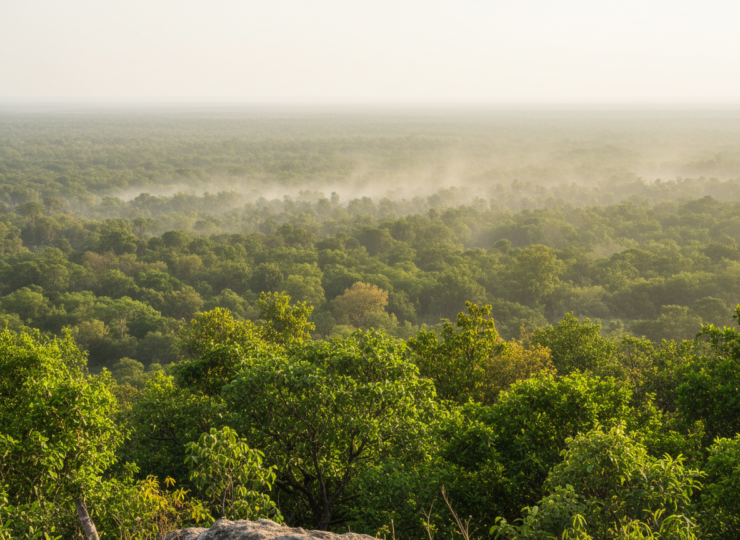
A forest can look productive and still be becoming more fragile. That is the warning emerging from a global analysis of two decades of satellite observations, which found that more than one-third of the world’s forests simultaneously increased their plant productivity while losing resilience.
The apparent contradiction matters because forest health is often judged through visible growth and carbon uptake. If trees and canopies continue to photosynthesise strongly, an ecosystem can appear to be coping with a warmer climate. But productivity says little about how readily that same ecosystem can recover after drought, heat or other disturbance.
Research published in Communications Earth & Environment on 10 September 2026 suggests that atmospheric drying is helping separate these two dimensions of forest performance. Rising vapour pressure deficit, a measure of how strongly the atmosphere draws moisture from vegetation, emerged as the primary driver of resilience loss across the global analysis.
Twenty years of forests observed from space
Peiqing Jing, Zhenfeng Shao and an international team combined multiple remote-sensing datasets covering global forests from 2001 to 2021. Their aim was not simply to ask whether forests were becoming greener or more productive, but whether the internal relationships that support carbon uptake, water use and recovery from disturbance were changing at the same time.
The researchers tracked gross primary productivity, which represents the carbon fixed by vegetation through photosynthesis, alongside satellite-derived indicators of ecosystem resilience. They also examined ecosystem photosynthetic efficiency and water-use efficiency, allowing them to test how tightly these functions moved together under changing moisture conditions.
Resilience was inferred from the behaviour of vegetation through time. The analysis used lag-1 autocorrelation of a satellite vegetation index within moving 60-month windows. In this framework, a system that increasingly retains the influence of previous disturbances is interpreted as recovering more slowly, a statistical warning signal of declining resilience.
The team then examined environmental drivers including atmospheric vapour pressure deficit and soil moisture, and used structural equation modelling to separate direct effects of water stress from pathways operating through resilience. Robustness checks included alternative soil-moisture products and deseasonalised measures of functional coupling.
Productivity and resilience are moving in opposite directions
The most striking result was the geographic scale of the divergence. More than one-third of global forest area showed increasing gross primary productivity at the same time as declining resilience between 2001 and 2021.
This means that stronger carbon uptake cannot automatically be read as evidence of improving forest condition. A forest may continue to accumulate carbon efficiently under ordinary conditions while becoming progressively less capable of returning to its previous state after environmental shocks.
Atmospheric aridity stood out as the principal pressure associated with the loss of resilience. Vapour pressure deficit rises when the air becomes warmer or drier relative to the moisture it can hold. Higher values increase the atmospheric demand for water and can force plants to regulate water loss more aggressively.
The physiological response can create a misleading signal. Under elevated atmospheric dryness, trees close their stomata to limit transpiration. Because water-use efficiency is commonly expressed as carbon gained relative to water lost, suppressing variation in water loss can make productivity and water-use efficiency appear more tightly coupled even when the underlying system is under greater stress.
A tighter relationship did not necessarily mean a healthier forest
Across tropical and boreal forests, higher vapour pressure deficit directly strengthened the statistical covariation between gross primary productivity and water-use efficiency. At first glance, that could look like improved coordination between carbon uptake and water use.
The researchers caution against that interpretation. The tighter relationship was consistent with stomatal constraint compressing variation in transpiration. In other words, the forest’s water-saving response can mechanically cause water-use efficiency to track productivity more closely without indicating that the ecosystem has become better at balancing carbon and water.
A different pathway appeared in boreal forests. There, atmospheric dryness was linked to resilience loss, which in turn weakened the relationship between gross primary productivity and ecosystem photosynthetic efficiency. In the structural equation model for boreal forests, vapour pressure deficit was associated with resilience loss with a path coefficient of 0.20, while resilience loss was associated with weaker productivity-to-photosynthetic-efficiency coupling with a coefficient of -0.16. Both paths were statistically significant at p < 0.01.
This helps explain how a forest can maintain or increase overall productivity while the coordination among its core functions deteriorates. Carbon uptake can remain high for a period even as the ecosystem’s capacity to absorb disturbance quietly erodes.
Disturbed forests were substantially more vulnerable
Forest condition also changed the strength of the response. Non-intact forests were approximately twice as sensitive to resilience loss as intact forests, indicating that structural simplification and previous disturbance can amplify vulnerability to atmospheric drying.
In intact forests, rising vapour pressure deficit weakened the coupling between productivity and water-use efficiency rather than strengthening it. The contrast suggests that forest structure and integrity shape how ecosystems reorganise under the same broad climatic pressure.
This distinction is important for conservation because climate exposure is only part of the risk equation. Logging, fragmentation and other forms of disturbance may leave forests with less structural and functional diversity available to buffer increasingly dry atmospheric conditions.
Why the finding matters for carbon sinks
Forests are central to the terrestrial carbon cycle, and climate assessments often pay close attention to trends in productivity and carbon storage. The new analysis shows why those measures should not stand alone.
A productive but less resilient forest may continue to function as a carbon sink until a sufficiently severe disturbance pushes it beyond its capacity to recover. If resilience has already been declining, the historical record of strong productivity may overstate how dependable that carbon sink will be under future heat and water stress.
That does not mean the study demonstrates an imminent collapse of more than one-third of the world’s forests. Resilience here is statistically inferred from satellite time series, and the observed divergence is a warning about changing ecosystem dynamics rather than a forecast that every affected forest will cross a tipping point.
The practical implication is instead that monitoring systems need to capture both output and stability. Gross primary productivity can tell researchers how much carbon vegetation is fixing. Resilience indicators can provide a different signal about how reliably that function may persist when conditions become more volatile.
A relevant warning for southern Africa
The study was global rather than designed around a single country, so its results should not be converted directly into a South African forest forecast. Even so, atmospheric water demand is a particularly relevant variable for regions where ecosystems already experience strong seasonal moisture constraints.
Southern African forest and woodland management therefore has reason to distinguish between short-term greenness or productivity and longer-term ecological stability. Restoration, fire management, fragmentation and the protection of intact vegetation may influence how strongly climate-driven atmospheric drying translates into resilience loss.
One of the paper’s co-authors is affiliated with the University of the Witwatersrand, but the evidence itself comes from a global remote-sensing analysis. Its value locally lies in the broader monitoring lesson: ecosystems can maintain apparently strong performance while becoming more sensitive underneath.
Remote sensing has limits
The study’s global coverage is a major strength, but it also brings important limitations. Satellite indicators necessarily simplify complex forest processes, and statistical resilience metrics do not directly measure every biological mechanism that determines whether individual forests recover from drought, fire or heat.
The structural equation models help distinguish plausible pathways, but observational data cannot establish causality with the certainty of a controlled experiment. Local factors such as species composition, stand age, soil properties, management history and disturbance regimes can modify the relationships seen at global scale.
The authors addressed some uncertainty through sensitivity analyses, including different soil-moisture datasets and alternative treatment of seasonal patterns. The broad conclusion nevertheless remains a population-level pattern across remotely sensed forests, not a diagnosis for every individual forest pixel.
A forest can grow while its safety margin shrinks
The central finding challenges a comforting assumption about ecosystem performance. More growth is not necessarily the same thing as more security.
Across two decades of observations, a substantial share of the world’s forests became more productive while simultaneously showing signs of slower recovery. Atmospheric drying was the dominant pressure associated with that loss of resilience, and previously disturbed forests appeared considerably more sensitive.
For climate monitoring, the implication is straightforward: measuring what forests produce today is not enough. Understanding whether they can continue producing it after tomorrow’s disturbance may be just as important.
Source Information
Study Title: Atmospheric aridity drives functional reorganisation and resilience loss in global forests
Authors: Peiqing Jing, Zhenfeng Shao, Deren Li and colleagues
Journal: Communications Earth & Environment
Published: 10 September 2026
DOI: 10.1038/s43247-026-04040-7
Study period: 2001 to 2021
Study design: Global multi-source remote-sensing analysis with resilience estimation, functional-coupling analysis and structural equation modelling