









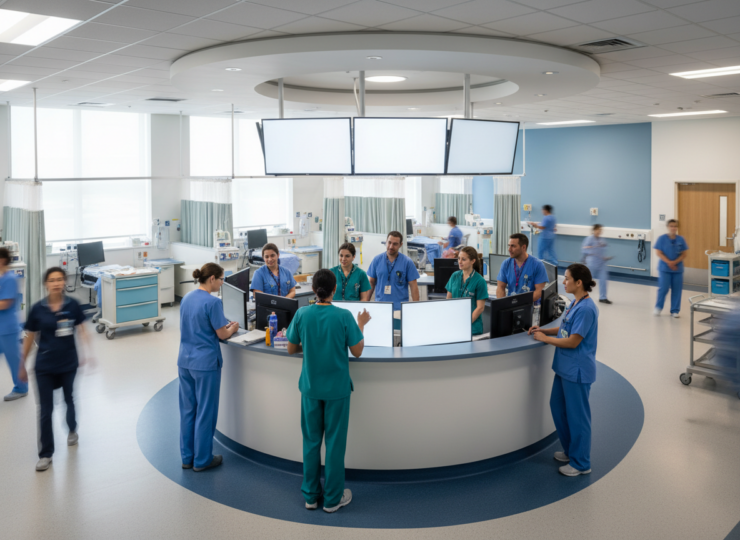
Emergency departments constantly balance two pressures that are difficult to reconcile: patients need timely care, while hospitals operate with finite staff, rooms, beds and budgets. A new modelling study suggests that smarter scheduling can make that trade-off more explicit. Using a year of real hospital data, researchers found that an optimisation system could substantially reduce simulated waiting times and staff overtime, although those gains came with higher overall labour expenditure.
The study, published on 1 October 2026 in Scientific Reports, developed a multi-objective scheduling framework based on simulated annealing, a computational optimisation technique designed to search large sets of possible solutions. Rather than optimising a single outcome, the model simultaneously considered patient waiting time and labour cost while respecting clinical constraints such as triage priority and maximum acceptable waiting periods.
Why emergency department scheduling is difficult
Emergency care is unusually challenging to schedule because demand varies across hours and days, patients arrive with different levels of urgency, and several resources must be coordinated at once. Adding a doctor does not necessarily solve a bottleneck if consultation rooms or beds remain unavailable. Likewise, minimising staffing expenditure can increase queues if the schedule becomes too lean during periods of high demand.
The researchers therefore treated emergency department scheduling as a multi-resource problem. Their framework discretised operating time into scheduling slots and incorporated doctors, consultation rooms and beds. It also imposed triage-priority and maximum-wait constraints, meaning that a mathematically efficient schedule could not simply postpone urgent patients to improve an average performance measure.
To search the large number of possible schedules, the study used simulated annealing. The method explores alternative solutions while retaining a controlled probability of temporarily accepting a worse solution. This helps the search avoid becoming trapped too early in a locally attractive schedule that may be inferior to options elsewhere in the solution space.
A model calibrated with a full year of hospital data
The analysis used annual 2023 data from a tertiary hospital. The researchers designed scheduling operations that reflected plausible clinical adjustments, including exchanging patient assignments, reallocating patients across doctors and fine-tuning staff shifts. They then tested the resulting framework under weekday, peak-day and night-shift scenarios.
This distinction matters because a schedule that performs well during ordinary daytime demand may fail during a surge or overnight period. The study therefore assessed whether the optimisation approach maintained useful performance across different operating conditions rather than reporting only one favourable scenario.
The objective function placed weight on waiting time and labour expenditure. Resource use, patient priority and waiting thresholds acted as practical constraints. In effect, the model asked how doctors and other resources could be arranged to improve timeliness without ignoring the financial consequences of doing so.
Waiting times fell by 20% to 35%
Compared with the hospital’s current scheduling system, the simulated annealing schedules reduced average waiting time by between 20% and 35%, depending on the scenario. The proportion of cases violating the specified waiting-time threshold also fell sharply, from 26.7% under the existing system to 14.2% after optimisation.
That represents a 46.8% relative reduction in the threshold-violation rate. This measure is important because averages can conceal poor experiences at the tail of a waiting-time distribution. A system could lower the mean wait while leaving a smaller group of patients waiting unacceptably long. The threshold result indicates that the simulated improvement extended beyond the average alone.
The optimisation also produced more balanced resource utilisation across weekday, peak-day and night-shift conditions. This suggests that the model was not simply shifting pressure from one resource to another. Instead, it attempted to coordinate several constrained resources within the same scheduling framework.
Less overtime, but higher total labour spending
The largest practical trade-off appeared in staffing costs. Overtime hours decreased by 29.7%, while overtime cost fell by 30.2%. Those figures suggest that a better-planned schedule could reduce dependence on reactive overtime and distribute workload more predictably.
However, the improvement was not cost-free. Total daily labour cost increased by 11.4%, from CNY 31,680 under the comparison schedule to CNY 35,280 after optimisation. Labour cost per patient visit similarly rose by 10.6%, from CNY 102.3 to CNY 113.1.
This is one of the study’s most policy-relevant findings. The model did not discover a way to simultaneously minimise every undesirable outcome. Instead, it quantified what hospitals might have to spend to obtain shorter waits, fewer threshold breaches and lower overtime. For administrators, that is potentially more useful than an optimisation result that improves performance only by assuming additional resources have no cost.
What the findings mean for hospital management
The results support the idea that emergency department performance is partly a coordination problem rather than simply a question of absolute resource scarcity. When several resources must be available in sequence, mismatched schedules can create queues even when individual resources appear adequately supplied. Computational scheduling can help identify combinations that are difficult to find manually.
At the same time, the cost results prevent an overly simple interpretation. A 20% to 35% reduction in simulated waiting time may be attractive, but decision-makers still need to determine whether the associated 11.4% increase in daily labour expenditure is justified by local clinical priorities, budgets and patient volumes. Different hospitals could reasonably make different choices.
The fall in overtime is also noteworthy from a workforce perspective. Overtime can be expensive and can contribute to fatigue when it becomes routine. The model’s combination of higher scheduled labour spending and lower overtime suggests a shift from reactive staffing toward more deliberate capacity allocation. Whether that translates into better staff well-being or clinical outcomes was not tested in this study.
Important limitations remain
The study should not be read as evidence that the proposed system has already improved care in a functioning emergency department. Its results came from an in-silico evaluation calibrated using data from one tertiary hospital. The optimisation was not prospectively deployed, and real clinical environments contain disruptions, behavioural responses and implementation constraints that simulations may not fully capture.
The single-centre design also limits generalisability. Emergency departments differ in patient mix, staffing models, wage structures, bed capacity, triage systems and patterns of demand. A schedule that produces a favourable trade-off in one hospital may require substantial recalibration elsewhere.
In addition, the reported cost increase is inseparable from the assumptions built into the model. Labour prices, waiting-time weights and operational constraints determine which solutions appear attractive. Prospective multi-centre testing would therefore be needed before the approach could be considered operationally validated.
Even with these limitations, the research demonstrates the value of presenting hospital scheduling as a measurable trade-off. The strongest result is not that an algorithm can make waiting disappear. It is that a model calibrated to real hospital data can estimate how much timeliness and workload improvements may cost, giving managers a more transparent basis for deciding which combination of efficiency, staffing and patient access they are willing to fund.
Source Information
Study: Song, Z. “Research on multi-objective scheduling optimization of emergency resources based on simulated annealing algorithm.” Scientific Reports (2026).
Published: 1 October 2026
DOI: 10.1038/s41598-026-72989-8