







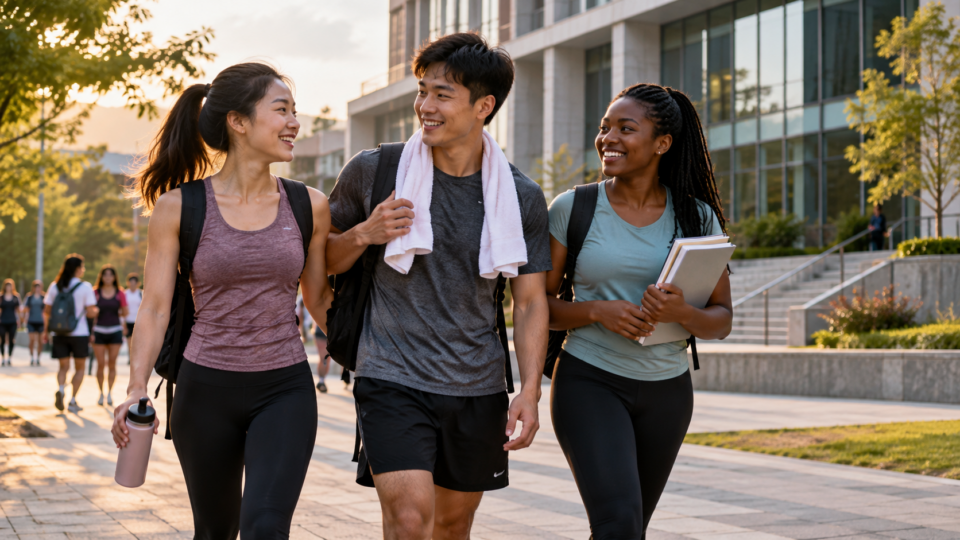
University students are often encouraged to treat exercise and academic work as competing demands on the same limited schedule. A large study of Chinese undergraduates points to a more complicated relationship: students who reported more physical exercise also tended to report stronger academic achievement, while social support and psychological resilience helped explain how those advantages were connected.
The research, published in Scientific Reports on 1 October 2026, analysed 950 valid questionnaires from undergraduate students across multiple Chinese universities. Rather than looking only for a simple exercise-to-grades relationship, the researchers tested a chain in which physical exercise was associated with social support, social support with psychological resilience, and resilience with academic achievement.
That distinction matters. Exercise can affect students through several routes at once. It may support cognitive functioning and stress regulation, but organised sport and regular physical activity can also create social contact, routines and opportunities to cope with challenge. The study therefore combined social support theory, conservation of resources theory and the theory of planned behaviour to examine these pathways together.
A large student sample and two analytical approaches
Researchers distributed 976 electronic questionnaires between September and December 2025 and retained 950 after excluding responses that were unusually fast, highly patterned or substantially incomplete. The sample was stratified across eastern, central and western China, different types of universities and all four undergraduate years.
The final group was reasonably balanced by academic year and gender. Women made up 52.3% of respondents and men 47.7%. Science and engineering students accounted for 40.6% of the sample, followed by humanities and social sciences at 24.8% and medical sciences at 24.6%.
Exercise, perceived social support, psychological resilience, academic achievement and time-management ability were measured using established or adapted scales. Importantly, academic achievement was based on students’ subjective assessment and satisfaction with their academic performance rather than a common objective GPA measure. The authors argued that this allowed comparison across universities with different grading systems, but it also limits what can be inferred about actual marks.
The analysis proceeded in two stages. Partial least squares structural equation modelling, or PLS-SEM, was used to estimate the relationships among the variables, including mediation and moderation. Significance testing used 5,000 bootstrap resamples. The researchers then built artificial neural networks as a second analytical check, using ten-fold cross-validation to assess whether the relative importance of the predictors remained similar when nonlinear relationships could be captured.
Exercise had both direct and indirect links to achievement
The structural model found a statistically significant positive association between physical exercise and academic achievement, with a standardised coefficient of 0.156. Exercise had an even stronger relationship with perceived social support, at 0.241, while its direct association with psychological resilience was 0.137.
Resilience stood out as the strongest direct predictor of academic achievement among the variables in the model. Its coefficient was 0.195, compared with 0.156 for exercise and 0.102 for social support. Social support was also positively associated with resilience, with a coefficient of 0.166.
The results therefore did not reduce the relationship to the idea that exercising students simply perform better academically. Several statistically significant indirect paths were identified. Exercise was associated with achievement through social support alone and through resilience alone. The full serial pathway from exercise to social support, then resilience and finally academic achievement was also significant, although its standardised indirect effect was relatively small at 0.008.
The model explained 24.3% of the variation in academic achievement, 22.7% of the variation in psychological resilience and 17.0% of the variation in social support. Individual effect sizes were mostly small, which is important context for interpreting statistically significant results from a sample of this size.
Resilience emerged as the strongest academic predictor
The neural-network analysis broadly reinforced the structural model. In the network predicting academic achievement, psychological resilience had the highest normalised importance at 64.58%. Physical exercise followed at 44.95%, while social support registered 25.55%.
The training and test errors were also close. For the academic-achievement model, mean root mean square error was 0.238 in training and 0.239 in testing. That similarity gave the researchers greater confidence that the network was not simply fitting idiosyncrasies in the training data.
The convergence between the two methods is useful, but it should not be mistaken for causal evidence. Both techniques analysed the same cross-sectional survey. They can show that the variables form a consistent predictive pattern, but they cannot establish that increasing a student’s exercise will necessarily cause resilience or academic performance to improve.
Time management changed some relationships, but not all
The researchers also examined whether time-management ability altered the strength of the relationships in the model. Four of six tested moderation effects were statistically significant.
Stronger time management amplified the associations between exercise and social support, exercise and resilience, social support and resilience, and social support and academic achievement. The interaction coefficient for exercise and social support was 0.140, while the exercise-to-resilience interaction was 0.118.
By contrast, time management did not significantly alter the direct exercise-to-achievement relationship, where the interaction had a p-value of 0.075. Nor did it significantly moderate the resilience-to-achievement relationship, with a p-value of 0.867.
This pattern suggests that time management may matter more for converting activities and relationships into usable social and psychological resources than for every final academic outcome. It is an interesting distinction for universities because it argues against treating time management as a universal explanation for why some students benefit more from exercise than others.
What universities can take from the findings
The practical implication is not that universities should replace study time with compulsory exercise. The evidence instead challenges a rigid separation between academic development, physical activity and student support.
Team sport, clubs and accessible physical-activity programmes may provide more than fitness opportunities if they also create social networks and manageable experiences of challenge. The study’s strongest exercise pathway was its association with social support, while resilience was the strongest predictor of academic achievement in both the structural model and neural-network ranking.
That could be relevant to institutions deciding how to allocate resources across sport, student wellbeing and academic-support programmes. It also suggests that the value of campus physical activity may be underestimated when success is judged only through fitness outcomes.
For South African universities, the finding is better treated as a hypothesis worth testing locally than as a ready-made intervention. Campus environments, access to facilities, transport, socioeconomic conditions and patterns of student support differ substantially from those in the Chinese sample. A local longitudinal or experimental study using objective activity measures and academic records would provide much stronger evidence for policy.
The limitations are substantial
The study’s design places clear boundaries around its conclusions. All major variables were self-reported, including exercise and academic achievement. Students who see themselves positively in one area may also rate themselves positively in another, even though the authors’ statistical checks did not identify a dominant common-method factor.
The data were collected at one point in time. As a result, the direction of the relationships remains uncertain. Stronger students may exercise more, resilient students may be more likely to maintain exercise routines, or other unmeasured factors may influence all three.
The sample was also limited to Chinese universities, and the exercise measure did not isolate the effects of particular activities, intensities or frequencies. The authors recommend longitudinal research, wearable measures of physical activity and objective academic indicators such as GPA in future work.
What the study does provide is a detailed picture of how physical activity, social relationships and psychological resources cluster around students’ perceptions of academic success. The strongest signal was not exercise on its own. It was resilience, embedded in a wider chain of exercise, social support and self-management. That makes the research less a claim that sport automatically raises grades and more an argument that academic performance is connected to a broader ecosystem of student life.
Source Information
Study Title: Development of a PLS-SEM-ANN hybrid model for predicting college students’ academic achievement from physical exercise through social support and psychological resilience
Authors: Yang Xiao, Chengying Lyu, Yuanwu Zhu, Hengzhi Guo, Qiongyue Zhang, Yu Fan et al.
Journal: Scientific Reports
Year: 2026
DOI: 10.1038/s41598-026-52158-7