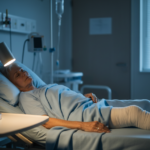





Sleep and wellbeing among nurses
Nurses work in environments where attention, judgment and recovery matter every day.
Shift schedules and demanding clinical responsibilities can make regular sleep difficult.
A new study of 1,149 nurses across 22 tertiary hospitals in China has examined how sleep quality relates to general wellbeing.
The researchers also assessed psychological resilience and a coping-related concept called adversity quotient.
Poorer sleep quality was associated with lower wellbeing and less favourable scores on both psychological measures.
The study suggests that sleep deserves attention when discussing the wellbeing of healthcare staff.
It does not show that improving sleep will necessarily cause wellbeing to improve.
That distinction is important because all measurements came from a cross-sectional survey.
What the researchers discovered
The study reported statistically significant relationships between sleep quality, resilience, adversity quotient and general wellbeing.
Its statistical model separated a direct association from three proposed indirect pathways.
Together, the indirect pathways accounted for 41.6 percent of the total modelled association.
The pathway through resilience alone accounted for 22.2 percent.
The pathway through adversity quotient alone accounted for 11.2 percent.
A third pathway, involving resilience followed by adversity quotient, accounted for 8.2 percent.
These are percentages of a modelled association, not percentages of nurses experiencing a particular problem.
They also do not represent improvements that could be guaranteed by an intervention.
How the study was conducted
The researchers surveyed nurses between September and November 2025 in Zhejiang Province.
The sample came from 22 tertiary medical institutions across six selected cities.
Nurses had to be registered professionals with at least one year of clinical experience.
The researchers retained 1,149 valid questionnaires after excluding 59 invalid responses.
The reported effective response rate was 95.1 percent.
Participants answered questions about sleep, wellbeing, resilience and adversity coping.
Researchers then examined correlations and fitted a structural equation model.
Because the information was collected at one point in time, the analysis cannot establish which changes came first.
Who participated
The sample was predominantly female, with women representing 93.2 percent of participants.
Almost half of the nurses were between 30 and 39 years old.
More than half had over ten years of professional experience.
About 80.8 percent reported working night shifts.
These details matter when interpreting the results.
Night work can be relevant to sleep opportunities, although this study did not experimentally manipulate shifts.
The participating institutions were tertiary hospitals, not a random sample of all healthcare facilities.
The findings should not automatically be generalised to every nursing workforce or healthcare system.
Measuring sleep quality
Sleep was measured using the Pittsburgh Sleep Quality Index, often shortened to PSQI.
The questionnaire asks about sleep experiences over the previous month.
Its components include sleep duration, disturbances and how long someone takes to fall asleep.
It also considers daytime difficulties and use of sleep medication.
Higher PSQI scores indicate poorer reported sleep quality.
This direction matters because negative statistical coefficients can otherwise be misunderstood.
The measure is widely used, but it relies on participants’ own accounts.
It does not provide the same information as objective sleep monitoring or a laboratory assessment.
What general wellbeing means
The researchers measured wellbeing using an 18-item General Well-Being Schedule.
The measure considers satisfaction with life, perceived health and energy.
It also addresses emotional experiences, perceived control and tension.
A higher score indicates more favourable general wellbeing.
This is a broad psychological measure rather than a diagnosis of a particular illness.
The study did not establish how many nurses had clinical depression or insomnia.
Instead, it investigated how variation in wellbeing scores related to other survey measures.
That distinction keeps the findings from being overstated.
Psychological resilience explained
Resilience describes a person’s capacity to maintain or recover psychological functioning under pressure.
It does not mean never becoming tired, worried or overwhelmed.
The researchers used the Connor-Davidson Resilience Scale to assess this characteristic.
Nurses with poorer sleep tended to report lower resilience.
Higher resilience, in turn, was associated with better wellbeing in the model.
The indirect coefficient through resilience was minus 0.137.
This was the largest of the three reported indirect pathways.
The result is compatible with the idea that recovery and coping resources are connected.
It does not demonstrate that sleep problems caused resilience to decline.
Understanding adversity quotient
Adversity quotient is a term for how people perceive and respond to challenges.
The study’s questionnaire assessed dimensions including control, responsibility, reach and endurance.
It is related to coping but is not identical to resilience.
Poorer sleep was associated with lower adversity quotient scores.
Those scores were also related to general wellbeing.
The indirect coefficient through adversity quotient was minus 0.070.
That pathway accounted for 11.2 percent of the total modelled association.
The finding does not mean that nurses can overcome insufficient rest simply by adopting a more positive attitude.
The proposed chain of relationships
The authors also tested a sequence connecting sleep quality with resilience, adversity quotient and wellbeing.
The model estimated a standardised indirect coefficient of minus 0.051 for this pathway.
It accounted for 8.2 percent of the total modelled association.
A sequential model can be useful for organising a research hypothesis.
However, a statistical sequence is not necessarily a real-world sequence of events.
All four variables were measured in the same survey.
Poor wellbeing might itself contribute to disturbed sleep, or other factors might influence several measures together.
Longitudinal and experimental research would be needed to distinguish these possibilities.
What the percentages really say
The researchers estimated a direct association accounting for 58.4 percent of the total modelled effect.
The remaining 41.6 percent was represented by the three indirect pathways.
These proportions describe how coefficients were divided within the fitted model.
They are not statements that 41.6 percent of sleep problems are caused by poor coping.
They do not establish that a resilience programme would recover 22.2 percent of lost wellbeing.
The analysis used 5,000 bootstrap resamples to assess uncertainty in the indirect estimates.
That statistical method can help evaluate the stability of estimates.
It cannot remove all confounding from observational data.
The realities of shift work
Nursing work often involves nights, weekends and changing schedules.
Hospital staff may also face physically demanding duties and emotionally difficult situations.
Such conditions can limit the opportunity for consistent rest.
The high proportion of night-shift workers in this sample makes scheduling an important contextual consideration.
However, the survey was not a trial of alternative shift patterns.
It cannot identify the ideal rota or the safest number of consecutive night shifts.
Those questions require direct evidence about scheduling interventions and outcomes.
The study does reinforce the importance of considering work conditions when discussing individual wellbeing.
Why personal resilience is not the whole answer
Resilience is sometimes presented as though it can compensate for any level of workplace strain.
That would be an inappropriate interpretation of this research.
A nurse can be highly resilient and still need sufficient sleep and recovery time.
Training in coping skills cannot create extra hours between demanding shifts.
The authors discuss resilience as a possible personal resource.
Their findings do not show that individuals can indefinitely offset poor rest through determination.
Employers should distinguish between supporting personal skills and reducing avoidable workplace demands.
Both may deserve attention, but neither was experimentally tested here.
What hospitals could investigate
Hospital managers may wish to review whether staff have adequate opportunities for rest.
Possible areas include scheduling, fatigue management and access to support.
The study’s authors also discuss strengthening resilience and adversity-related coping resources.
These are potential responses rather than interventions proven effective by the survey.
A hospital changing its policies would need to evaluate the results in its own workforce.
Important outcomes could include sleep quality, staff wellbeing and patient safety.
Managers should avoid using correlational findings to promise a specific benefit.
Practical improvements require evidence that changes work in real settings.
Why the results need caution
The central limitation is that the study was cross-sectional.
It cannot establish whether poorer sleep preceded lower wellbeing.
The variables were also measured through self-reported questionnaires.
A participant’s overall mood could influence answers to several questions.
Other influences, such as workload intensity and organisational support, were not fully examined.
The researchers tested for common-method bias but could not rule it out entirely.
The sample was confined to tertiary hospitals in one Chinese province.
These limitations do not erase the observed associations, but they restrict causal and global conclusions.
Why the study matters internationally
Sleep and occupational wellbeing are relevant to healthcare systems around the world.
Nevertheless, staffing structures and working conditions differ between countries.
The results should not be treated as direct evidence about nurses in South Africa or elsewhere.
A study in another healthcare system could find different relationships or effect sizes.
Comparative research might examine whether scheduling, staffing and workplace support change the pattern.
Such work would also help determine which practical measures offer the greatest benefit.
For now, the study provides a useful question for healthcare leaders rather than a universal solution.
How can nursing workplaces protect recovery while maintaining safe clinical services?
What future research should test
Researchers could follow nurses over time to see whether changes in sleep predict later wellbeing.
Objective sleep measures could complement self-reported questionnaires.
Studies could also test the effects of changes to shift schedules or protected rest periods.
Randomised or carefully designed quasi-experimental evaluations would strengthen causal inference.
Other research could examine whether psychological support changes coping scores and wellbeing.
Including workload, staffing and organisational support would help account for additional influences.
Comparisons across hospital types and countries would improve generalisability.
These approaches could turn the current associations into more actionable evidence.
The bottom line
A survey of 1,149 nurses across 22 Chinese hospitals found that poorer sleep quality was associated with lower general wellbeing.
Psychological resilience and adversity quotient were also statistically connected with that relationship.
The modelled indirect pathways represented 41.6 percent of the total association.
The largest single indirect pathway involved resilience.
The findings are not proof that sleep problems caused lower wellbeing.
They also do not establish that resilience training can substitute for adequate rest.
For healthcare organisations, the research is a reason to examine sleep, recovery and workplace conditions together.
The next step is to test which practical changes genuinely help nurses.
Source Information
Study: Associations between sleep quality and well-being among nurses: the serial mediating roles of psychological resilience and adversity coping.
Authors: Yan Cai, Jiayu Mao, Chunqing Yang, Ping Gao, Hanlin Ji, Yunna Zhao, Hao Chen, Junzhi Xiang and Xiaoqun Xu.
Journal: Frontiers in Psychology. Published 30 September 2026.
Methodology: Multicentre cross-sectional survey of 1,149 nurses at 22 tertiary hospitals in Zhejiang Province, China, with questionnaire measures and structural equation modelling.