








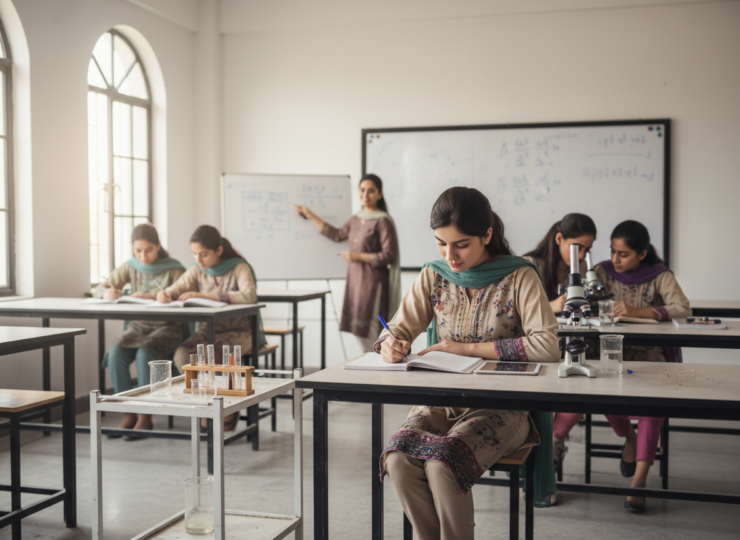
Why do academically capable young women decide against science, technology, engineering and mathematics? A new study from southern Punjab, Pakistan, suggests that the answer cannot be reduced to academic ability. Instead, students’ confidence, the support available around them and the social costs they associate with STEM all appear to shape whether they intend to pursue these fields.
The peer-reviewed study, published on 3 October 2026 in Humanities and Social Sciences Communications, surveyed 920 female intermediate-level students in Multan District. The researchers examined a set of psychological, institutional and cultural factors that may help explain why women remain underrepresented in STEM even when they have the academic potential to enter these disciplines.
Looking beyond academic ability
Gender gaps in STEM are often discussed in terms of achievement, subject preparation or individual interest. The new study takes a broader approach. Nadia Rehman, Xiao Huang and Amir Mahmood focused specifically on factors that can influence the perceived attractiveness and feasibility of a STEM pathway before students enter university.
The researchers measured students’ self-confidence in their STEM abilities, teacher support, access to career counselling, exposure to female role models, perceived difficulty of mathematics, cultural restrictions surrounding coeducation and preferences concerning work-life balance. The central outcome was whether a student intended to choose a STEM major.
This distinction matters because an educational decision can be shaped by much more than whether a student is capable of completing the coursework. A student may perform well academically while still seeing a STEM degree as difficult to navigate socially, institutionally or personally.
A survey of 920 students across four areas
The study used a cross-sectional survey design and a multi-stage cluster sampling approach. The 920 participants were female students at the intermediate level drawn from four tehsils in Multan District in southern Punjab.
Participants completed a structured questionnaire covering the seven main factors investigated by the researchers. The team then used chi-square tests and correlation analysis to examine relationships in the data, followed by binary logistic regression to estimate which factors independently predicted an intention to choose a STEM major.
The regression model showed useful discriminatory performance. Its pseudo R-squared was 0.26, while the area under the receiver operating characteristic curve was 0.818. The model correctly classified 85% of cases. An AUC above 0.8 indicates that the combination of variables had substantial ability to distinguish between students with and without an intention to pursue STEM within this sample.
Those figures do not mean that the model explains every individual decision, nor do they turn the observed relationships into causal effects. They do, however, show that the measured psychological, institutional and cultural factors collectively contained meaningful information about students’ stated educational intentions.
Confidence, teachers, counselling and role models mattered
Four factors were significantly associated with a greater likelihood of intending to choose a STEM major: stronger self-confidence in STEM ability, greater teacher support, access to career counselling and exposure to female role models.
Together, these findings point to the importance of the environment in which educational preferences develop. Confidence is an individual perception, but it can be reinforced or weakened by repeated experiences in classrooms, by the encouragement students receive and by whether they can see people like themselves succeeding in a field.
Career counselling may be especially relevant at the intermediate stage because students are approaching decisions that can shape university admission and later employment. Better information can make pathways into STEM more concrete by clarifying entry requirements, available disciplines and possible careers. Female role models can serve a different function by making participation visible and socially imaginable.
Math difficulty and social constraints pushed in the opposite direction
Three factors significantly reduced the likelihood of intending to choose STEM: perceiving mathematics as difficult, cultural restrictions on coeducation and preferences related to work-life balance.
The coeducation result is particularly important in the regional context. If studying a desired subject requires attendance in an educational environment that a student or her family considers culturally unacceptable, academic ability alone cannot remove that barrier. The practical set of available choices becomes narrower.
Work-life considerations also show how expectations about a future career can influence an educational choice years earlier. A student who believes STEM careers will be difficult to reconcile with anticipated family responsibilities may rationally treat that perceived future cost as part of her present decision.
Perceived mathematics difficulty adds another layer. The study does not establish that students who viewed mathematics as difficult actually had lower mathematical ability. The variable captures perception, which is precisely why the authors argue that avoidance of STEM should not automatically be interpreted as evidence of academic incompetence.
The findings point to several intervention points
The study suggests that increasing women’s STEM participation may require interventions at several levels rather than a single recruitment campaign. Schools can address classroom confidence and teacher support. Career services can improve access to information. Mentorship programmes can increase exposure to female STEM professionals. Families and communities can be included in discussions about educational pathways where social expectations materially constrain students’ choices.
The authors also argue for gender-sensitive pedagogy and institutional arrangements that reduce barriers associated with restrictive norms. The broader implication is that expanding the number of formally available STEM places may be insufficient if students experience substantial psychological or social costs in trying to occupy them.
At the same time, interventions should not assume that every woman ought to choose STEM. The relevant policy question is whether students can make educational choices without avoidable barriers, incomplete information or expectations that systematically make one set of fields less accessible to them.
Important limits to what the study can show
The cross-sectional design is the clearest limitation. Because predictors and intentions were measured at one point in time, the analysis cannot establish causal direction. Greater teacher support might encourage STEM intentions, for example, but students who are already interested in STEM may also seek or perceive more support from teachers.
The outcome was an intention to choose a STEM major rather than subsequently observed university enrolment. Intentions are meaningful, but some students may later change their plans because of grades, finances, family circumstances, admissions outcomes or new interests.
Geography also matters. The participants came from four tehsils in one district of southern Punjab, so the results should not be treated as estimates for all female students in Pakistan or for other countries. Cultural expectations, school resources and access to universities can differ substantially across regions.
Finally, a model that correctly classified 85% of cases is not a complete account of educational decision-making. Unmeasured influences can still matter, and statistical prediction within a sample does not guarantee the same performance elsewhere.
A decision shaped by the environment around ability
The study’s main contribution is to shift attention from whether young women can succeed in STEM to the conditions under which they decide whether STEM is worth pursuing. Among these 920 students, confidence and supportive educational resources were associated with stronger STEM intentions, while perceived mathematical difficulty and social constraints were associated with weaker intentions.
That pattern suggests that talent alone does not determine who enters technical fields. Educational systems also shape whether students can convert ability into aspiration, and whether aspiration can become a realistic choice.
Source Information
Study: “Barriers to women’s participation in STEM education: a regional study of southern Punjab, Pakistan”
Authors: Nadia Rehman, Xiao Huang and Amir Mahmood
Journal: Humanities and Social Sciences Communications
Published: 3 October 2026
DOI: 10.1057/s41599-026-09251-z