









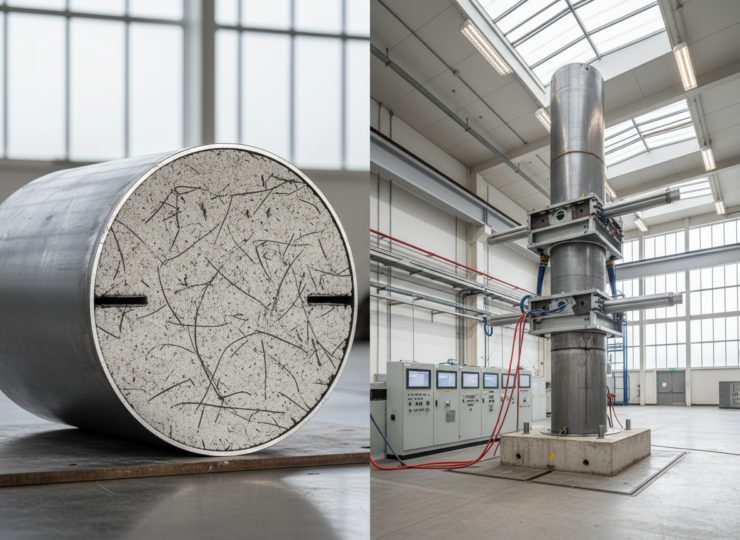
Steel tubes filled with concrete are widely used in columns because the two materials can work together: the steel confines the concrete while the concrete helps stabilise the surrounding tube. A new experimental and numerical study suggests that replacing conventional concrete with ultra-high-performance fibre-reinforced concrete, or UHPFRC, can substantially increase the lateral resistance and energy dissipation of these composite columns while potentially reducing the amount of steel required.
The findings matter particularly for structures expected to experience repeated lateral loading, including the cyclic demands associated with earthquakes. Stronger material alone does not guarantee better seismic behaviour. Structural members also need to sustain repeated reversals of load, dissipate energy and retain useful capacity as damage accumulates. The study therefore examined several aspects of performance rather than relying on compressive strength as a single indicator.
Eight columns were tested under combined loading
Researchers Mohamed A. Sakr, Ayman A. Seleema, Omnia Kharoub and Mostafa Abo Elnour at Tanta University in Egypt tested eight circular steel tubular column specimens under combined axial and lateral cyclic loading. Their peer-reviewed study was published in Scientific Reports on 3 October 2026.
The experimental programme varied three important design features. The columns contained normal-strength concrete, high-strength concrete or UHPFRC. Steel tube thickness was either 2 mm or 5 mm, and the imposed axial load level was either 5% or 25%. This allowed the researchers to compare how the concrete filling, steel confinement and axial demand influenced the response under repeated lateral cycles.
The team evaluated failure modes, hysteretic behaviour, lateral load-carrying capacity, stiffness, ductility and energy dissipation. These measures capture different aspects of structural response. Load capacity indicates the maximum resistance achieved, while hysteretic behaviour and energy dissipation are especially relevant when a member is repeatedly pushed and pulled during cyclic loading.
UHPFRC produced large gains in the thinner steel tubes
The clearest quantitative differences appeared in specimens using the 2 mm steel tube. According to the study, UHPFRC-filled columns achieved 91.5% greater load-carrying capacity than comparable columns filled with normal-strength concrete. Relative to high-strength concrete, the UHPFRC-filled columns carried 31.5% more load.
The improvement was not limited to peak resistance. Energy dissipation increased by 101% compared with the normal-strength concrete-filled columns and by 24% compared with the high-strength concrete-filled columns under the same 2 mm tube comparison. That distinction is important because energy dissipation reflects the capacity of a structural element to absorb repeated loading rather than simply withstand one maximum force.
The researchers also report that using UHPFRC could enable steel savings of up to 71% while maintaining comparable or superior lateral capacity. This result does not mean that steel can simply be reduced by 71% in any building design. It reflects the particular specimen configurations and comparisons investigated in this study, and practical designs would still need to satisfy applicable codes, stability requirements, connection details, fire performance and other structural demands.
Why the concrete inside the tube changes the response
Concrete-filled steel tubes rely on interaction between their components. The external tube provides confinement, while the concrete core contributes compressive resistance and can delay local instability of the steel. UHPFRC adds high material strength and fibre reinforcement to this composite action.
The cyclic results therefore point to a broader design trade-off. Increasing steel thickness is one route to greater structural resistance, but improving the performance of the infill can alter how much steel is needed to achieve a target response. If that relationship holds across larger-scale members and realistic construction conditions, designers could potentially optimise columns around both material quantity and structural performance rather than treating tube thickness and concrete strength independently.
This possibility is relevant to resource efficiency, but it requires careful interpretation. UHPFRC is a specialised material whose composition, fibre content, production requirements, cost and embodied impacts differ from those of conventional concrete. A reduction in steel mass is therefore not automatically equivalent to a lower-cost or lower-carbon column. Those outcomes require dedicated economic and life-cycle assessment.
The experiments were paired with numerical modelling
Alongside the physical tests, the researchers developed a finite element model incorporating confinement effects and cyclic material behaviour. The model was validated against the experimental response and proposed as a way to predict the performance of UHPFRC-filled circular steel tubular columns.
Combining laboratory testing with numerical simulation is useful because experimental programmes can only examine a limited number of configurations. Once a model has been adequately validated, it can be used to explore parameter combinations that would be expensive or impractical to test individually. However, numerical predictions remain dependent on the assumptions, constitutive relationships and validation range used to construct the model.
What the results could mean for seismic design
The study provides evidence that UHPFRC can do more inside a circular steel tube than increase nominal material strength. In the tested columns, it improved lateral capacity and energy dissipation, two characteristics that are central to structural response under cyclic loading.
The magnitude of the reported gains is notable. A 91.5% capacity increase over normal-strength concrete and a 101% increase in energy dissipation in the 2 mm tube comparison indicate that the choice of infill materially changed the behaviour of the composite member. The smaller, but still substantial, gains over high-strength concrete also suggest that the result cannot be explained simply as a comparison between ordinary and stronger concrete.
For engineering practice, the potential value lies in design flexibility. A higher-performing infill may allow engineers to reach a required lateral capacity with a different balance of concrete and steel. This could be attractive where reducing steel section thickness, member weight or material use is a priority, provided that the complete design remains safe and constructible.
Important limitations remain
The experimental evidence comes from eight specimens. That is sufficient to demonstrate meaningful behaviour within the tested matrix, but it is not a comprehensive survey of every geometry, material formulation, loading history or connection condition encountered in buildings and infrastructure.
The reported percentage improvements should therefore be interpreted as results for the specific tested configurations, not universal performance multipliers for all UHPFRC-filled steel columns. Full structural systems can also fail or degrade through mechanisms not represented by an isolated column specimen.
The study also focuses on structural performance rather than a complete sustainability or economic comparison. The reported potential for steel savings is technically important, but future work would need to compare material production, cost, constructability, durability, repair requirements and life-cycle environmental impacts before concluding that a particular UHPFRC design is preferable overall.
Even with those limits, the combination of cyclic testing and validated numerical modelling provides a useful basis for further investigation. The results show that changing the concrete core can substantially reshape the performance of a concrete-filled steel tube, and that UHPFRC deserves attention not only as a high-strength material but as part of an integrated composite structural system.
Source Information
Study: Experimental and numerical investigations of UHPFRC-filled circular steel tubular columns under axial and lateral cyclic loads
Authors: Mohamed A. Sakr, Ayman A. Seleema, Omnia Kharoub and Mostafa Abo Elnour
Journal: Scientific Reports
Published: 3 October 2026
DOI: 10.1038/s41598-026-69255-2