









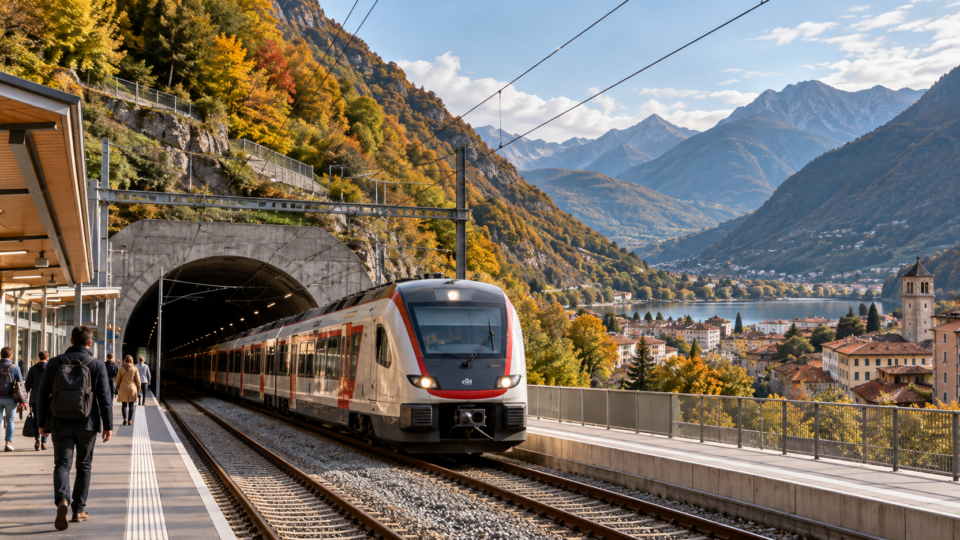
A major railway tunnel in southern Switzerland appears to have changed how people get to work and university, not simply how quickly trains move. New peer-reviewed research estimates that commuters most directly served by the Ceneri Base Tunnel and accompanying public transport improvements became 4.2 percentage points more likely to use public transport as their main commuting mode than comparable commuters elsewhere in the region. The finding is based on an analysis of 12,683 commuters drawn from a survey of 24,577 residents, with reported travel patterns spanning 2019 and 2023.
The result offers an unusually concrete answer to a question facing transport authorities worldwide: when governments invest in expensive rail infrastructure, do people actually change their travel habits? The answer in this Swiss case was a measurable, though far from universal, shift towards trains and buses. Importantly, the estimate concerns a new tunnel together with wider improvements to the public transport network, rather than the tunnel’s engineering works in isolation.
Why this railway project matters
The Ceneri Base Tunnel opened in 2020 in Ticino, Switzerland’s southernmost canton. Its role was to improve the north-south railway connections between urban centres including Lugano, Bellinzona and Locarno. A regional service overhaul, introduced around the same period, also changed train frequency and network integration. These changes created an opportunity to investigate whether a substantially better service could persuade commuters to choose public transport over cars or motorbikes.
The practical gains were considerable. According to background evidence reported in the paper, journeys on the Lugano-Locarno corridor could be completed in about 30 minutes, while Lugano-Bellinzona journeys took about 15 minutes, roughly halving travel times on important links. Such improvements can make rail a credible alternative for commuters who previously regarded driving as more convenient.
Yet new infrastructure does not automatically lead to fewer car trips. Better trains might attract people who already used buses, encourage additional journeys or primarily benefit residents living close to stations. To assess whether the project changed the balance between public and private motorised travel, researchers needed to compare the people most exposed to the improvement with those less directly affected.
How the researchers examined commuting behaviour
Leonardo Conte, Jules Grandvillemin, Clément Rames and Orane Solim Koenga, researchers at the École Polytechnique Fédérale de Lausanne, published their analysis on 9 October 2026 in Frontiers in Sustainable Cities. Their starting point was the INDMOB mobility survey, conducted in Ticino between September and December 2023.
Survey organisers contacted a random selection of 50,000 residents aged 19 and older. Of these, 24,577 completed at least part of the questionnaire. Respondents described their current travel behaviour and recalled their travel patterns in autumn 2019, before the tunnel opened. The survey also collected information about residence and workplace locations, transport subscriptions, driving licences and other characteristics relevant to mode choice.
For the main analysis, the researchers retained 12,683 respondents who had usable commuting information and travelled principally by public transport or private motorised transport. Walking and cycling were excluded because the research question concerned the choice between these two motorised categories over regional commuting distances. Public transport included trains and buses; private motorised transport included cars and motorbikes.
The resulting sample was predominantly car-oriented: 9,775 commuters, or approximately 77%, reported private motorised transport as their main mode, while 2,908, or about 23%, used public transport. These are characteristics of the analytical sample, not a claim that 77% of all Ticino residents drove to work.
A comparison designed to separate the tunnel effect from broader trends
The researchers used a method known as difference-in-differences. Rather than comparing rail use before and after the opening alone, they compared how travel behaviour changed in two groups over the same period.
The directly exposed group consisted of 1,734 commuters whose journeys crossed between northern and southern Ticino along corridors served by the tunnel. The comparison group comprised 10,949 commuters whose homes and work or study destinations were within the same broad regional zone. Both groups lived in Ticino and experienced some of the wider transport changes, but the first group stood to benefit most from the new north-south connection.
This design matters because commuting changed for many reasons between 2019 and 2023, including the pandemic, remote work, employment patterns and transport policy. The method attempts to estimate the additional change among tunnel-exposed commuters beyond the change observed in the comparison group.
Two statistical specifications were tested. A simpler model compared the groups without further adjustments. A second model controlled for age, gender, public transport subscription status and the local level of public transport service. These factors were included because people with different resources and residential circumstances may make different travel choices even when offered the same railway improvements.
The main finding: a 4.2-percentage-point increase
In the unadjusted model, the tunnel-exposed group showed an estimated 6.7-percentage-point greater increase in public transport commuting than the comparison group. Its reported 95% confidence interval ran from 3.2 to 10.2 percentage points.
After accounting for the selected demographic and transport variables, the estimated difference was 4.2 percentage points. The 95% confidence interval was 1.7 to 6.7 percentage points, with a reported p-value of 0.001. This adjusted result is the study’s principal finding.
The researchers describe the adjusted increase as approximately a 13% relative rise compared with the treated group’s pre-opening public transport share of around 32%. The distinction between percentages and percentage points is essential. A 4.2-point increase from a 32% baseline corresponds to 36.2%, whereas a 4.2% relative increase would be much smaller. The study’s figure is an estimated difference attributable to the intervention under the model assumptions, not a claim that every exposed traveller switched modes.
Adding the explanatory variables also improved the model’s reported fit substantially. Its R-squared rose from approximately 0.02 in the simpler specification to 0.43 in the adjusted model. This does not mean the tunnel explained 43% of commuting behaviour. It means the full collection of variables in that model accounted for more of the observed variation in mode choice.
Subscriptions and local service still mattered
The adjusted model identified several associations beyond the tunnel exposure. Holding the other included factors constant, people with a public transport subscription were 48.0 percentage points more likely to use public transport as their main commuting mode. Women were 5.7 points more likely to do so, while the age variable showed a negative association of 9.5 points as specified in the model.
The public transport service measure also mattered: a one-unit improvement on the researchers’ service-quality index was associated with a 2.4-point higher probability of using public transport. The paper reports that the region’s service-quality measure improved by about 10% between 2019 and 2023.
These figures require careful interpretation. A person who buys a rail subscription may already prefer trains; the study does not demonstrate that handing someone a subscription would, by itself, increase their probability of commuting by public transport by 48 points. The estimates describe conditional relationships within the study’s model. They nevertheless illustrate why building a railway is only one part of making it useful: fares, connecting services and access to stations influence whether commuters can take advantage of faster journeys.
What transport planners can learn
The strongest practical message is that infrastructure and service design work together. The tunnel removed a geographic bottleneck, while associated timetable and network changes made the improvement usable. For someone travelling between Lugano and Bellinzona, the value of a shorter rail journey depends on whether the first and last legs of the commute are convenient, whether trains run at useful times and whether tickets are affordable.
That has implications well beyond Switzerland. In regions considering new commuter rail lines, upgrading the main corridor without reliable feeder services may limit the number of drivers who switch. Conversely, improvements to connections, frequency and fare integration may increase the value of expensive infrastructure already in place.
The result also complements a broader issue examined by Research Today: living near jobs does not necessarily mean people can access better opportunities. Both lines of research point to the importance of actual connectivity rather than distance or infrastructure on a map. A fast rail link can shorten a journey, but its usefulness depends on where people live, work and can reach a station.
For South African readers, the Swiss result should be treated as evidence about a particular transport system rather than a prediction for local rail investment. Differences in safety, reliability, affordability, urban form and existing rail coverage could substantially change the response. The transferable question is whether an investment improves the complete door-to-door journey enough to alter people’s choices.
Important limitations behind the estimate
Although the researchers use a quasi-experimental design, the study was not a randomised experiment. Its causal interpretation depends partly on the assumption that the directly exposed and comparison groups would have followed similar commuting trends without the tunnel and service changes. The authors could not test this assumption using multiple pre-opening observations because the dataset did not contain a series of earlier measurements.
Another limitation is the survey’s retrospective design. Participants answered in 2023 and were asked to remember their commuting behaviour in 2019. Some may have recalled their earlier habits incorrectly. The 2019 to 2023 period also included COVID-19 disruptions, which may have affected cross-regional and local commuters differently, even though the statistical comparison accounts for shared time trends.
The comparison group was not completely insulated from the policy intervention. Residents travelling within the same region could still benefit from the broader public transport timetable overhaul. That means the estimate is best read as the additional change associated with direct exposure to the tunnel corridor, rather than the entire regional impact of all transport improvements.
The research focused on people’s main mode of commuting and did not measure every stage of a multimodal journey. It excluded walking and cycling from the main comparison and did not directly calculate greenhouse gas savings, the number of vehicle kilometres avoided or a full cost-benefit return on the tunnel investment. The findings therefore support a shift in mode choice, not a precise estimate of the project’s environmental payoff.
Finally, the analysed population was restricted to people with usable work or study commuting data. The findings cannot automatically be extended to retirees, people who do not commute, recreational trips or residents living in different transport environments.
Why the finding is significant
Major transport investments are often promoted with forecasts of future passenger demand. This study instead examines behaviour several years after an actual infrastructure change. Its adjusted estimate suggests that the Ceneri Base Tunnel and related service improvements helped public transport win a modest but meaningful share of everyday journeys among commuters positioned to benefit.
The result is neither proof that rail tunnels always pay for themselves nor evidence that infrastructure alone can solve car dependence. It shows that when a major railway improvement substantially reduces travel times and fits into a functioning regional network, measurable changes in commuting choices are possible. The next challenge for transport research is to determine which travellers change behaviour, whether the shift persists and how much environmental and economic benefit follows.
Source Information
Study: Railway infrastructure breakthrough and mode choice: evidence from the Ceneri Base Tunnel in Switzerland.
Authors: Leonardo Conte, Jules Grandvillemin, Clément Rames and Orane Solim Koenga.
Journal: Frontiers in Sustainable Cities, Urban Transportation Systems and Mobility, volume 8.
Publication date: 9 October 2026.
Research design: Peer-reviewed original research; difference-in-differences analysis of recalled 2019 and reported 2023 commuting patterns from 12,683 survey participants, drawn from 24,577 survey respondents.
DOI: 10.3389/frsc.2026.1938839.