





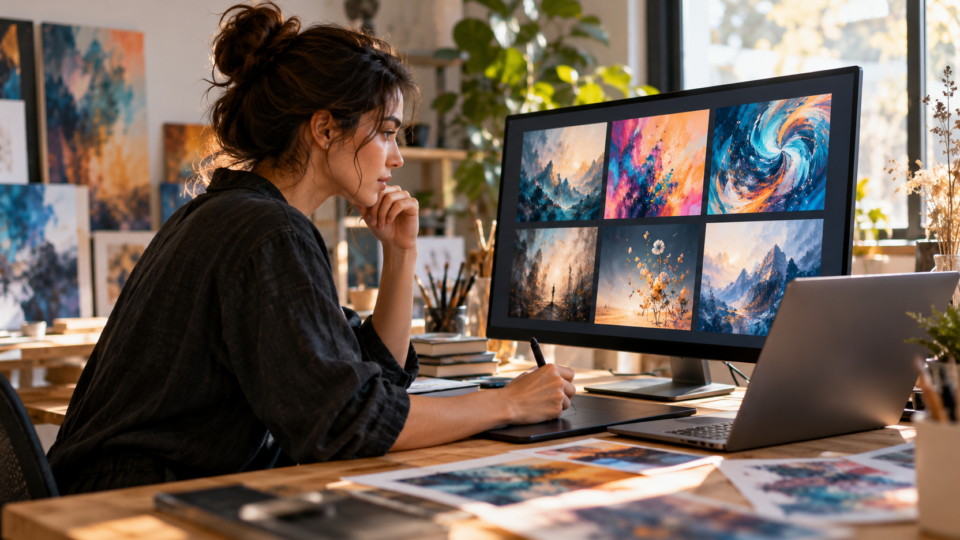
Giving an artificial intelligence system more control over an artwork does not necessarily make the creative experience better. In two experiments involving 600 participants, people reported the strongest sense of creativity when AI contributed to the work but users retained meaningful choices about prompts, styles and final results. Fully automated generation produced less favourable ratings than a collaborative approach, according to research published on 9 October 2026 in Frontiers in Psychology.
The finding challenges a simple assumption behind many generative-AI products: that removing more effort always improves the user experience. It also offers a more specific question for designers, educators and artists. When a system can generate an image in seconds, which parts of the process should remain under human control?
Two experiments tested different kinds of creative control
Researchers Chenyang Wang, Miao Chen and Wen Yang investigated how the design of an AI-assisted digital-art workflow shapes people’s assessment of their own creativity. They conducted two separate between-subjects experiments, each with 300 valid participants. The average age was approximately 24 years in both samples, and the authors planned 100 participants per experimental condition.
The first experiment compared three approaches. In the human-only condition, participants developed an artwork concept without AI image generation. In the AI-only condition, the system supplied generated images and users could select a final result, but could not revise prompts or regenerate outputs. In the human-AI co-creation condition, participants could enter and modify prompts, choose visual styles, request new outputs and curate the final work.
The second experiment compared three specific workflows with low, moderate or high AI involvement. Under low involvement, AI offered limited ideas while the person directed the work. Under moderate involvement, AI generated options and feedback, but users could repeatedly adjust prompts and styles and choose the result. Under high involvement, the system performed most of the generation and people mainly selected or confirmed an output. These were distinct packages of features, not simply three settings on one continuously adjustable automation scale.
After their digital-art tasks, participants answered questions about perceived creativity, psychological ownership, perceived agency, creative flow, aesthetic evaluation and emotional resonance. The researchers used seven-point agreement scales. They also obtained independent evaluations of finished works, making it possible to distinguish how creative participants felt from how their outputs were rated by others.
Collaboration outscored AI-only generation
In the first experiment, the mean perceived-creativity score was 4.645 in the human-AI co-creation condition, compared with 4.272 for human-only creation and 3.315 for AI-only generation. The difference between collaborative creation and AI-only generation was 1.330 points on the seven-point scale.
The overall difference among the three groups was statistically significant, F(2, 297) = 34.812, p < 0.001. The reported partial eta-squared was 0.190, a measure of the size of the group effect in the statistical analysis. It is not a claim that AI increased real-world creativity by 19%.
These numbers support a specific interpretation: people in the tested co-creation workflow rated their final work as more creative than people who mostly selected from AI-generated options. The experiment does not establish that every artist will produce better work with AI, nor that an AI-assisted image is inherently more original than a human-created one.
Ownership, agency and flow did not tell exactly the same story
The researchers examined three psychological experiences that can easily be confused. Psychological ownership means feeling that the work is one’s own. Perceived agency concerns whether the person feels able to direct what happens. Creative flow refers to becoming absorbed and engaged in the creative task.
In Study 1, psychological ownership was actually highest in the human-only group, averaging 4.782. Co-creation followed at 4.600, while AI-only generation averaged 3.143. This is an important qualification: using AI did not make people feel more ownership than making their own concept without it.
Perceived agency showed a different pattern. Co-creation scored 4.593, human-only creation 4.372 and AI-only generation 2.973. Creative flow was similarly strong for co-creation (4.492) and human-only creation (4.430), but lower for AI-only generation (3.164). The results suggest that participation in decisions may matter even when a machine does much of the technical production.
Across the combined data, perceived creativity correlated with psychological ownership (r = 0.565), agency (r = 0.564) and flow (r = 0.600). These positive relationships are consistent with the idea that feeling involved makes an output feel more creative. Correlations alone cannot show which experience caused another.
Moderate AI involvement performed best in the second experiment
The second experiment sharpened the question by varying the kind of AI assistance. The moderate-involvement workflow achieved a mean perceived-creativity rating of 5.155, compared with 3.985 for low involvement and 3.647 for high involvement. The moderate group therefore scored 1.170 points above the low-involvement group and 1.508 points above the high-involvement group.
The overall group effect was F(2, 297) = 57.204, p < 0.001, with partial eta-squared of 0.278. Participants in the moderate workflow also reported the highest psychological ownership (4.860), agency (4.935) and creative flow (5.052). The high-involvement workflow had the lowest corresponding scores, at 3.875, 3.425 and 3.692.
This is not evidence of a universal sweet spot at exactly 50% AI involvement. The conditions differed in several features at once, including prompt-editing rights, the opportunity to regenerate images and final-selection control. The experiment identifies the most favourable of three tested workflows; it cannot isolate which individual feature drove the difference or define an optimal automation percentage.
Independent reviewers saw differences too
One potential objection is that people may simply feel more creative when they are allowed to click, edit and choose more often. To examine whether the findings extended beyond self-perception, the researchers asked three independent evaluators to rate finished artworks on several criteria, including novelty and overall creativity. Agreement among the evaluators was high, with an intraclass correlation coefficient of 0.87.
In Study 1, co-created artworks received a mean external creativity rating of 4.81, compared with 4.16 for human-only work and 4.34 for AI-only work. In Study 2, the moderate-involvement group again led with 4.96, compared with 4.12 for low involvement and 4.41 for high involvement.
The differences in independent ratings were statistically significant in both studies, but smaller than the differences in participants’ own perceived-creativity scores. That distinction matters. The strongest claim supported by the paper concerns the experience of creativity, with supplementary evidence of differences in rated output quality. Neither set of ratings proves that the works were more commercially valuable, more innovative in professional practice or more enduring as art.
Why the psychological pathway is interesting but not proven
The authors also tested a statistical model proposing that co-creation may increase perceived creativity through a sequence: stronger ownership, then greater agency, then deeper creative flow. They used 5,000 bootstrap resamples to estimate the uncertainty around the model’s indirect effects.
The estimated complete three-stage indirect effect was 0.0418, with a 95% confidence interval of 0.0122 to 0.0834. The combined indirect effect through the tested psychological pathways was 1.1077, with a confidence interval of 0.8226 to 1.4392. Once these mediators were included, the estimated direct effect of co-creation had a confidence interval crossing zero, so it was not statistically distinguishable from zero in that model.
These results are consistent with the proposed explanation, but they do not prove that ownership caused agency, which then caused flow. All three experiences were measured after the task. Without measuring or experimentally manipulating them at separate times, the order remains a theoretical interpretation rather than an established causal chain.
What the findings mean for AI tools and creative work
For people designing image generators, presentation tools, marketing platforms or creative software, the practical lesson is not to minimise human input at any cost. A system that offers editable suggestions, lets users compare alternatives and preserves the ability to revise important decisions may be experienced differently from one that simply presents a finished answer.
The study also suggests a useful distinction between reducing repetitive effort and removing creative control. Automating a technical step can free attention for judgment, experimentation and refinement. Automating the judgment itself can leave users feeling detached from the outcome. That possibility deserves testing in professional contexts where ownership and responsibility are especially important.
The findings connect with a separate Research Today report on 695 German knowledge workers, which found that perceived AI support was associated with different ways of reshaping work. The two studies measured different outcomes and cannot be combined into one causal conclusion, but both highlight why the design of human participation matters beyond simply adopting an AI tool.
For education, the implications are similarly nuanced. Students who generate a complete image or answer with minimal involvement may finish a task quickly, but the psychological experience can differ from one in which they formulate ideas, test alternatives and explain their choices. This complements Research Today’s earlier coverage of the gap between everyday AI use and educational use, although the current experiments did not measure learning gains.
Important limits on the conclusion
The samples were relatively young, with average ages close to 24, and the tasks concerned short digital-art activities. The study therefore does not establish how experienced designers, older users or people working under real commercial deadlines would respond. The paper reports approximately 10 to 12 minutes for the Study 1 task and questionnaire, far removed from a multiweek creative project.
The workflow comparisons bundled several controls together, so a favourable outcome cannot be attributed solely to the amount of AI computation. Participants’ self-reports may also be influenced by novelty, expectations or a desire to see their own choices reflected in the result. Independent art ratings partly address this concern but remain judgments made in a controlled setting, not objective measures of artistic achievement.
Finally, the experiments evaluated particular generative-art interactions at one point in time. As interfaces change, the relationship between automation and user control may change too. Future studies could test individual features separately, track the same creators over longer periods and examine whether differences in agency translate into better learning, more original work or greater professional satisfaction.
The bigger question is who gets to decide
Across two experiments, the most favourable creative experiences emerged when AI could help generate possibilities while users retained meaningful influence over the result. The evidence is strongest for subjective creativity and specific tested workflows, not for a universal rule about how much automation is ideal.
That distinction matters as generative tools become more capable. The most helpful creative assistant may not be the one that makes every decision. It may be the one that leaves people with decisions worth making.
Source Information
Original study: The impact of human-AI co-creation on perceived creativity in generative AI art: a serial mediation mechanism of psychological ownership, perceived agency, and creative flow.
Authors: Chenyang Wang, Miao Chen and Wen Yang.
Journal: Frontiers in Psychology, Performance Science section, volume 17.
Publication date: 9 October 2026.
Study design: Two peer-reviewed between-subjects digital-art experiments with 300 participants each (600 total), plus independent evaluations of artworks and statistical mediation analysis.
DOI: 10.3389/fpsyg.2026.1986050.