A small patch of seafloor beside an Italian volcanic island is providing a warning about the future of the Mediterranean Sea. Researchers studying microscopic organisms that build protective shells found a marked change in community composition around a seawater pH of 7.7.
When they applied that locally observed threshold to climate projections, more than 400,000 square kilometres of Mediterranean coastal seafloor were projected to experience conditions below it by the end of the century under a very high greenhouse gas emissions scenario.
The research, published in Scientific Reports on 8 October 2026, combines underwater sampling, environmental DNA, microscope observations and an ensemble of climate models. Its central finding is not that the entire Mediterranean will suddenly become lifeless at one precise pH value.
Instead, it identifies a possible ecological transition: as seawater becomes more acidic, organisms that make calcium carbonate shells become less prominent relative to forms that use other materials. The study also shows why counting species alone can miss important changes in how ecosystems function.
Why a small change in ocean pH matters
Seawater absorbs some of the carbon dioxide released into the atmosphere. This slows the build-up of carbon dioxide in the air, but the dissolved gas changes seawater chemistry. More dissolved carbon dioxide generally means more hydrogen ions and a lower pH, a process called ocean acidification. A lower pH does not mean the sea has become acidic in the everyday sense of having a pH below seven. Most seawater remains alkaline even as its pH falls.
The pH scale is logarithmic, so small numerical differences represent meaningful chemical changes. Ocean acidification also reduces the availability of carbonate ions, which many organisms use to build shells and skeletons made from calcium carbonate. The effects differ among species and depend on temperature, food, oxygen and local water chemistry.
The Mediterranean is especially important because its semi-enclosed waters are warming rapidly and its coasts support fisheries, tourism, marine habitats and densely populated communities. The new study does not measure economic losses, but it examines organisms involved in sediment processes and the cycling of carbon and nutrients. Their responses can reveal ecological change that is not obvious from the surface.
A natural laboratory beside Ischia
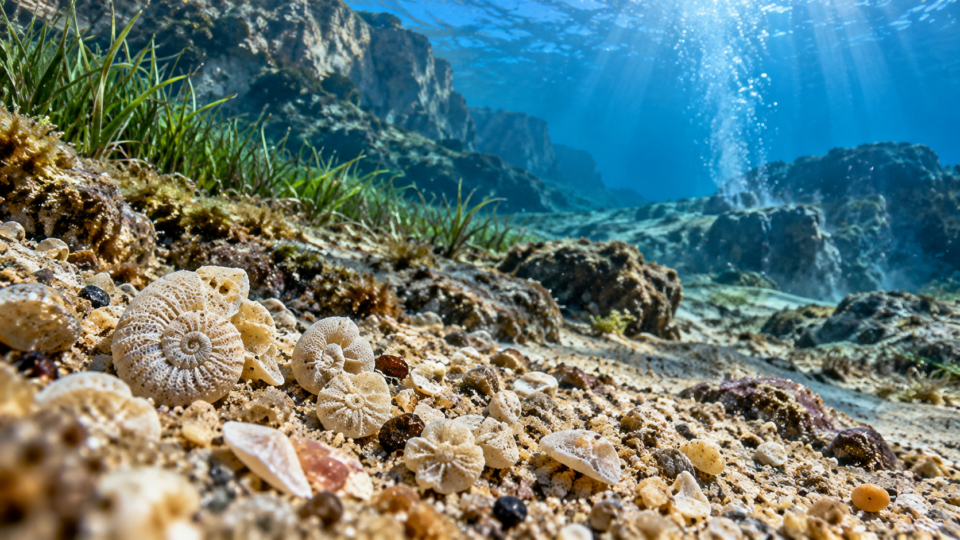
Fabrizio Frontalini, Mattia Greco and colleagues studied benthic foraminifera, tiny mostly single-celled organisms living on or within seafloor sediments. Some build hard calcium carbonate shells, known as tests. Others make shells by cementing together sediment particles, while still others have organic coverings. This variation allows scientists to compare groups that may respond differently to changing seawater chemistry.
The team sampled near Castello Aragonese on Ischia, a volcanic island in the Gulf of Naples. Carbon dioxide escapes naturally through vents in the seabed, producing a steep local gradient in seawater pH. Such sites act as natural laboratories because neighbouring habitats experience different levels of dissolved carbon dioxide without researchers needing to acidify the ocean themselves.
Divers collected surface sediment from 14 sites in October 2021, including ten along a southern transect and four along a northern transect. The measured seawater pH values ranged from 6.53 to 7.93. The northern transect ranged from 7.02 to 7.93 and the southern from 6.53 to 7.92. The researchers measured environmental conditions at the sediment-water interface and collected replicate material for microscopy and DNA analysis.
Natural carbon dioxide vents have advantages over a short laboratory experiment, including exposure of entire communities to locally altered chemistry. They also have limitations. Conditions near a volcanic vent can fluctuate and may differ from those caused by gradual global emissions. The study therefore uses the vent system to identify a plausible biological response, not as a perfect reproduction of every Mediterranean coastline in 2100.
How the team measured the invisible community
One part of the analysis involved traditional microscopy. The researchers examined the physical shells and shell fragments recovered from sediment, distinguishing forms built from calcium carbonate from those made of other materials. They also considered whether specimens were living, and how frequently shells were fragmented. Fragmentation can offer a clue about dissolution, although it is not a direct measure of every chemical process occurring in the sediment.
A second part used environmental DNA metabarcoding. The researchers extracted DNA from sediment and sequenced a marker in the 18S ribosomal RNA gene, which can help identify foraminiferal lineages. This approach detects organisms that may be missed by visual counting, including forms without readily recognisable mineral shells.
After filtering, the genetic dataset contained 1,578,394 high-quality sequencing reads and 1,199 amplicon sequence variants, or ASVs. An ASV is a distinct DNA sequence recovered by the analysis, not automatically a distinct species. This matters because it would be misleading to report the 1,199 variants as 1,199 confirmed species.
The scientists grouped samples according to their community composition, compared the resulting groups with pH and other environmental variables, and then examined how shell-building traits differed between them. By comparing the molecular and physical evidence, they could ask whether seawater chemistry changed what kinds of organisms were present, even when conventional diversity scores remained relatively stable.
The clearest signal was in shell type, not species counts
The study found three community clusters across the sampled pH gradient. In its multivariate analysis, pH alone accounted for 47% of the variation in community structure, with a reported p-value of 0.021. Oxygen concentration and depth were not statistically significant predictors in that particular analysis.
That 47% is a model-based description of variation in the sampled communities. It does not mean that acidity causes exactly 47% of all changes in Mediterranean marine life. Nor does it exclude the influence of other unmeasured factors.
Interestingly, conventional within-sample diversity indices did not show a significant correlation with pH. A reader looking only at the number or diversity of DNA types might therefore miss the shift. But the proportion of calcium carbonate shell builders changed significantly between community clusters. Microscopy supported the DNA results, showing fewer calcareous forms in the more acidified areas and greater shell fragmentation near the vents.
That distinction is central to the paper. Two communities can contain similar numbers of kinds of organisms yet function differently if the organisms have different roles. In this case, losing shell-building forms could alter the production, breakdown and burial of carbonate material in sediments.
Why the researchers focused on pH 7.7
Both the genetic and morphological evidence suggested a marked change in the balance of shell types around pH 7.7. Above that level, calcium carbonate shell builders were more prominent in the study’s comparison communities. Below it, communities increasingly favoured organisms with other kinds of coverings.
The threshold is an empirically observed ecological reference point for these sampled foraminifera, not a universal boundary between safe and unsafe ocean conditions. Different organisms, sites and depths can have different sensitivities. The team noted that earlier work near Ischia had also observed important community changes around pH 7.8, providing some context for the new result.
Researchers further tested whether two sites with especially poor genetic identification rates were driving the pattern.
After excluding those sites, the differences between clusters remained statistically significant for calcareous-ASV richness (p = 0.015, compared with 0.0064 before exclusion) and relative abundance (p = 0.026, compared with 0.014 before exclusion).
This sensitivity analysis supports the direction of the finding, while the small number of sites still limits generalisation.
A major uncertainty was hidden in the DNA database
One of the study’s most important methodological cautions is that 68% of the detected ASVs, on average, could not be assigned to a known foraminiferal taxon using the reference database. Unassigned DNA reads also represented an average of 63% of all reads, exceeding 90% at two sites.
These are not necessarily organisms unknown to science. They are sequences that the researchers could not confidently match to entries in the available reference library. Without a reliable identification, the scientists could not always infer the type of shell the organism makes. That leaves an important gap in the functional-trait analysis.
To reduce the risk of misleading assignments, the authors used a conservative sequence-matching threshold and checked the unmatched sequences. The study demonstrates both the power and the limitations of environmental DNA: it can reveal hidden diversity, but the usefulness of its results depends heavily on the quality of reference databases.
What the climate projections say about 2100
The researchers then combined their pH threshold with Bio-ORACLE projections based on ten CMIP6 climate models. The projections covered eight decadal time steps from 2020 to 2090, at a spatial resolution of 0.05 degrees, under several possible emissions pathways.
They distinguished two types of exposure. Chronic exposure meant that the projected decadal mean pH fell to or below the reference threshold. Episodic exposure meant that the projected minimum pH crossed the threshold even if the average remained above it. That distinction matters because a short period of unusually low pH may still affect organisms with sensitive life stages.
Under SSP5-8.5, a very high emissions scenario, the study projects that more than 400,000 square kilometres of Mediterranean coastal seafloor would experience pH below 7.7 by the 2090 to 2100 period. The affected regions include extensive stretches of the western and southern Mediterranean, as well as parts of the Adriatic.
The paper describes particularly widespread chronic exposure along sections of the western Mediterranean coast and around several enclosed coastal waters.
Under the less extreme SSP3-7.0 and SSP4-6.0 pathways, projected threshold crossings are more geographically limited, with episodic exposure concentrated in parts of the western Mediterranean and selected northern coastal areas. This scenario comparison matters: the 400,000 square kilometre figure is not an unconditional forecast. It is an outcome of the study’s threshold and model assumptions under a specific high-emissions pathway.
The authors also tested whether projected threshold crossings were large relative to differences between climate models. Under SSP5-8.5, 75% of the affected area crossed the threshold by a margin greater than the local standard deviation across the ten-model ensemble.
This offers some reassurance that the spatial signal is not entirely dependent on one model, but it does not remove uncertainty about future emissions, local water chemistry or the transferability of the biological threshold.
What changing microscopic life could mean for ecosystems
Foraminifera may be small, but their shells contribute to marine sediments and carbonate cycling. If calcareous forms decline while non-calcifying forms become more common, the community’s role in producing and preserving carbonate material may change. The study raises concerns about wider ecological reorganisation, including effects on sediment processes and marine food webs.
These are plausible ecological implications, not impacts directly measured across the entire Mediterranean. The researchers did not measure future fisheries income, tourism losses or a precise reduction in ocean carbon storage. Such outcomes would require additional ecosystem and economic studies.
The broader importance of biodiversity to ecosystem functioning is also evident in Research Today’s coverage of a synthesis of 423 studies on biodiversity and ecosystem services. The Mediterranean study adds a complementary lesson: understanding biodiversity requires attention not only to how many organisms are present, but also to what those organisms do.
Why the projections need careful interpretation
The first limitation is geographic scale. The biological threshold comes from 14 sampling sites around one volcanic island, while the future projection covers an entire sea. The team draws on earlier regional research, but local ecology, sediment composition and water chemistry vary widely around the Mediterranean.
The second limitation is time. Sampling occurred during one campaign in October 2021. Organisms can experience daily, seasonal and longer-term pH changes, and the study did not continuously track the same communities over many years. Conditions within sediment pore spaces may also differ from measurements at the sediment-water interface, where the researchers took their pH readings.
Third, a carbon dioxide vent is an informative natural analogue, not a controlled experiment that isolates every cause. The study’s statistical association between pH and community composition is persuasive, but some ecological differences may be influenced by local processes that were not fully measured.
Fourth, the climate maps are model projections, not observations of future biodiversity loss. The 7.7 reference point was applied to projected pH values, but a map of where that threshold is crossed is not itself a map of confirmed extinctions. Species may adapt, move or respond differently when warming, oxygen loss, food availability and other pressures interact.
Finally, the incomplete DNA reference database makes functional assignments uncertain for a substantial share of the community. The study’s combination of microscopy and sequencing strengthens its findings, but it cannot entirely eliminate this blind spot.
What comes next for ocean monitoring
The study offers a practical direction for researchers and environmental managers. Instead of tracking only the number of species or broad measures of biodiversity, monitoring programmes could include functional traits, such as whether organisms produce calcium carbonate shells. Repeated surveys combining microscopy, environmental DNA and carbonate chemistry would help determine whether the Ischia threshold is useful in other Mediterranean habitats.
Such work would also help distinguish chronic exposure from brief episodes of low pH, a difference that may be important for coastal organisms. Better DNA reference libraries and measurements within sediments could improve the reliability of future assessments.
The finding is a warning rather than a prediction of inevitable collapse. A locally observed shift near pH 7.7, paired with high-emissions projections of extensive threshold crossings, points to a potential change in the biological machinery of Mediterranean seafloors. How large that change becomes will depend on emissions, regional conditions and the responses of organisms that are still poorly understood.
Source Information
Study: Ocean acidification pushes Mediterranean marine calcifiers toward a tipping point.
Authors: Fabrizio Frontalini, Mattia Greco, Nicola Casadei, Ines Barrenechea Angeles, Marina Montresor, Maria Virginia Alves Martins and Jan Pawlowski.
Journal: Scientific Reports, volume 16, article 31490.
Published: 8 October 2026.
Research type: Peer-reviewed field sampling, morphological and environmental DNA analysis, combined with multi-model climate projections.
Study setting: 14 sediment sampling sites around Ischia, Italy, collected October 2021.