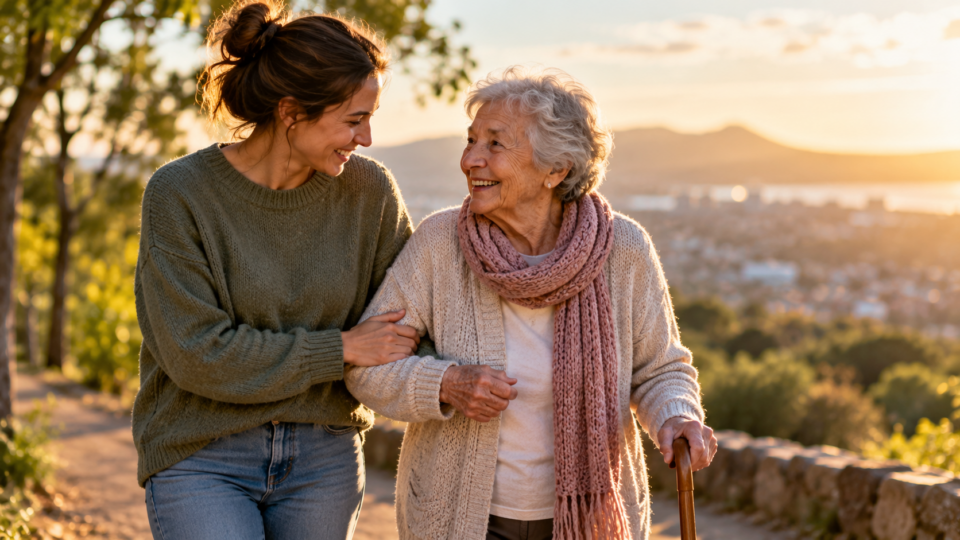
Why helping others may matter
A major European study suggests that older people who offer unpaid practical assistance to people outside their household are less likely to report heart problems. The research is observational, however, and it cannot show that helping others prevents cardiovascular disease. People who are already healthier may simply be better able to help.
Researchers Raquel Cervigón and Evangelos Kontopantelis examined 62,881 adults aged 50 to 84 in 28 countries using Wave 9 of the Survey of Health, Ageing and Retirement in Europe (SHARE). Interviews took place during 2021 and 2022. The study appeared in PLOS One on 9 October 2026.
It extends discussions about the health value of social relationships by asking whether being the person who provides help, rather than receives it, is linked to cardiovascular health.
What the researchers measured
The study focused on practical assistance to relatives, friends or neighbours who lived outside the respondent’s household. Assistance could involve transport, repairs, gardening, household tasks or paperwork. It was not a study of intensive, round-the-clock care for a spouse living in the same home.
Participants were classified according to whether they had provided such assistance during the preceding 12 months, and whether they helped one recipient or at least two. Cardiovascular history was measured by asking whether a doctor had ever diagnosed heart attack, coronary thrombosis, coronary occlusion or another heart problem, including congestive heart failure.
This was self-reported lifetime history, not newly verified disease during a follow-up period. Stroke was examined separately. The researchers adjusted their statistical models for age, sex, education, marital status, household wealth and country, and undertook further sensitivity analyses.
Who participated
The final dataset included 62,881 community-dwelling adults aged 50 to 84. Respondents aged 85 or older and those living in nursing homes were excluded. Only 269 otherwise eligible participants, approximately 0.43%, lacked information required for the analysis. Of those included, 16,178, or 25.7%, reported helping somebody outside their household.
The remaining 46,703 did not report such help. Across the full sample, approximately 11.8% reported one of the heart diagnoses covered by the question. These figures describe a selected survey population and should not be interpreted as the current heart-disease prevalence in every European country.
The raw difference was four percentage points
Among respondents who helped others, 8.8% reported cardiovascular disease, compared with 12.8% of those who did not help. That is a four-percentage-point difference before adjusting for other characteristics. Stroke was reported by 2.5% of carers and 4.2% of non-carers. Yet the groups differed in ways that could affect both their capacity to help and their health.
Carers were younger on average, at 66.0 years compared with 69.2 years among non-carers. Hypertension was reported by 39.9% of carers and 48.8% of non-carers; diabetes by 11.7% and 16.2%, respectively. Such differences make it unsafe to interpret the unadjusted four-point gap as a benefit caused by helping.
What happened after adjustment
In the main adjusted logistic regression, people providing informal care had an odds ratio of 0.85 for reported cardiovascular disease, with a 95% confidence interval from 0.78 to 0.93 and p below 0.001. In statistical terms, the estimated odds were 15% lower after accounting for measured demographic and socioeconomic factors.
That is not the same as proving that helping reduces an individual’s future probability of a heart attack by 15%. The analysis concerned past diagnoses and recent helping activity observed at one point in time.
Additional models including hypertension, diabetes, depressive symptoms, body mass index, smoking, inactivity and social-network size yielded odds ratios around 0.86, with 95% confidence intervals of 0.78 to 0.94 and 0.79 to 0.95.
These added factors may themselves be pathways through which social participation relates to health, making their interpretation more complicated.
Helping more recipients was not consistently better
Respondents who helped one person had an adjusted odds ratio of 0.83, with a 95% confidence interval of 0.76 to 0.91, compared with non-carers. Those helping two or more people had an odds ratio of 0.88, with a 95% confidence interval of 0.79 to 0.98. The association was therefore not progressively stronger among those helping more people.
This matters because a simple dose-response pattern might have been expected if the number of people helped directly determined the health benefit. However, number of recipients is a crude measure of caring intensity. Helping one person for many hours each week may be more demanding than occasionally helping several neighbours.
The survey could not fully distinguish these patterns.
Related findings for stroke and other conditions
For a combined heart-disease-or-stroke outcome, the adjusted odds ratio was 0.80, with a 95% confidence interval of 0.74 to 0.87. In an exploratory stroke-only analysis it was 0.70, with a 95% confidence interval of 0.63 to 0.79. The apparently stronger stroke association should not be read as evidence of stronger protection.
Stroke can impair movement, speech and cognition, making it harder for someone to provide assistance afterwards. The direction of influence may therefore run from health to helping. Carers also showed slightly lower adjusted odds of hypertension, 0.93 with a 95% confidence interval of 0.88 to 0.98, and diabetes, 0.86 with a 95% confidence interval of 0.81 to 0.91.
These secondary observations do not establish a physiological mechanism.
Could healthier people be more able to help?
Reverse causality is the central difficulty. Someone who has already experienced heart failure, stroke or declining mobility may be unable to drive a neighbour or assist with household repairs. The investigators examined several restricted samples to explore this concern.
After excluding respondents who received assistance themselves, the odds ratio was 0.81 (95% confidence interval 0.74 to 0.89). Excluding those with limitations in activities of daily living gave 0.87 (0.80 to 0.96). Excluding people with depressive symptoms produced 0.87 (0.78 to 0.96).
However, after excluding respondents reporting fair or poor overall health, the estimate moved toward no association: 0.95 (0.84 to 1.06). Because that confidence interval includes one, it did not demonstrate a clear difference in that subgroup. Restricting samples can introduce selection problems of its own, so none of these checks settles the causal question.
Sensitivity tests and remaining uncertainty
The most restrictive analysis included 33,006 people and produced an odds ratio of 0.89, with a 95% confidence interval of 0.80 to 1.00. A survey-weighted analysis gave an estimate of 0.78, with a confidence interval of 0.63 to 0.96. The authors also reported an E-value of approximately 1.39 for the primary association.
This sensitivity statistic gauges the strength of an unmeasured factor’s relationships with both helping and cardiovascular health that could explain away the association. A value around 1.4 is not particularly large: unmeasured physical fitness, mobility, health-service use or other circumstances could plausibly be relevant.
Large sample size makes estimates more precise but does not eliminate hidden confounding.
What this means for communities
Practical help may keep people socially connected and physically active and give them a continuing sense of purpose. It may also involve emotional strain, travel expenses and physical demands. Those possibilities were not established as causal mechanisms by this study.
The findings do not justify instructing older people to take on unpaid caring duties as a form of medical prevention, and they should not be used to stigmatise people with disabilities who cannot volunteer. Community programmes can value manageable, voluntary opportunities for participation without claiming that they are proven to prevent heart attacks.
Established cardiovascular prevention and appropriate medical treatment remain essential.
Why the design matters
The study was cross-sectional. It asked about helping during the past year but about heart conditions diagnosed at any point in a person’s life. A diagnosis could have preceded the reported assistance by decades. Both caring and disease history were self-reported, and the outcome grouped different heart conditions.
The survey did not measure the hours, physical intensity or emotional burden of help sufficiently to distinguish light neighbourly assistance from demanding care. Participants were community-dwelling adults in SHARE countries, so findings cannot simply be generalised to institutionalised older people or to other regions.
A stronger future study would follow initially disease-free adults over time, measure changes in helping behaviour, and identify new clinically confirmed cardiovascular events.
The central finding
The study provides evidence of an association, not a proven intervention. Across 62,881 older adults, those providing practical assistance outside their household reported fewer past heart problems, even after several statistical adjustments. But younger age, better health and the ability to offer help complicate the interpretation.
The responsible takeaway is that helping others may be one feature of socially engaged, healthier ageing, while the direction and mechanisms of the relationship remain unresolved.
Source Information
Original research: Cervigón, R. and Kontopantelis, E. (2026). Informal care outside the household by older people and cardiovascular health of caregivers: A Cross-Sectional Analysis of the SHARE European study. PLOS One, 21(10), e0359074.
Published: 9 October 2026.
Study type: Peer-reviewed cross-sectional observational analysis of SHARE Wave 9 (2021 to 2022), 62,881 adults aged 50 to 84 across 28 countries.
DOI: https://doi.org/10.1371/journal.pone.0359074.
Research data: SHARE Release 9.0.0; statistical code
Statistical code DOI: 10.6084/m9.figshare.33122441.