When a choice comes with an extra mental task
People making uncertain decisions must balance the security of a familiar option against the possibility of a better but less predictable outcome.
A new controlled laboratory experiment suggests that adding a separate mental task can shift that balance toward caution, while a form of non-invasive electrical brain stimulation is associated with more frequent risky choices. The findings come from 60 adults tested in India and were published in PLOS One on 9 October 2026.
The results concern a specialised laboratory task, not everyday investing, gambling or clinical treatment.
Why the experiment matters
Choosing whether to stick with something familiar or try an uncertain alternative is a common problem in everyday life. A consumer may weigh a known product against a new brand. A manager may decide whether to investigate a promising idea or continue a reliable approach. Cognitive scientists call this the exploration-exploitation trade-off.
Research suggests that attention, working memory and past feedback all matter. This study examined two influences at once: the extra mental effort of answering trivia questions and transcranial direct current stimulation, or tDCS, targeting the left dorsolateral prefrontal cortex.
That brain region contributes to attention, goal maintenance and flexible decisions, but stimulation effects vary across settings.
Who took part
Researchers Ankit Singh, Varun Dutt and Akash K. Rao recruited 60 healthy adults aged 18 to 45 at the Indian Institute of Technology Mandi. The participants’ average age was 24.8 years, with a standard deviation of 3.4 years. The sample included 36 men and 24 women from different academic backgrounds.
People with relevant medical or neurological contraindications were screened out. Recruitment took place between April and July 2025. Participants received fixed compensation rather than payments tied to winning the decision game. Each participant was randomly assigned to one of four experimental conditions, with 15 people per group.
Four conditions separated mental load and stimulation
The study used a two-by-two experimental design. Half the participants received active anodal tDCS and half a sham procedure. Separately, half answered trivia questions before decisions and half went straight to the decisions. This produced four groups: active stimulation with trivia, active stimulation without trivia, sham with trivia, and sham without trivia.
The researchers aimed to test whether the two manipulations had independent effects or whether the effect of stimulation depended on mental load. Participants were not told whether they had active or sham stimulation, although the experimenter knew. The success of participant blinding was not formally tested.
What brain stimulation involved
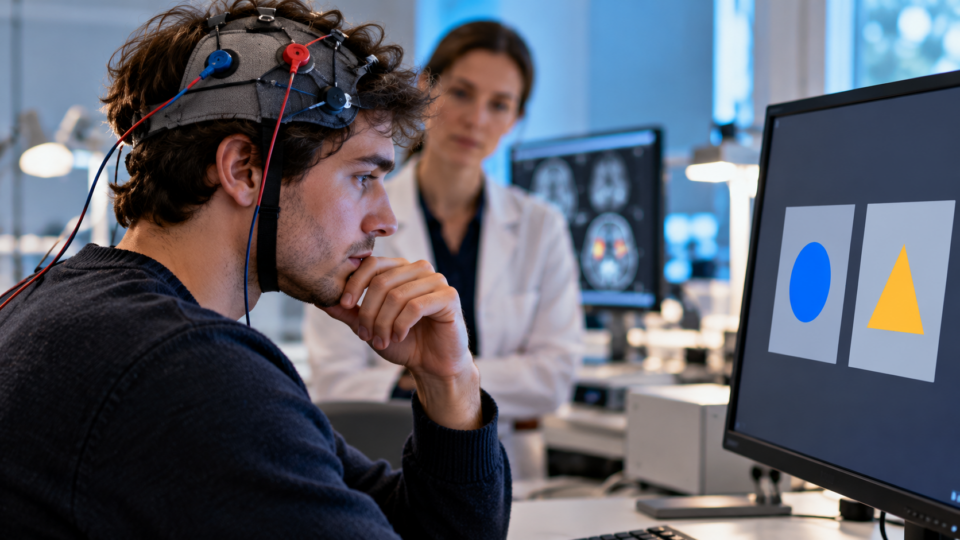
Active stimulation used a weak electrical current of up to 2 milliamperes for approximately 20 to 22 minutes, with the main electrode positioned to target the left dorsolateral prefrontal cortex. In the sham condition, current was briefly ramped up and then turned down to mimic the initial sensation without sustained stimulation.
The stimulation took place before the decision task. The authors reported no serious adverse effects, although some participants experienced transient tingling. The experiment does not demonstrate that an individual brain region was selectively activated, nor does it establish a safe or effective consumer method for improving decisions.
Readers should not attempt to replicate electrical stimulation themselves.
The 50-trial decision game
Every participant completed 50 decisions. The safe option delivered a guaranteed reward of about 2.5 to 3.5 points. The risky option offered either nothing or a much larger reward of 16 to 18 points, with a probability of roughly 18% to 22% for the larger outcome.
A third option allowed participants to spend one point to reveal the current trial’s risky-outcome probability before choosing safe or risky. Researchers recorded reaction time, risky choices, paid information-seeking choices and alternation between safe and risky selections. Importantly, paying for information was a separate choice from taking a risk.
Switching often could indicate exploration, but it could also reflect uncertainty or unstable learning.
How trivia added mental demand
In the trivia conditions, participants answered one general-knowledge question before each decision. The questions covered topics such as geography, science, culture, mathematics and history. Half the questions were comparatively straightforward recall items and half required more complex reasoning or comparison. The order was randomised.
The no-trivia groups made the same reward decisions without that preceding task. This manipulation added mental processing demands, but it also added time and a different sequence of events. The design cannot perfectly separate mental load from every other difference introduced by the trivia questions.
Extra mental work slowed decisions
Participants in the trivia condition took an average of 4.35 seconds to respond to the decision screen, compared with 3.27 seconds for those without trivia. That difference of 1.08 seconds was statistically significant in the authors’ factorial analysis, F(1,56) = 4.219, p = 0.045, with partial eta-squared of 0.070.
Active stimulation participants responded numerically faster than sham participants, 3.34 versus 4.28 seconds, but the stimulation main effect did not meet the study’s significance threshold, p = 0.083. The stimulation-by-trivia interaction for reaction time was also not significant, p = 0.609.
It would therefore be inaccurate to describe brain stimulation as proven to speed decision-making in this experiment.
Risk-taking moved in opposite directions
The clearest behavioural differences concerned risky choices. Under active stimulation, participants selected the risky alternative on average in 59.1% of trials, compared with 33.8% under sham. The stimulation main effect was reported as F(1,55) = 323.285, p below 0.001, partial eta-squared 0.855.
Trivia-based load was associated with fewer risky choices, 42.8% compared with 50.6% in the no-trivia condition, F(1,55) = 27.109, p below 0.001. The interaction was not significant, p = 0.800.
The pattern was therefore consistent with stimulation increasing risky selection and trivia reducing it, without evidence that their effects on this particular outcome depended on each other.
A closer look at the four groups
The mean proportion of risky choices under sham stimulation was 37.7% without trivia and 30.1% with trivia. Under active stimulation it was 62.5% without trivia and 55.7% with trivia. Those numbers make the opposing directions easier to understand. In both stimulation conditions, adding trivia corresponded to fewer risky selections.
In both trivia conditions, active stimulation corresponded to more risky selections. Yet this does not mean active stimulation improved decisions. The risky alternative sometimes paid nothing, and the study did not establish a universal benchmark for the best behaviour outside its particular reward structure.
Information seeking behaved differently
Paying one point to reveal information occurred in 31.3% of trials under active stimulation and 26.1% under sham, a significant main effect, F(1,55) = 5.916, p = 0.018. But the average effect of trivia alone was not significant, p = 0.921. Instead, the interaction between stimulation and trivia was significant, F(1,55) = 14.217, p below 0.001.
Under sham, information seeking was lower with trivia, 22.1%, than without it, 30.3%. Under active stimulation, it was higher with trivia, 35.2%, than without it, 27.5%. The researchers did not report separate simple-effects tests for every cell, so the individual contrasts should be treated as descriptive rather than each being declared statistically significant.
Switching between options also depended on context
Participants alternated between safe and risky options on 18.7% of transitions under active stimulation, versus 13.2% under sham. The stimulation main effect was significant, p = 0.002. The overall trivia effect was not significant, p = 0.308, but the stimulation-by-trivia interaction was, p = 0.016.
Under sham, alternation was 14.5% without trivia and 12.0% with it; under active stimulation it was 15.8% without trivia and 21.6% with trivia. The authors noted that the statistical assumption of equal variance was violated for alternation, so this particular interaction deserves additional caution.
More switching should not automatically be equated with better learning.
What the results do and do not establish
The experiment suggests that the same additional mental task can have different relationships with different components of decision behaviour. Trivia slowed responses and reduced risky selections, while the effects on costly information gathering and switching depended on stimulation condition.
These distinctions are more informative than saying mental overload simply makes people irrational or stimulation makes them smarter. There was no real-world consumer choice, clinical outcome or long-term performance measure. A statistically significant shift in behaviour is not the same as an improvement in the quality of a decision.
Limits that matter
The sample was small, with 15 participants in each group, and came from one institution. The choice-outcome analyses used 59 complete cases rather than all 60 participants. The experimenter was aware of stimulation assignments, blinding success was not assessed, and individual electric-field delivery was not measured directly.
The participants were predominantly young adults, so the findings should not be generalised to older people or to people with neurological conditions. The study tested several related outcomes, raising the importance of replication. Some effects were very large in this sample, but independent studies are needed to establish how stable they are.
Why everyday readers should care
The practical relevance is conceptual rather than prescriptive. The experiment illustrates why decision-makers should distinguish between the time it takes to choose, the willingness to accept uncertainty, the desire to purchase information and the tendency to switch strategies. These are different behaviours.
In workplaces, schools and digital products, unnecessary cognitive demands may change the way people engage with uncertain options, but this single laboratory study cannot specify the magnitude or direction of such effects in those settings. It also offers no justification for self-administered brain stimulation.
What researchers should test next
A larger preregistered replication across multiple sites could test whether the striking risk-choice difference persists and whether the information-seeking interaction remains after correction for multiple outcomes.
Follow-up work could vary the expected value of the safe and risky options, use incentives tied to performance, and test cognitive demand that is more representative of real tasks. Researchers could also compare different stimulation protocols and include formal checks of blinding.
Those improvements would clarify whether the observed changes are robust and whether any of them improve adaptive decision-making rather than simply shifting choices.
The central finding
In a randomised four-group laboratory experiment involving 60 adults, trivia questions increased decision time and reduced risky choice. Active prefrontal tDCS was associated with more risky choices, more paid information seeking and more switching between options. The effect of trivia on information seeking and switching differed by stimulation condition.
These results reveal distinct, context-dependent aspects of decision-making under uncertainty, but they do not establish that electrical stimulation improves real-life judgment.
Source Information
Original research: Singh, A., Dutt, V. and Rao, A. K. (2026). Cognitive load and prefrontal neuromodulation shape exploration, risk-taking, and information seeking in experience-based decision making. PLOS One, 21(10), e0360059.
Published: 9 October 2026.
Study type: Peer-reviewed, randomised 2 × 2 factorial laboratory experiment involving 60 adults aged 18 to 45, 50 decision trials per participant.