




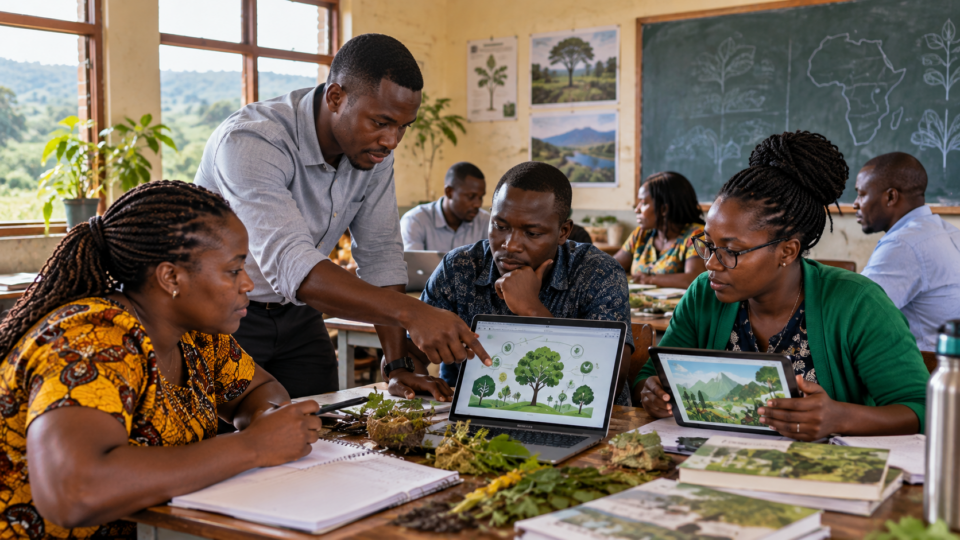
A low-cost digital learning platform developed for teacher trainees in Uganda received an overall satisfaction rating of 4.38 out of five, according to research published on 13 October 2026. The project involved 52 in-service trainees and explored whether a simple, context-specific website could make environmental education more accessible.
The researchers found that 86% of respondents considered the platform easy to navigate, while 88% believed its multimedia resources improved their understanding of environmental concepts. Google Analytics recorded an average engagement time of eight minutes and 49 seconds, with the most activity taking place over weekends.
These results describe a promising user experience, not proof that the platform improved examination results or long-term teaching performance. The study used iterative design, surveys, interviews and usage analytics rather than a randomised comparison with conventional teaching.
Why environmental education needed a different approach
Environmental education helps teachers introduce topics such as sustainability, ecosystems, pollution and resource management to their learners. In teacher-training programmes, however, these subjects must compete for limited classroom time with other professional requirements.
The Ugandan study focused on the Diploma in Education Primary programme, which serves teachers already working in schools. Because these trainees often attend classes during weekends and school holidays, the researchers argued that a flexible online resource could help them study outside conventional teaching hours.
The challenge was not simply to place lecture notes on a website. The team wanted to build a learning environment that suited local access conditions, reflected the environmental education curriculum and could be refined through feedback from the people expected to use it.
The resulting platform was called the EnviroEd Learning Hub. It was built using Google Sites, a website-creation tool that allows educators to organise text, videos, activities and links without developing a custom software application.
Who took part in the research?
The research took place at a government-accredited teacher-training institute in southwestern Uganda. The principal student sample comprised 52 in-service teacher trainees drawn from a population of 67, alongside two teacher educators and one information and communications technology instructor.
The researchers described a systematic sampling procedure for selecting student participants. Educators and the ICT instructor were selected purposively because their responsibilities gave them direct knowledge of curriculum delivery and technical support.
The study was designed around four iterative phases. Instead of releasing a completed website and assessing it once, the researchers collected feedback, made changes and evaluated the refined version. This is known as design-based research.
Data came from online questionnaires administered at several stages, interviews, two focus-group discussions and Google Analytics. Combining these sources allowed the researchers to examine what participants said about the website alongside some evidence of how it was used.
A framework built around usability and collaboration
The design drew on the Technology Acceptance Model, which examines perceived usefulness and perceived ease of use, and Social Constructivist Theory, which emphasises learning through interaction, participation and shared meaning-making.
Those frameworks guided practical decisions about navigation, resource presentation and learning activities. A platform that is technically accessible but difficult to navigate may still fail to support learning, particularly when users have limited time or variable internet access.
The team also paid attention to whether materials could be accessed on the devices trainees actually used. This matters because a digital resource that works well on a desktop computer may be less practical for learners who depend on mobile devices.
The researchers reported that feedback during the development process influenced the organisation of materials and the inclusion of multimedia and interactive features. This iterative approach was intended to make the website more responsive to users than an untested, one-size-fits-all design.
What the final evaluation found
The final student survey included 50 respondents, slightly fewer than the 52 trainees involved in the wider project. Of these respondents, 38, or 76%, identified multimedia resources as a preferred feature.
Clear content organisation was selected by 58% of respondents. Interactive tools and ease of navigation were each identified by 50%, indicating that different features mattered to different users.
A larger proportion, 88%, agreed or strongly agreed that multimedia helped them understand environmental education concepts. The researchers reported a mean rating of 4.4 out of five on this item, with a standard deviation of 0.74.
Another 78% indicated that multimedia content performed well on their devices, with a mean rating of 4.0 and a standard deviation of 0.91. This is encouraging but also suggests that some participants may have experienced device-related limitations.
The study’s overall platform satisfaction score was 4.38 out of five. That figure summarises participants’ reported experience rather than providing a direct measure of knowledge gained or teaching quality.
The researchers also reported that 86% found the platform easy to navigate. Taken together, the results indicate that the design was generally well received among the participating trainees.
What the usage data added
Google Analytics recorded an average engagement time of eight minutes and 49 seconds. The highest usage occurred on weekends, consistent with the programme’s structure and the schedules of teachers studying while employed.
This observation matters because digital education tools are often evaluated using satisfaction questionnaires alone. Usage analytics can add a different perspective by showing whether learners actually open and spend time with the resource.
However, engagement time should not be confused with focused study time or learning achievement. A long session may reflect careful reading, but it may also include inactivity, interruptions or difficulty finding information.
The study did not establish that eight minutes and 49 seconds is an optimal learning duration. The figure is best understood as descriptive evidence of platform interaction within this particular educational setting.
Qualitative interviews and focus groups offered further context. Participants valued the combination of organised content, videos and other multimedia resources, and some described gaining confidence in using digital tools for professional learning.
Why a low-cost platform could matter
Many education technology initiatives require dedicated software, extensive technical support or recurring licensing expenditure. A site built on a widely available website tool may lower some of those barriers, although connectivity, device access and staff time still carry costs.
For institutions operating with constrained budgets, the study suggests that thoughtful organisation and locally relevant content can be at least as important as sophisticated technology. The platform was designed around a particular curriculum and group of learners rather than introduced as a generic digital product.
The approach may be relevant to other professional training programmes where participants work during the week and have limited opportunities to attend in-person sessions. Flexible access could support revision and preparation between scheduled classes.
The environmental education focus is also significant. Teachers who can find understandable, reusable resources may be better placed to introduce sustainability topics in their own classrooms, though this project did not directly measure downstream outcomes among school pupils.
The distinction between access and learning
The authors interpreted their findings as evidence that a contextually designed digital platform can improve access, engagement and perceived usefulness in teacher education. Those are meaningful outcomes for a development project.
Yet positive attitudes are not the same as demonstrated educational gains. The research did not report a randomised controlled trial, and the available results do not show a robust comparison of standardised knowledge scores between platform users and a separate control group.
Participants may have responded positively partly because the website was new, because they knew the researchers or because the intervention addressed a previously unmet need. These possibilities do not invalidate their feedback, but they limit causal conclusions.
The sample was also relatively small and drawn from one training institution. Findings from 52 trainees cannot automatically be generalised to all Ugandan teachers or to education systems elsewhere in Africa.
Infrastructure remains another practical constraint. Even a relatively simple platform depends on functioning devices, electricity, internet connectivity and some level of digital literacy. A design that performs well under one set of conditions may require modification in another.
How institutions could use the findings
A practical lesson is to begin with learners’ circumstances before selecting technology. Institutions could ask when students study, what devices they use, how much data they can afford and which topics they find difficult to understand.
They could then test a small prototype, collect feedback and revise it before expanding the platform. The Ugandan project illustrates how surveys, interviews and analytics can be combined to support this process.
Educators should also distinguish between making a resource available and ensuring that it supports learning. Clear objectives, accurate content, accessible formats and opportunities for feedback remain necessary even when students report high satisfaction.
For environmental education specifically, local examples may make abstract concepts more relevant. A resource that connects sustainability topics to familiar landscapes and community challenges could be more useful than one based entirely on distant contexts.
What future studies should test
The next step would be to compare learning outcomes for trainees using the platform with those receiving other forms of instruction. Assessments administered before and after training could provide stronger evidence about knowledge acquisition.
Researchers could also examine whether teachers subsequently use environmental education concepts in their own classrooms, and whether their pupils show measurable improvements in understanding or behaviour.
Longer follow-up would help determine whether initial enthusiasm persists after the novelty of the platform fades. Studies across several institutions could also reveal which design features work consistently and which need local adaptation.
The most defensible conclusion is that a relatively simple, iteratively designed website was acceptable and useful to many participants in this Ugandan teacher-training setting. The project provides a practical model for developing accessible digital resources, while leaving their long-term educational impact open for further testing.
Source Information
Study title: Designing a contextual google site-based learning platform for environmental education in Ugandan teacher training: a design-based research study.
Authors: Nicodemus Epaphras, Esther Kibga and Jane Rarieya.
Journal: Discover Education, volume 5, article 1161.
Publication date: 13 October 2026.
Research design: Iterative design-based research using surveys, interviews, focus groups and Google Analytics.
Participants: 52 in-service teacher trainees, two teacher educators and one ICT instructor at a southwestern Ugandan training institute; final student survey n = 50.
Key findings: Overall satisfaction 4.38/5; 86% found navigation easy; 88% reported improved understanding from multimedia; average analytics engagement time 8 minutes 49 seconds.
Original DOI: 10.1007/s44217-026-02291-2.