









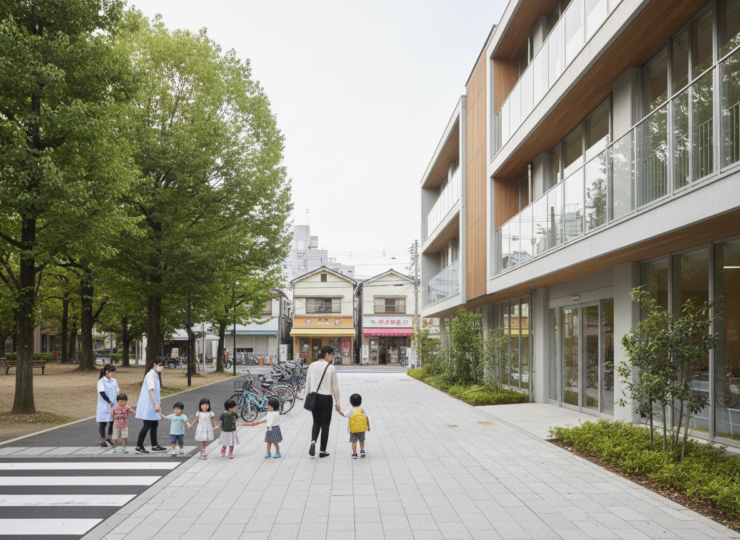
A childcare centre is more than a building. For families, it sits inside the daily chain of commuting, shopping, walking and collecting children. For childcare workers, the same centre is a workplace connected to parks, streets, medical services and routes that must remain safe during everyday outings and emergencies.
A new study from Japan shows how those different roles shape what people value in urban childcare infrastructure. Surveying parents and childcare workers across 41 facilities in Matsudo City, researchers found that satisfaction with the equipment and internal environment of the childcare facility was the strongest predictor of overall satisfaction for both groups. Yet when the researchers looked more closely, parents and workers emphasised different features of the surrounding city.
Parents placed greater weight on features that fit childcare into family life, including shopping facilities, parks, transport and safe evacuation routes. Childcare workers placed more emphasis on the resources and conditions that support care itself, including parks and playgrounds, staff spaces, cleanliness and safe pedestrian environments.
The findings, published on 1 October 2026 in Smart Construction and Sustainable Cities, suggest that planning childcare infrastructure requires more than choosing a building and measuring its capacity. The neighbourhood around the facility can affect how well it works for both the people using the service and the people providing it.
A city-level view of childcare
The researchers studied Matsudo City in Chiba Prefecture, within the commuting area of Tokyo. The city has a population of roughly 500,000 and includes public, private and small-scale childcare facilities across neighbourhoods with different population densities and levels of childcare capacity use.
Rather than treating a childcare facility as an isolated building, the researchers defined urban childcare infrastructure broadly. Their framework included the facility itself as well as the surrounding environment, safety systems, public transport, parks, medical and commercial facilities and other local resources that support childcare.
All licensed childcare facilities in Matsudo City were invited to participate. Forty-one agreed: 14 public facilities, 10 private facilities and 17 small-scale facilities. The researchers distributed 622 questionnaires to parents and obtained 308 valid responses, a response rate of 49.5%. They also distributed 344 questionnaires to childcare workers and received 245 responses, a response rate of 71.2%.
The final sample therefore represented two substantial perspectives on the same childcare environments: 308 parents and 245 workers. Because some respondents had missing data, the number included in individual analyses varied slightly. Parent analyses generally included between 306 and 308 people, while worker analyses included between 234 and 244.
The questionnaire examined three broad domains: facility equipment, the surrounding environment, and the safety of that surrounding environment. The researchers first tested correlations with overall satisfaction and then used multiple regression models to identify which domains were independently associated with the overall evaluation of a childcare facility.
The facility itself had the strongest link to satisfaction
For both groups, all three domains were significantly positively correlated with overall satisfaction. But the internal facility environment emerged as the strongest independent factor.
Among parents, satisfaction with facility equipment had a standardised regression coefficient of β = 0.446. Among childcare workers, the coefficient was β = 0.429. In both models, this was stronger than the corresponding associations for the surrounding environment and surrounding safety.
The three-domain model explained 41.9% of the variance in parents’ overall satisfaction and 52.6% of the variance among childcare workers. Both models were statistically significant at p < 0.001.
That difference in explanatory power is informative. The physical environment captured by the study accounted for more than half of the variation in workers’ overall evaluations, but a smaller proportion of parents’ evaluations. The authors suggest that parents may also be judging factors not measured in the survey, such as the quality of care, relationships with staff and individual family circumstances.
Workers, meanwhile, spend sustained periods inside the facility and routinely use its equipment, surrounding resources and safety infrastructure as part of their jobs. Their overall judgement may therefore be more directly tied to these physical conditions.
Inside the centre, comfort mattered to both groups
When the researchers broke down satisfaction with facility equipment, the comfort of furniture and equipment was an important factor for both parents and workers. Beyond that shared priority, their evaluations diverged in ways that reflected their different roles.
For parents, six of 25 candidate equipment items were independently associated with satisfaction. Comfort of furniture and equipment was the strongest, followed by the size of childcare rooms and the availability of educational materials and toys. The model explained 53.7% of the variance in parents’ satisfaction with facility equipment, with an adjusted R² of 0.528.
Parking-related items were statistically associated with parents’ evaluations, but the relationships were comparatively small. This suggests that parents were not judging the facility primarily by the convenience of the few minutes spent arriving or leaving. They were especially attentive to the environment in which their children spend much of the day.
For childcare workers, six of 24 candidate equipment items were independently associated with satisfaction. Comfort of furniture and equipment again ranked first, but staff break spaces and facility cleanliness were also prominent. This model explained 72.4% of the variance in workers’ equipment satisfaction, with an adjusted R² of 0.716.
The result highlights a part of childcare infrastructure that can be easy to overlook. A facility must provide an appropriate environment for children, but its quality as a workplace can also matter substantially to the people delivering care every day.
Parents valued neighbourhood convenience while workers focused on usable local resources
The clearest differences appeared outside the building.
Among parents, nine of 19 surrounding-environment items were independently associated with satisfaction. Shopping facilities such as supermarkets had the strongest association, followed by access to parks and playgrounds. The model explained 62.9% of the variance in parents’ satisfaction with the surrounding environment, with an adjusted R² of 0.618.
This pattern reflects the way childcare is embedded in a family’s daily movements. A centre near shops, transport and recreational space can make it easier to combine drop-off and collection with commuting, errands and children’s activities.
Childcare workers looked at the neighbourhood through a somewhat different lens. Five of the 19 surrounding-environment items were independently associated with their satisfaction. The number of parks and playgrounds was the strongest factor, followed by the safety of those spaces, medical facilities and commercial facilities. Their model explained 46.8% of the variance, with an adjusted R² of 0.456.
For workers, nearby parks are not simply amenities. They can become extensions of the childcare environment, particularly for centres that use neighbourhood spaces for outdoor activities. Medical facilities and other nearby resources may also matter for routine operations and emergency preparedness.
Safety priorities also reflected different responsibilities
Parents and childcare workers shared several safety priorities, including maintained sidewalks, clear visibility, neighbourhood security and evacuation routes. But the relative importance of those features again differed.
For parents, six of 16 safety items were independently associated with satisfaction. Maintenance of evacuation routes had the largest association, followed by sidewalk maintenance. The model explained 57.4% of the variance in parents’ satisfaction with surrounding safety, with an adjusted R² of 0.566.
For childcare workers, sidewalk maintenance was the most prominent safety factor. That makes practical sense because workers may regularly move groups of young children through the neighbourhood for walks and off-site activities. Crime-prevention equipment was also associated with worker satisfaction, pointing to a broader operational view of safety.
The distinction matters for planners. A route that feels convenient to a parent travelling with one child may pose different challenges to a worker supervising an entire group. Likewise, parents may place particular value on knowing that a centre has safe evacuation connections during a disaster even if those routes are rarely used in ordinary life.
What the findings mean for urban planning
The study argues for a more integrated approach to childcare planning. Decisions about childcare facilities often sit across administrative boundaries. One department may oversee childcare services, while others control roads, parks, public transport, disaster planning, crime prevention or welfare services.
The results suggest that these systems are experienced together. A high-quality childcare building can still be weakened by unsafe sidewalks, poor access to parks or inadequate evacuation routes. Conversely, a well-connected neighbourhood cannot compensate fully for cramped rooms, uncomfortable equipment or poor working conditions inside the centre.
For facility design, the evidence points toward adequate room sizes, comfortable and flexible furniture, appropriate learning materials, cleanliness and proper staff spaces. At neighbourhood scale, it points toward accessible parks, safe pedestrian routes, nearby everyday services and credible disaster-preparedness infrastructure.
The broader implication is that childcare infrastructure has at least three overlapping users: children, families and workers. Their interests often align, particularly around safety and good internal environments, but they are not identical. Planning based on only one perspective risks missing conditions that are important to the others.
Important limitations
The findings should not be read as universal design rules. The study was cross-sectional, so it identifies associations rather than proving that changing a particular feature will cause satisfaction to rise. It was also conducted in a single Japanese city, which limits how confidently the findings can be generalised to cities with different transport systems, childcare models, urban forms or cultural expectations.
Participation was voluntary. Although all licensed childcare facilities in the city were invited, the 41 participating facilities were those that agreed to take part rather than a random sample. Parents were also current users of childcare facilities, which may shape their evaluations.
The surrounding environment was measured through participants’ perceptions rather than objective spatial indicators. Future work could combine surveys with geographic information systems, network analysis, catchment areas and disaster-hazard data to test whether subjective satisfaction corresponds with measurable accessibility and risk.
Even with those limitations, the study provides a useful quantitative comparison of people who encounter the same childcare infrastructure from different sides. Parents and workers largely agreed on the importance of the facility itself, but their neighbourhood priorities reflected the practical realities of family life and childcare work.
Source Information
Study: Ohara, K., Nakao, R., Sindete, M.J. et al. Urban childcare infrastructure in Japan: evaluating satisfaction from the perspectives of parents and childcare workers in Matsudo City.
Journal: Smart Construction and Sustainable Cities, Volume 4, Article 22 (2026).
Published: 1 October 2026.
DOI: 10.1007/s44268-026-00100-1