








A hidden threshold beneath frozen ground
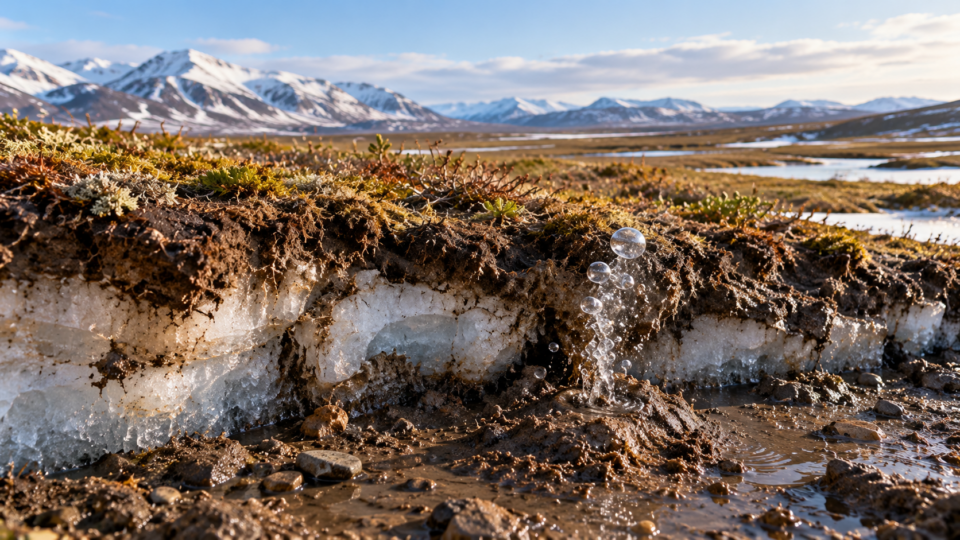
Frozen ground can act as a barrier to gas moving through soil.
As that ground warms, the barrier may weaken in ways that are not gradual.
New laboratory experiments have identified pressure thresholds at which gas suddenly breaks through thawing soil.
The research was conducted using silty sand collected from Alaska’s North Slope.
Scientists controlled the temperature, confinement and pressure applied to frozen specimens.
They observed that gas movement depended on several interacting physical properties.
The results could improve models of gas migration in degrading permafrost.
They do not directly measure methane escaping from the Arctic landscape.
Why permafrost matters
Permafrost is ground that remains frozen for at least two consecutive years.
It occurs across extensive northern landscapes and in some high-altitude regions.
Frozen soils can contain organic carbon and influence the movement of groundwater and gas.
Warming changes the distribution of ice and liquid water within the ground.
It can also affect the strength of the soil.
These changes matter because gas may accumulate beneath relatively impermeable layers.
A weakened layer can sometimes allow that gas to move upward.
Understanding when this happens is one part of assessing climate-related changes in cold regions.
The new study focused specifically on the mechanics of breakthrough.
The research question
Researchers wanted to identify the conditions required for gas to pass through an initially ice-sealed soil specimen.
That is different from asking how much methane microbes produce.
It is also different from measuring the total methane emitted by a landscape.
The team examined how water content, tensile strength and confinement changed with temperature.
They then applied gas pressure to frozen specimens.
The experiments sought to establish when sustained flow first appeared.
This pressure was treated as the breakthrough threshold.
The central finding was that the threshold shifted substantially as the soil warmed.
The relationship was not captured by temperature alone.
A laboratory study using Alaskan soil
The scientists used silty sand obtained from Alaska’s North Slope.
They prepared controlled specimens rather than testing intact natural permafrost in the field.
The material was dried, processed and combined with water under specified laboratory conditions.
That preparation made comparisons more consistent.
It also reduced some of the complexity found in natural soils.
Real permafrost may contain layers, roots, ice lenses, fractures and varying mineral compositions.
Those features can influence gas pathways.
The experiment therefore offers mechanistic evidence rather than a direct replica of an Arctic landscape.
The authors explicitly cautioned against treating laboratory thresholds as field measurements.
Why the team used nitrogen
Although methane migration motivated the research, nitrogen was the gas injected into the specimens.
That choice was deliberate.
Nitrogen allowed the scientists to examine mechanical breakthrough without adding methane hydrate formation and dissociation.
The experiments therefore isolated part of a larger environmental process.
They measured when pressure could open a path through frozen soil.
They did not recreate every chemical or biological process involved in methane release.
No methane emissions were measured at an Arctic field site.
The distinction is essential for interpreting the climate implications.
The study provides information that could inform models of methane movement.
What happens to water below freezing
Water in soil does not necessarily freeze all at once.
Some liquid water can remain around soil particles even at temperatures below zero.
The amount depends on temperature and the properties of the material.
Researchers measured how this unfrozen fraction changed during cooling and warming.
The sharpest changes occurred near the freezing point.
The study found particularly rapid variation between approximately zero and minus two degrees Celsius.
At colder temperatures, a smaller residual liquid fraction persisted.
That changing mixture of ice and water affects how strongly soil particles are held together.
It also influences the spaces through which gas could travel.
Frozen soil becomes stronger as it cools
The team carried out direct tensile tests to measure resistance to pulling the soil apart.
Colder specimens generally resisted greater tensile forces.
At minus 15 degrees Celsius, the reported tensile strength exceeded 2,500 kilopascals.
Near the thawing point, the material offered much less resistance.
The authors described a transition from more ductile behaviour toward brittle failure as temperature decreased.
This pattern reflects changing ice bonding and unfrozen water content.
It helps explain why a gas barrier can behave differently after relatively small temperature changes.
However, tensile strength alone did not predict every gas breakthrough threshold.
The pressure and confinement conditions also mattered.
A pressure threshold rather than an open channel
The scientists increased gas pressure under controlled conditions.
Gas did not automatically flow simply because the soil became warmer.
Breakthrough required sufficient pressure to overcome the resistance of the pore network and surrounding material.
In some tests, no measurable migration occurred even after complete thawing.
That observation is an important qualification.
Warming can increase susceptibility without guaranteeing release.
The pressure available beneath the soil remains critical.
A gas reservoir with insufficient pressure may not force a path through saturated sediment.
The study therefore points to threshold behaviour rather than an inevitable response at one temperature.
The importance of confinement
Soil at depth is squeezed by the weight and pressure of surrounding material.
The laboratory reproduced different levels of confinement.
Higher confinement generally raised the pressure required for gas to break through.
This meant the threshold could be much higher than the tensile strength measured without confinement.
The distinction matters for interpreting subsurface conditions.
A shallow specimen and a deeply confined layer cannot be assumed to behave identically.
The researchers used pressures representing a range of subsurface stress states.
They observed breakthrough under different combinations of warming and gas pressure.
These results could help improve mechanical representations in future models.
What the seven stress-controlled tests showed
The study reported seven stress-controlled gas breakthrough cases.
The confining pressures ranged from 500 to 4,000 kilopascals.
At gas pressures of 200 to 500 kilopascals, breakthrough was not observed in the reported low-pressure cases.
At 750 kilopascals, one case showed breakthrough only after the specimen reached zero degrees Celsius.
Other cases involved substantially higher gas pressures.
Under stronger confinement, breakthrough occurred near minus one degree Celsius.
Those cases used gas pressures between 2,000 and 3,900 kilopascals.
The exact outcomes depended on the test conditions.
They should not be converted into a universal pressure threshold for natural permafrost.
Why minus one degree mattered
Several of the higher-pressure experiments showed breakthrough near minus one degree Celsius.
That temperature lies close to a region where the material’s water and ice balance changed rapidly.
The soil also lost much of its tensile resistance as it approached thawing.
Together, these changes made the barrier more vulnerable under sufficient pressure.
The authors identified the range between roughly minus two and minus one degrees as particularly important.
That does not mean every Arctic soil fails at minus one degree.
Natural materials have different structures and compositions.
The result identifies a critical interval for the tested silty sand.
Field studies are needed to determine how similar processes operate in heterogeneous ground.
Freezing and thawing are not identical
The researchers observed a small difference between the freezing and thawing paths.
This behaviour is called thermal hysteresis.
At the same temperature, the amount of unfrozen water can differ depending on whether soil is cooling or warming.
That difference can influence strength and gas transport.
For the tested material, the contrast was especially relevant near the phase-change interval.
The finding suggests that knowing a soil’s temperature may not be enough.
Its recent thermal history can also matter.
Models that treat freezing and thawing as perfectly reversible may miss some details.
The authors considered this another reason to account for coupled physical processes.
What happened after breakthrough
Breakthrough was not always followed by a steady, continuous stream of gas.
Some tests showed temporary flow peaks followed by declining pressure and flow.
The researchers linked these patterns to limited gas supply and the properties of newly formed pathways.
Water and ice redistribution may also partially reseal fractures.
This adds another layer of complexity.
The conditions that initiate a gas pathway are not necessarily the conditions that keep it open.
A brief breakthrough event and a persistent leak could have different consequences.
The study helps distinguish those stages in a controlled setting.
It did not establish how long such pathways would remain active in nature.
What the findings mean for methane
Methane is a potent greenhouse gas, making its movement through permafrost environmentally important.
Frozen ground can restrict gas migration from deeper reservoirs.
Thawing may alter that restriction.
The new results offer laboratory evidence that warming can lower the pressure needed for breakthrough.
However, actual methane release depends on more than the strength of a soil barrier.
Gas availability, geology, hydrology and microbial activity also influence emissions.
The study did not calculate the amount of methane entering the atmosphere.
It cannot establish that Arctic methane emissions will rise by a particular percentage.
Its contribution is to improve understanding of one possible physical pathway.
What the study does not prove
These experiments were conducted on prepared specimens of a single soil type.
They did not reproduce the full heterogeneity of natural permafrost.
The researchers used nitrogen rather than methane.
They did not observe a natural gas-emission crater forming.
Nor did they measure changes in regional greenhouse gas concentrations.
The laboratory thresholds should therefore not be treated as predictions for a particular Arctic site.
The authors describe them as constraints for developing and calibrating models.
Those models would need testing against field observations.
Keeping these limits clear makes the findings more useful, not less important.
Why climate models could benefit
Models of frozen ground must represent how temperature, water, stress and gas movement interact.
Simplified assumptions can overlook sudden changes in permeability.
The experiments provide measurements against which physical model components can be tested.
Researchers can examine whether simulated soil barriers fail at realistic pressures.
They can also explore how confinement changes the predicted onset of gas migration.
This may improve assessments of subsurface processes in warming regions.
It does not by itself resolve uncertainty about future Arctic emissions.
That larger question requires observations of carbon stores, methane production and transport.
The laboratory results contribute one part of that evidence.
Questions for future research
Further experiments could use different soil types and mixtures.
Researchers could test layered materials that more closely resemble natural ground.
Changing porewater chemistry may reveal how salinity influences thresholds.
Field measurements could examine gas pressure and temperature together.
Comparisons with real gas migration events would help validate models.
Experiments with different gas systems could explore additional processes.
Long-term testing might clarify whether newly formed pathways reseal or remain open.
These steps could connect controlled mechanics with environmental outcomes.
The current study provides a foundation for that work.
The bottom line
Laboratory experiments using Alaskan silty sand found that gas breakthrough depends on pressure, temperature and confinement.
Warming weakened the frozen soil barrier, particularly near its main phase-change interval.
Yet low gas pressures did not produce breakthrough in every case, even after thawing.
Higher confinement increased the pressure required for gas movement.
The experiments used nitrogen and did not measure actual methane emissions.
The results therefore describe physical thresholds rather than a forecast of Arctic methane release.
They could help researchers build better models of how trapped gases move through degrading permafrost.
The central message is that a thawing gas barrier may change suddenly when several conditions align.
Source Information
Original research: Experimental evidence of threshold-driven gas breakthrough in thawing permafrost.
Authors: Zihao Shang, Leela Radarapu and Marcelo Sanchez.
Journal: Frontiers in Environmental Science, published 16 October 2026.
Methodology: Laboratory measurements of unfrozen water, tensile strength and nitrogen gas breakthrough in frozen silty sand from Alaska under controlled thermal and confinement conditions.