



Resistance beyond hospitals
Antibiotic resistance is often discussed in the context of hospitals and prescriptions.
But resistant bacteria can also be present in wastewater and rivers.
A new South African study has investigated that environmental dimension in Johannesburg.
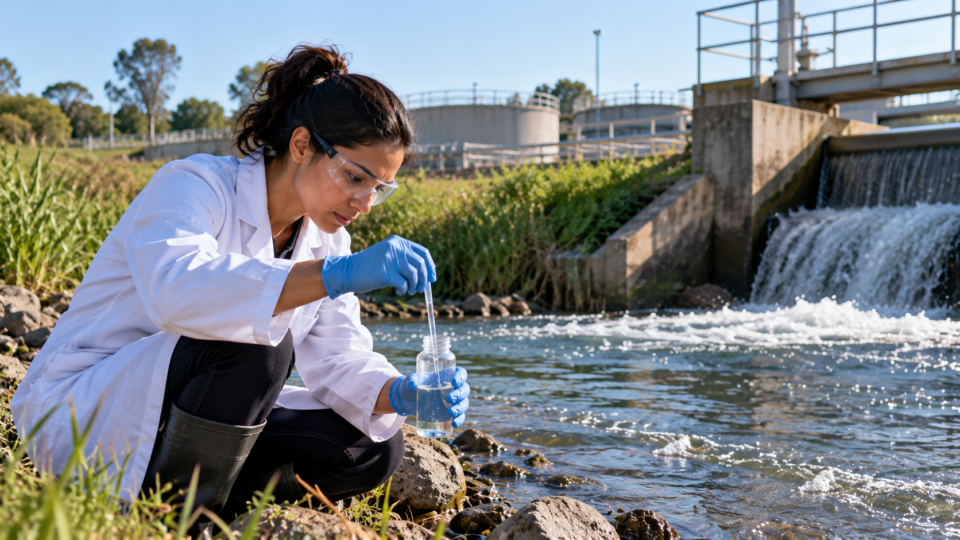
Researchers collected water around two municipal wastewater treatment plants and their receiving rivers.
They found bacteria with resistance to selected antibiotics, including a small number meeting a multidrug-resistance definition.
The two treatment plants performed very differently in reducing the targeted bacterial counts.
The results highlight why treated wastewater can still require careful monitoring.
They do not show that either plant was the only source of resistant bacteria in nearby waterways.
What the researchers found
The study involved 72 water samples collected during three sampling campaigns in 2023.
The researchers targeted bacteria in the Enterococcus and Staphylococcus groups.
Both groups were detected across the sampled locations.
One treatment plant showed comparatively limited bacterial reduction.
The second achieved reductions approaching nine-tenths for the targeted organisms.
The researchers also tested 54 bacterial isolates for antibiotic susceptibility.
Six isolates met the study’s definition of multidrug resistance.
Genomic analysis identified resistance-related genes in selected isolates.
Together, the findings provide a snapshot of environmental resistance rather than a complete assessment of all microbes in the rivers.
A study rooted in Johannesburg
The two plants receive municipal wastewater, including inputs associated with households and hospitals.
The authors identified them as WWTP1 and WWTP2.
Both use activated sludge treatment, but their wider processes differ.
WWTP1 uses activated sludge followed by chlorination.
WWTP2 also includes maturation ponds before chlorination.
Their reported design capacities were 150,000 and 405,000 kilolitres per day, respectively.
Researchers collected samples at the inflow and outflow of each facility.
They also sampled river water upstream and downstream of the discharge points.
This layout allowed comparisons across treatment and river locations, though not definitive source attribution.
How the sampling worked
The researchers collected water in June, August and late October 2023.
At each campaign, they sampled influent, effluent and upstream and downstream river sites.
They collected three samples at each of the eight sampling locations.
That produced 72 water samples across the three campaigns.
The samples were placed in sterile bottles and transported cold for laboratory analysis.
Researchers measured basic water-quality characteristics at the sites.
They then cultured selected bacteria and examined antibiotic susceptibility.
Six selected multidrug-resistant isolates underwent whole-genome sequencing.
The design provided multiple locations and dates, but only a limited number of sampling periods.
Why wastewater matters
Wastewater treatment plants receive a mixture of materials from many sources.
These can include microorganisms, residues of antibiotics and other chemicals.
Treatment reduces many pollutants, but not every organism or genetic fragment is necessarily eliminated.
Some bacteria carry genes that help them withstand particular antibiotics.
Resistance-related genetic material can also move among microorganisms under certain conditions.
The environmental presence of such bacteria matters because waterways connect human activities with broader ecosystems.
However, detecting resistance does not automatically establish a route to human infection.
The study examined environmental samples rather than patients.
Its conclusions therefore concern potential dissemination, not documented illness.
The difference between the two plants
The authors reported bacterial removal of approximately 0.68 to 10.76 percent at WWTP1.
At WWTP2, the reported reductions were approximately 89.5 to 90.5 percent.
Those figures describe the targeted bacterial measures used in this study.
They should not be interpreted as overall treatment efficiency for every contaminant.
The second plant’s maturation ponds may have contributed to the difference.
The researchers could not establish that this design feature alone explained the results.
Influent characteristics, operational conditions and disinfection performance may also matter.
The contrast nevertheless points to the value of examining treatment performance in detail.
A single generic label such as wastewater treatment plant can conceal meaningful operational differences.
What happened in the rivers
The targeted bacteria were found both upstream and downstream of the discharge points.
Concentrations generally tended to be higher downstream.
This pattern is compatible with wastewater discharge contributing to bacterial burdens.
But it is not proof that the discharge was the only cause.
Bacteria already present upstream indicate additional possible sources.
Runoff, sewage leaks and other local contamination can influence rivers.
The study did not trace every organism to a specific origin.
The authors therefore described the plants as potential contributors to environmental resistance.
That caution is essential when discussing responsibility for contamination.
Which bacteria were studied
Enterococcus species are common in environmental and intestinal settings.
Some species can also cause infections under particular circumstances.
Staphylococcus species likewise include organisms with clinical relevance.
The researchers used selective culture methods to recover presumptive members of these groups.
They then applied laboratory tests to characterise isolates.
The study was not a comprehensive survey of all bacterial species present.
Nor were all cultured organisms sequenced.
Results are most accurately interpreted for the organisms and isolates actually examined.
A wider environmental microbiology study might reveal additional patterns.
What multidrug resistance means here
The study used a predefined criterion for multidrug resistance.
An isolate had to be non-susceptible to at least one agent in three or more antimicrobial classes.
Six of the 54 isolates tested met that definition.
That is not equivalent to saying all bacteria in the water were multidrug resistant.
Nor does it mean every antibiotic would fail against those isolates.
Different antibiotics act through different mechanisms.
The researchers observed resistance involving drugs such as azithromycin, tetracycline and teicoplanin.
These results describe laboratory susceptibility profiles.
Clinical treatment decisions require patient-specific testing and medical judgment.
What genome sequencing added
The researchers selected six multidrug-resistant isolates for whole-genome sequencing.
Sequencing allowed them to examine genetic features associated with resistance.
They identified four Enterococcus faecium sequence types.
The reported types were ST1052, ST1058, ST94 and ST32.
They also identified a multidrug-resistant Staphylococcus aureus isolate of sequence type ST243.
Resistance-related genes reported in Enterococcus included msr(C), erm(B) and lsa(A).
The Staphylococcus analysis identified norA and norR.
These details strengthen the evidence that resistance determinants were present.
They do not establish that those genes moved between bacteria during the study.
Genes are not the same as infections
A resistance gene can be important without directly demonstrating a public-health event.
Genetic information indicates potential mechanisms of antibiotic resistance.
Laboratory susceptibility testing provides a different kind of evidence.
Neither alone shows that a person was exposed to the organism.
The study did not track recreational water users, nearby residents or clinical infections.
It also did not demonstrate transfer of the identified genes into new bacterial hosts.
Such events are biologically plausible in some settings.
But this particular research cannot quantify their probability.
The distinction helps avoid turning an environmental warning into an unsupported claim of an outbreak.
Why normal-looking water measures may miss something
The researchers recorded temperature, pH, dissolved oxygen and total dissolved solids.
Several conventional physicochemical readings were within relevant reported ranges.
Yet resistant bacteria and resistance-related genes were still detected.
This illustrates why water-quality assessment cannot rely on appearance or a few basic measurements alone.
A river may look clear while containing microorganisms.
Conversely, a single bacterial detection does not provide a complete safety classification.
Different tests answer different questions.
Monitoring programmes need to match their measurements to the risks they intend to assess.
Antimicrobial resistance surveillance can add information that standard chemical readings do not capture.
The wider South African context
South Africa faces significant challenges in maintaining wastewater infrastructure.
The authors referred to the 2023 Green Drop assessment of municipal wastewater systems.
That assessment identified many facilities needing urgent improvement.
However, the new study examined only two Johannesburg plants.
It cannot be used to estimate resistance levels across all South African wastewater systems.
The findings are locally important without being nationally representative.
They also connect with Research Today’s earlier coverage of environmental contamination in South Africa.
Different pollutants require different measurement methods and responses.
The shared issue is the need for reliable evidence about what enters local environments.
What might explain the contrast
The second treatment plant included maturation ponds that the first did not.
Such ponds can provide additional opportunities for biological and physical processes.
The authors considered this a possible contributor to better bacterial reduction.
However, they did not conduct a controlled comparison of otherwise identical facilities.
The plants also differed in size and potentially in wastewater composition.
Chlorine conditions and other operational details were not fully measured.
The researchers specifically noted that chlorine was not assessed to confirm suspected disinfection problems.
It would therefore be premature to recommend one engineering modification solely from these results.
Detailed plant audits could identify which factors most influence bacterial removal.
What the study cannot tell us
This was a snapshot across three sampling periods rather than continuous surveillance.
Bacterial counts can vary with rainfall, flows and operating conditions.
The study focused on selected bacterial groups.
Only six multidrug-resistant isolates underwent genome sequencing.
The researchers did not prove where every resistant organism originated.
They also did not measure human exposure or illness.
The study therefore cannot estimate the risk of infection for an individual river user.
Its strength is identifying signals that justify more extensive monitoring.
Its limitations should shape how confidently those signals are interpreted.
What better monitoring could involve
Researchers could sample more treatment plants over longer periods.
Repeated sampling during dry and wet conditions could reveal variability.
Additional bacterial groups and resistance genes could be examined.
Paired measurements of treatment operations might help explain performance differences.
Genomic comparisons across upstream, influent, effluent and downstream locations could improve source tracing.
Studies could also assess antibiotic residues alongside resistant organisms.
These approaches would make environmental surveillance more informative.
They would not automatically solve wastewater management problems.
But they could help direct resources toward the processes and locations that need attention.
Why this matters for public health
Antimicrobial resistance is a problem spanning healthcare, agriculture and the environment.
Wastewater is one point where these systems intersect.
Understanding environmental reservoirs may help inform prevention strategies.
The new findings do not establish an immediate health emergency at the sampled rivers.
They do show that resistant organisms can persist in environments connected to wastewater treatment.
The authors called for routine monitoring and optimisation of treatment processes.
Those recommendations follow from the observed variation between the two plants.
Any intervention should be evaluated for actual changes in microbial loads and resistance patterns.
Public communication should distinguish potential hazards from demonstrated exposures and outcomes.
The bottom line
Researchers at the University of South Africa analysed 72 samples from two Johannesburg wastewater treatment plants and nearby rivers.
They detected targeted bacteria across sampling locations and identified resistance to several antibiotics.
Six of 54 tested isolates met their multidrug-resistance definition.
One plant showed far lower bacterial reduction than the other.
Genome sequencing revealed clinically relevant resistance-related determinants in selected isolates.
The study does not prove that either plant was the sole source of resistant bacteria downstream.
It also does not document infections caused by the sampled water.
The findings support more systematic surveillance of wastewater and receiving rivers.
For South Africa, the message is the importance of measuring microbial risks as well as conventional water-quality indicators.
Source Information
Original study: Antibiotic resistance in South African wastewater: a snapshot from two treatment plants and their receiving rivers.
Authors: Nkgameleng K. Mokhonoana, Titus A. M. Msagati, Tshepo J. Malefetse, Khomotso Chokoe and Ilunga Kamika.
Journal: Frontiers in Water. Published 19 October 2026.
Methods: 72 water samples collected at two Johannesburg wastewater treatment plants and receiving rivers during three sampling campaigns in 2023; culture-based bacterial assessment, antibiotic susceptibility tests and sequencing of six selected isolates.