






Why circuit boards are difficult to recycle
Discarded circuit boards contain valuable metals, but extracting them efficiently is harder than simply melting down a pile of electronics. A board is a composite of copper pathways, insulating materials, solder joints and attached components.
Those components may contain different metals and require different downstream treatment.
Separating them before further processing can improve the purity of recovered material and make subsequent recycling steps more targeted.
The central challenge is therefore not just recovering a particular metal.
It is dismantling a tightly integrated object without creating a more complicated waste stream. A new experimental study from Delft University of Technology examines an electrochemical way to address both problems at once: release components from used printed circuit boards and recover tin from the solder holding them in place.
The results offer an intriguing proof of concept, although they do not yet establish the economics or environmental performance of a commercial recycling plant.
What the researchers actually tested
Fabian M.
Kadisch, Patrick J.
Teuwisse, Shoshan T.
Abrahami and Yongxiang Yang published the work in Scientific Reports on 9 September 2026.
Rather than attempting to dissolve every material in a circuit board, they targeted solder connections.
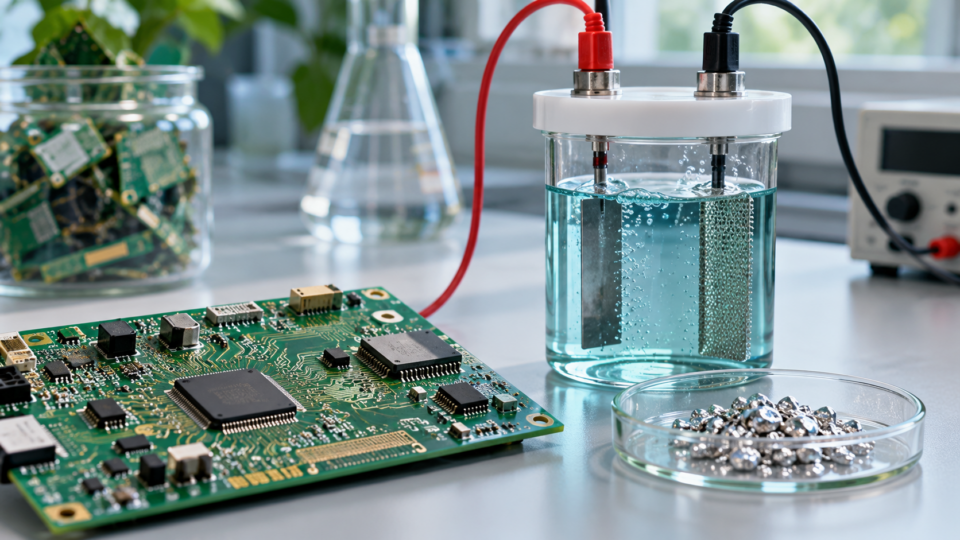
They placed waste printed circuit boards in an electrically connected anode basket and used a methanesulfonic-acid-based electrolyte.
The basket incorporated a metallic net, a polyethylene anode bag and graphite conducting flakes.
Electrical current encouraged tin-containing solder to dissolve, allowing mounted components to detach.
At the same time, tin was deposited at the cathode as a recovered metal product.
This pairing matters: conventional dismantling and metal recovery can be separate operations, whereas the proposed process attempts both in one electrochemical system.
The researchers explored operation under controlled current and under controlled anodic potential, providing two ways to assess the trade-off between detachment and electrochemical recovery.
The results, and their precise meaning
The researchers reported component-depopulation efficiencies of up to 90% under constant-current conditions and 87.5% under constant anodic potential.
Their reported cathodic current efficiency exceeded 92%, while energy consumption for tin recovery was between 140 and 340 kilowatt-hours per tonne of recovered tin.
These figures are promising but refer to different aspects of the process.
Depopulation efficiency describes the release of mounted components from the boards, not the recovery of every valuable element contained in the original electronic waste.
Cathodic current efficiency describes how effectively electrical charge contributes to the intended deposition reaction.
Energy per tonne of tin is a process-specific measure; it is not a complete energy or carbon footprint for recycling a tonne of whole circuit boards.
Treating these numbers as interchangeable would exaggerate what the experiment demonstrated.
The researchers also did not show that every component type was recovered undamaged or that all resulting fractions were immediately suitable for resale.
How an electrochemical dismantling process works
The underlying principle is selective electrochemical dissolution.
Solder holds many electronic components to a board through metallic connections.
When an appropriate potential is applied in a suitable electrolyte, metal at those connections can enter solution as ions.
As the solder joint weakens, the component may detach from the board without requiring the whole assembly to be shredded first.
In the same cell, a cathode can receive dissolved metal ions and reduce them back to metallic tin.
That is the central advantage of combining dismantling with electrodeposition.
The approach seeks to move a targeted material through a controlled chemical pathway rather than dispersing it into a mixed fragment stream.
Selectivity is crucial, however.
Circuit boards contain copper, coatings and other metals that can interact with the electrolyte.
A process that works well for a particular sample and operating condition must still prove its robustness across a heterogeneous supply of waste electronics.
Why the anode basket matters
The study’s hardware design is more than a minor engineering detail.
Waste circuit boards are irregular objects with uneven electrical contact, nonconductive surfaces and components of different sizes.
The anode basket provided a way to place those objects in the electrochemical system while maintaining an electrical pathway through graphite conducting flakes and the metallic net.
The polyethylene bag helped contain material within the assembly.
These choices show how the researchers translated a chemical idea into a physical treatment arrangement for actual boards rather than relying only on pure solder specimens.
Nevertheless, industrial waste streams are far more varied than a controlled experiment.
Boards may be corroded, coated, densely packed or manufactured with different solder compositions.
A commercial design would need to handle this variation consistently, safely and at a practical throughput.
The broader recycling opportunity
Electronics recycling often begins with collection, sorting and physical dismantling.
More precise separation at an early stage can make later processing less complicated because capacitors, connectors and other parts need not remain mixed with shredded laminate and copper.
Recovering tin at the same time could create a useful material stream rather than sending dissolved solder constituents into waste treatment.
This fits the wider circular-economy goal of keeping materials in use while reducing unnecessary extraction.
It does not mean the recovered components can simply be installed in new devices.
Many would still require identification, testing or separate metal recovery.
Likewise, recovered tin must meet relevant purity requirements for its intended use.
The experiment points toward a more selective first processing stage, not a complete closed-loop solution for all electronic waste.
Where the energy figures fit
An energy requirement of 140 to 340 kilowatt-hours per tonne of tin is informative for comparing electrochemical operating conditions, but its denominator deserves attention.
Tin is only one constituent of a printed circuit board. A facility must also collect and transport boards, prepare feedstock, manage electrolyte, handle separated components and process remaining solids.
Electricity use can vary with current density, cell geometry and the concentration of recoverable solder.
Consequently, the reported energy figure should not be presented as the total energy required to recycle a tonne of electronic waste. A rigorous life-cycle assessment would compare the full process chain with established alternatives, including the environmental burdens of reagents and waste treatment.
That evidence would be needed before concluding that the method is greener at industrial scale.
What the study does not establish
The paper is an experimental demonstration, not a randomized comparison of commercial recycling facilities.
It does not establish how much a full-scale plant would cost to build or operate, how long electrodes and electrolytes would remain effective, or whether the same performance would hold for every class of circuit board.
The maximum reported component release also leaves a fraction of attachments behind.
Reprocessing that fraction could affect cost and throughput.
Moreover, the experiment’s tin recovery should not be confused with recovery of precious metals, rare earths or copper from the rest of the board.
Those require additional downstream operations.
These limits do not negate the result.
They define the next research questions: durability, contamination, recovery purity, process control, scale and comparison with established recycling routes.
What comes next for the technology
Future studies could test larger and more diverse batches of waste boards, quantify the purity of recovered tin and identify which electronic components detach most reliably.
They could also investigate whether electrolyte can be reused without accumulating problematic impurities, how the anode basket performs over repeated cycles and how much manual handling is required. A pilot-scale trial would allow researchers to measure throughput, maintenance needs and the cost of electricity and reagents under more realistic operating conditions.
It would also clarify whether component separation improves the value of the remaining material streams enough to justify adding the electrochemical stage.
These questions matter because an elegant laboratory method only becomes a recycling solution when it works with inconsistent feedstock and produces materials that someone can use.
The significance without the hype
The most useful contribution of the study is its demonstration that dismantling and tin recovery need not be treated as entirely separate tasks.
In the tested configuration, electrochemical dissolution weakened solder connections while electrodeposition recovered metallic tin.
Up to nine in ten components were detached under the best reported constant-current condition, and the cathodic recovery reaction showed high current efficiency.
That is a concrete technical advance.
It is not evidence that electronic waste has been solved, or that the process is ready to replace existing industrial operations.
The study provides a plausible building block for more selective recycling systems.
Its ultimate value will depend on how well that block integrates with sorting, further metal recovery and safe treatment of the material left behind.
For readers interested in other circular technologies, Research Today has also covered a recyclable flow battery and research on solar-energy forecasting, illustrating how materials and energy innovation require careful attention to what was actually tested.
Source Information
Study title: Electrochemical depopulation of waste printed circuit boards (WPCBs) with simultaneous recovery of tin
Authors: Fabian M. Kadisch, Patrick J. Teuwisse, Shoshan T. Abrahami and Yongxiang Yang
Journal: Scientific Reports
Publication date: 9 September 2026
Study design: Experimental electrochemical dismantling and tin-electrodeposition study
Sample or scope: Waste printed circuit boards processed in an anode-basket electrochemical cell under constant-current and constant-potential conditions
Key finding: Up to 90% component depopulation under constant current, more than 92% cathodic current efficiency and 140–340 kWh per tonne of recovered tin