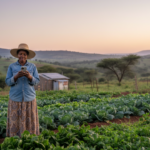







Household size, employment and family structure were associated with child poverty in a survey of 504 children in northern Tanzania.
The results offer local evidence, not a national causal estimate.
What researchers studied
Researchers surveyed children aged seven to 17 in Moshi District Council and Moshi Municipal Council, using a multistage school-based sampling design.
They combined three deprivation dimensions into a multidimensional poverty index and classified children as very poor, poor or not poor.
Descriptive comparisons and ordered logistic regression examined associations with demographic and household characteristics.
Children’s own responses provided information about deprivation beyond household income alone.
The study was cross-sectional, recording circumstances at one point rather than tracking changes in family resources.
What they found
Child age, household size, household structure and employment status of the household head were significant predictors in the statistical model.
Older children and those in two-parent or non-agricultural households were less likely to be in more deprived categories.
Larger households and those headed by unemployed adults were associated with greater deprivation.
The findings describe patterns across the sampled children.
They do not establish that changing household composition or employment status alone would cause a specific reduction in child poverty.
What it means
The findings point to household economic security as an important consideration in local social-protection planning.
Policymakers could investigate targeted support for families with many dependants, employment opportunities beyond subsistence agriculture and services that reflect children’s reported needs.
Such policies would still require independent evaluation.
The research also illustrates how a favourable regional poverty average may conceal meaningful differences between households, depending on their livelihood pressures and access to essential services.
Important limitation
The survey covers school-attending children in one part of Tanzania, limiting its generalizability to children elsewhere or those not enrolled in school.
Its cross-sectional design cannot establish cause and effect.
The authors lacked data on land tenure and farm size, potentially important in agricultural communities.
They also did not directly measure proximity to tourism or agro-industry employment.
Those omissions constrain interpretation and the strength of policy recommendations.
Source Information
Study: Assessment of socio-economic and demographic factors on child poverty: a case study of Northern Zone of Tanzania
Authors: Leon Anthony Mutalemwa; Hossein Miraji
Journal / Source: Frontiers in Sociology
Published: 26 October 2026