








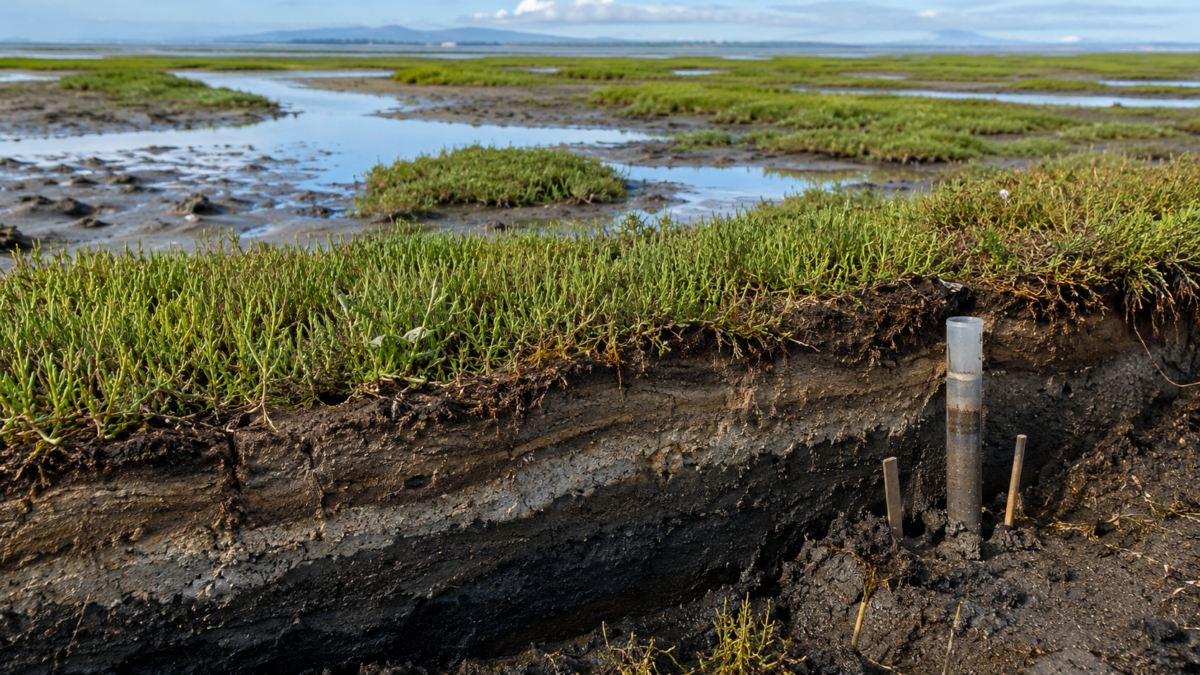
A restored coastal wetland accumulated organic carbon for two decades at rates that standard global estimates would have substantially underestimated, according to a new study based on almost 4,000 sediment samples.
The research offers unusually detailed evidence for something that is often assumed rather than measured.
Restoring tidal wetlands can help rebuild habitat and protect coastlines. These ecosystems are also promoted as blue carbon systems because organic matter can become buried and stored in their waterlogged sediments.
But knowing that wetlands contain carbon is not the same as knowing how much a restored site actually stores over time.
Researchers have now followed that process across 20 years of recovery.
Twenty years of mud became a climate record
The study, published in Communications Earth & Environment on 7 August, examined a restored intertidal habitat in the United Kingdom.
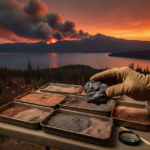
Researchers analysed 3,987 sediment samples taken across both saltmarsh and mudflat habitat.
Rather than sampling only the upper layer, they measured carbon through the depth of the accumulated sediment and separated different forms of organic matter.
Since tidal flow was restored to the site, roughly 125,000 cubic metres of sediment had accumulated.
Average organic-carbon accumulation reached about 15 tonnes of carbon per hectare each year.
That is important because much of a wetland’s carbon is not stored in the visible plants above the ground.
It is stored underneath them.
The deeper carbon was the harder carbon to lose
Not all organic matter behaves in the same way.
Fresh plant material near the surface is relatively easy for microbes to break down. Scientists describe much of this material as labile because it can be decomposed comparatively quickly.
Deeper in the restored wetland, however, the researchers found a larger proportion of recalcitrant organic matter.
This material is more resistant to decomposition.
That distinction matters for climate accounting.
A wetland containing large amounts of recently deposited organic matter may appear carbon-rich, but some of that material can return to the atmosphere as it decomposes.
Carbon buried deeper in sediment and dominated by more persistent material has a greater chance of remaining stored for longer periods.
The study therefore did more than measure how much carbon was present.
It examined what kind of carbon had accumulated and where it was being stored.
Standard estimates missed what the site was actually doing
One of the clearest findings concerned the way blue carbon is normally estimated.
When detailed measurements are unavailable, researchers and policymakers often use standard carbon-density values to estimate how much carbon an ecosystem contains.
Those defaults are useful because sampling every wetland in detail would be expensive.
But they can also hide major local differences.
At this restored site, standard global defaults substantially underestimated the carbon stock.
The researchers found that elevation, sediment depth and the type of organic matter all influenced how much carbon had accumulated.
Their proposed solution is more detailed accounting that divides wetlands according to elevation and distinguishes between different fractions of organic matter.
That may sound technical.
The practical implication is straightforward.
Two wetlands of the same size do not necessarily store the same amount of carbon.
Restoration can rebuild more than vegetation
Wetland restoration is often judged by what becomes visible.
Saltmarsh plants return. Birds recolonise. Tidal channels develop. Mudflats begin functioning again.
Carbon accumulation happens more quietly.
Sediment arrives with each tide, organic material becomes incorporated into it, and layers gradually build.
Over decades, that process can create a substantial below-ground carbon store.
The new study shows that restored habitat can develop this function over time rather than merely preserving carbon that was already present.
But the finding should not be stretched too far.
The researchers measured sediment organic carbon accumulation. The study does not establish the complete greenhouse-gas balance of every restored wetland, nor does one UK site provide a universal carbon-storage rate for coastal restoration elsewhere.
That distinction is particularly important as nature-based climate solutions become increasingly connected to carbon accounting and investment.
South Africa has its own blue-carbon opportunity
The research has a natural South African connection.
South Africa’s blue-carbon ecosystems include salt marshes, seagrass beds and mangroves, largely concentrated in the country’s estuaries. CSIR research has identified these systems as important carbon stores but also emphasised how dynamic local estuaries can be.
Local research at the Swartkops Estuary has already shown what is lost when these habitats disappear.
CSIR ecosystem accounting found that historical losses of intertidal and supratidal salt marsh substantially reduced the estuary’s carbon-sequestration potential.
That makes restoration attractive.
It also makes accurate measurement important.
If South African restoration projects are eventually expected to demonstrate climate benefits alongside biodiversity, flood protection or water-quality improvements, relying on one global carbon number may not be enough.
Local elevation, sediment supply, vegetation and estuary dynamics can change the answer.
A promising result still needs replication
The new study is unusually detailed, but it examines one restored site.
Other wetlands may accumulate sediment more slowly. Some may contain different vegetation, receive less organic material or experience greater erosion.
The paper is also currently available as an early-access manuscript that the journal says will undergo further editorial processing before final publication.
The researchers are therefore not providing a universal conversion factor for wetland restoration.
Their stronger contribution may be methodological.
They show why measuring carbon through the full sediment profile, rather than relying on shallow samples and global averages, can change how a restored wetland is valued.
That is an important shift.
The question around nature-based climate solutions is increasingly moving beyond whether an ecosystem can store carbon.
The harder question is whether we are measuring what it actually stores.
After twenty years of tides, sediment and ecological recovery, this restored wetland suggests the answer may sometimes be considerably more than our shortcuts assume.
Source Information
Study Title: Evaluating the long-term fate of carbon in a restored intertidal habitat
Authors: Eleanore J. Burrell, Hannah L. Mossman, Martin J. Taylor et al.
Journal: Communications Earth & Environment
Published: 7 August 2026
DOI: 10.1038/s43247-026-03897-y