









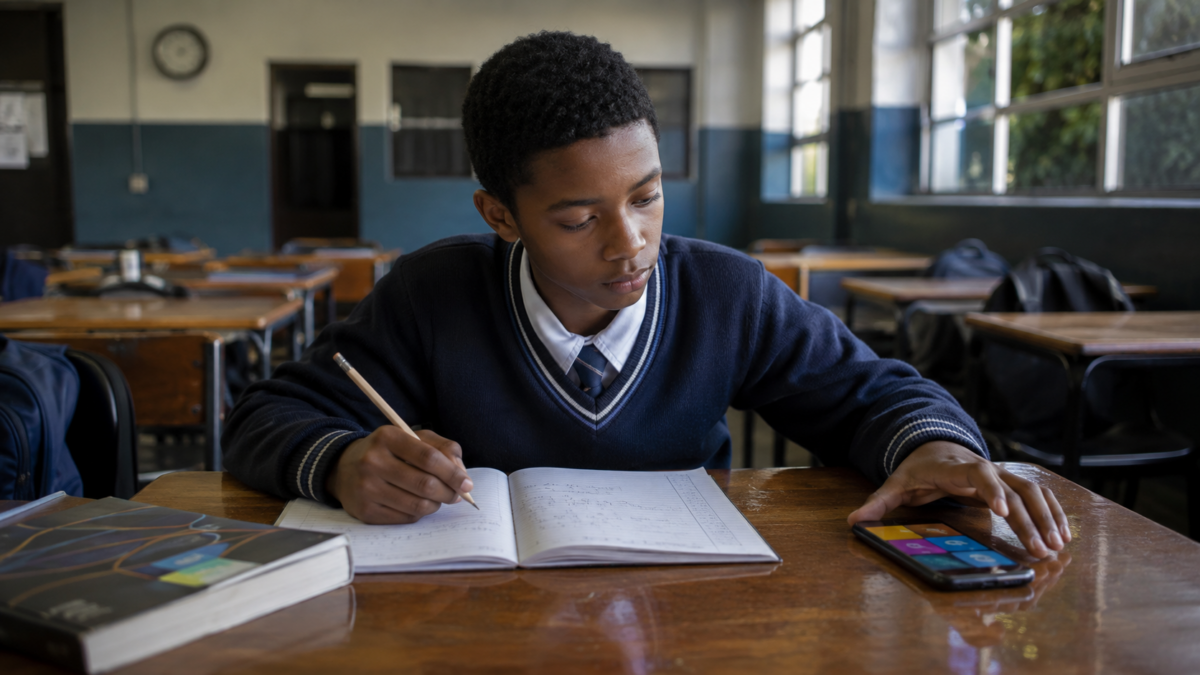
Children who opened their first social-media accounts in Grade 6 or 7 went on to record lower standardised scores in mathematics and their home language than comparable students who waited until at least Grade 9, according to new research tracking more than 5,000 learners across several years of schooling.
For parents, the question of when a child should join social media can feel almost impossible to separate from everything else happening around that age.
Classmates already have accounts. Group conversations move online. A first smartphone begins to represent independence rather than simply a way to contact home.
The usual debate then turns towards screen time: how many hours children spend online and whether those hours are replacing homework, sleep or physical activity.
A new study suggests another question deserves attention.
When did the social-media use begin?
Researchers followed school results over several years
The study, published in Nature Human Behaviour, analysed 5,227 students from northern Italy.
Researchers combined detailed information about when students received smartphones and created their first personal social-media accounts with standardised school assessments taken at several points during their education.
Those assessments covered mathematics, Italian and English.
Instead of comparing heavy social-media users with light users at one moment in time, the researchers compared students according to when they first opened a personal account.
Children who joined in Grade 6, Grade 7 or Grade 8 were compared separately with students who waited until Grade 9 or later.
That gave the researchers something unusually valuable.
They could examine students’ academic performance before social-media adoption and then see how the groups changed afterwards.
Starting in Grade 6 produced the clearest difference
The strongest result appeared among the earliest users.
By Grade 8, students who had opened a social-media account in Grade 6 scored about 0.22 standard deviations lower in Italian and 0.18 standard deviations lower in mathematics than comparable students who waited until at least Grade 9.
The negative pattern was also evident among students who started in Grade 7.
Results for Grade 8 adoption were considerably less robust, suggesting that the age at which access begins may matter rather than there being a simple divide between social-media users and non-users.
The researchers also found that earlier users were more likely to repeat a school year, less likely to achieve an excellent final Grade 8 result and reported lower academic confidence.
The effects were not enormous.
But educational differences do not need to be enormous to matter when they accumulate across several years.
English produced an unexpected exception
One subject did not follow the pattern.
The researchers found no evidence that earlier social-media adoption reduced English-language performance.
They cannot say exactly why.
One possibility they raise is that children encounter substantial amounts of English while using social platforms, particularly through videos, entertainment and other internationally distributed content. That exposure could provide some incidental language practice that does not exist for mathematics or the students’ primary school language.
The explanation remains hypothetical.
But the finding is important because it makes the results more nuanced than a simple claim that social media damages every form of learning.
The effects differed according to what students were learning.
The problem may be when the phone enters everything else
Researchers also examined what might help explain the difference.
They did not rely on students estimating their daily screen time, which can be difficult to report accurately.
Instead, they measured what they called smartphone pervasiveness: how much phone use had entered important parts of everyday life, such as immediately after waking, before sleeping, during homework and while at school.
Higher smartphone pervasiveness was associated with lower mathematics and Italian scores.
When this measure was included in the analysis, it accounted for roughly 33% to 47% of the relationship in mathematics and 15% to 34% in Italian, depending on the comparison being made.
This does not prove that distraction is the entire explanation.
But it supports a plausible mechanism.
Social media may matter partly because it makes the smartphone harder to put down at moments when attention would otherwise belong somewhere else.
Joining earlier also means being exposed for longer
Age and duration are difficult to separate.
A child who opens an account in Grade 6 has accumulated several additional years of social-media exposure by the time both groups reach secondary school.
That may matter.
The researchers found that the negative academic pattern generally became stronger with longer exposure, particularly among those who started in Grade 6 or 7.
This makes the finding different from research asking whether using social media for one extra hour today affects tomorrow’s test.
The study instead asks what happens when social media becomes part of daily life earlier in a child’s school career.
That is a much longer educational window.
South African schools are already dealing with the online part of childhood
The research was conducted in Italy, and its results cannot simply be transferred to South African learners.
But the underlying question is already present in South African schools.
The Department of Basic Education has been expanding its Online Safety Integrated Programme and, during a district training workshop in April 2026, worked with educators on issues including cyberbullying, harmful content, online grooming and other digital risks.
Its Online Safety Curriculum Guidelines provide a structured progression for learners from Grades 8 to 12.
The new research adds a different dimension to that conversation.
Online safety is not only about what children encounter on a platform.
Schools and parents may increasingly need to think about when permanent access begins, how social media fits around homework and sleep, and whether digital habits become established before learners have developed reliable ways of managing distraction.
That does not require treating smartphones as educational enemies.
Research Today has previously reported South African learners and teachers expressing support for carefully planned smartphone use in science classrooms.
The distinction is between using a device for a defined educational purpose and carrying an attention-demanding social environment into almost every part of the day.
This was not a randomised experiment
The study is stronger than a typical one-off survey, but it still has limitations.
Researchers did not randomly assign children to join social media at different ages.
They used a statistical approach known as difference-in-differences, combined with matching, to compare similar students and account for factors including earlier academic performance, parental education, household circumstances and family structure.
That makes the causal interpretation more credible.
It does not make it perfect.
Unmeasured differences between families could still influence both the age at which children are allowed onto social media and their later academic performance.
The study also relies partly on teenagers remembering when they first created accounts, and all participants came from one region of northern Italy.
The researchers themselves caution that different cultural, educational or technological environments could produce different results.
The important question may be when, not only how much
Debates about children and phones often search for one number.
Two hours is acceptable. Four hours is too much. A particular age is safe while another is not.
The new study cannot provide such a neat rule.
What it does suggest is that the timing of social-media adoption deserves more attention than it has received.
Children do not encounter social media for the first time as fully formed adults with established study habits, impulse control and routines.
They encounter it while those behaviours are still developing.
Starting earlier therefore does more than add another app to a phone.
It gives that app more years in which to become part of homework, bedtime, school breaks, conversations and ordinary moments of boredom.
For education, that may be the more important measurement.
Not simply how long a learner spent online today.
But how early the habit became part of growing up.
Source Information
Study Title: Longitudinal effect of early social media use on standardized learning outcomes during school career
Authors: Marco Gui, Chiara Respi, Giovanni Abbiati, Cristiana Paladini, Sofia Ercolanoni, Francesca Milzani, Tiziana Pirola et al.
Journal: Nature Human Behaviour
Published: 3 August 2026
DOI: 10.1038/s41562-026-02522-4