


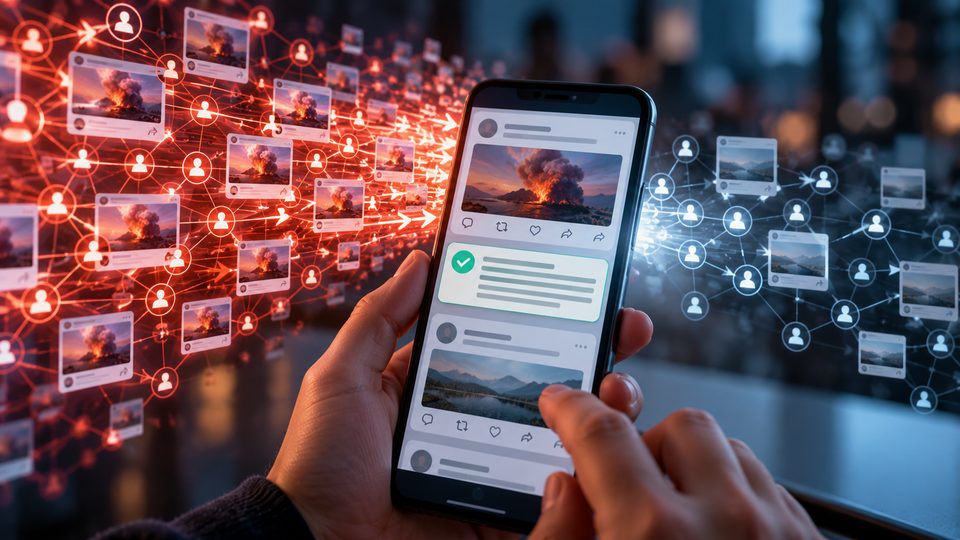





Artificial intelligence promises to remove work from employees’ plates. It can draft reports, summarise documents, analyse information and produce recommendations while the human user turns to something else. But handing the task to AI does not necessarily hand over the responsibility.
Research published in Frontiers in Psychology on 24 September 2026 suggests this gap between execution and accountability may carry a hidden after-hours cost. Among 642 hybrid and predominantly remote employees who used AI for work at least weekly, greater dependence on AI delegation was associated with more vigilance about what the technology was doing. That vigilance, in turn, was linked to more work-related rumination and weaker recovery.
The researchers call this the AI delegation paradox. The technology can reduce the effort required to perform a task while leaving the employee psychologically attached to it. Instead of wondering whether their own unfinished work is waiting, employees may find themselves wondering whether the AI misunderstood the instruction, produced an error or generated an output they will later have to fix.
Following regular AI users across seven weeks
Yifan Zhang, Tianyou Li and Chunming Chen recruited workers from knowledge-intensive occupations in which AI-assisted work was routine. Participants had to use AI tools for work at least once a week and work in a hybrid or predominantly remote arrangement.
At the first survey, 742 people reported their access to AI, dependence on delegating work to it, boundary-management preferences and demographic information. Seven weeks later, 642 completed the second survey, an 86.5% retention rate.
The final sample averaged 35.52 years of age and 6.47 years of organisational tenure. Women made up 50.8% of respondents. Participants used AI for work on an average of 3.93 days a week and worked remotely for 2.91 days a week. Their occupations spanned IT and digital services, finance, consulting, education, administration, marketing and related professional work.
The seven-week separation matters because it reduces the problem of measuring every concept at exactly the same moment. It still does not make the research an experiment, however. The study can identify a temporally separated pattern of associations, not prove that increasing AI use will cause a particular employee to recover less effectively.
The researchers measured a new kind of vigilance
Central to the study was a 12-item measure the authors call AI process vigilance. It captures four related concerns: monitoring the progress of delegated work, worrying about output quality, anticipating errors and feeling a loss of control.
The measure showed strong internal reliability, with a Cronbach’s alpha of 0.914. At the second wave, participants recorded an average vigilance score of 3.33 on a five-point scale. The result does not mean every employee was highly worried about AI, but it indicates that post-delegation concern was not an unusual edge case in this sample.
The researchers also measured work-related rumination, psychological detachment and recovery. They controlled for factors including age, gender, organisational tenure, AI-use frequency, remote-work frequency and workload. Indirect effects were tested with 5,000 bootstrap resamples, while sleep quality and emotional exhaustion were examined as additional outcomes.
AI availability was linked to dependence, then vigilance
The first part of the pattern was straightforward. Continuous access to AI was strongly associated with greater dependence on AI delegation, with a standardised coefficient of β = 0.486. Delegation dependence was then associated with greater AI process vigilance at β = 0.426. Both relationships were statistically significant at p < 0.001.
AI availability also had a direct positive association with vigilance, β = 0.233. In other words, workers surrounded by readily accessible AI tools were more likely to rely on them and, separately, more likely to remain attentive to the processes they had handed over.
The next link is where the after-hours consequences become clearer. AI process vigilance was associated with greater work-related rumination at β = 0.411. Rumination was then associated with weaker psychological detachment at β = -0.392.
Psychological detachment mattered substantially for recovery. It was positively associated with recovery outcomes at β = 0.402. Rumination itself had a negative association with recovery of β = -0.276, while AI process vigilance retained a smaller direct negative association of β = -0.147.
The full chain was statistically significant
The authors tested whether these links formed the sequential pathway proposed by their theory. Continuous AI availability was indirectly associated with greater vigilance through delegation dependence, with an effect of β = 0.207 and a 95% confidence interval from 0.165 to 0.252.
Extending the chain through vigilance and rumination produced an indirect effect of β = 0.085. Extending it further to psychological detachment produced a negative indirect effect of β = -0.033.
The complete sequence from AI availability through delegation dependence, vigilance, rumination and psychological detachment to recovery was also statistically significant. The standardised indirect effect was β = -0.013, with a 95% confidence interval from -0.019 to -0.009.
That final coefficient is small. It would be a mistake to interpret the research as showing that AI delegation inevitably damages employee wellbeing. Its value is instead in identifying a plausible mechanism that conventional workload measures can miss: employees can stop executing a task without achieving cognitive closure on it.
Simply preferring strong boundaries did not remove the effect
The researchers expected employees who preferred clearer boundaries between work and personal life to be less affected by vigilance. The evidence did not support that moderation hypothesis.
The interaction between AI process vigilance and boundary preference was not statistically significant, at β = -0.038 and p = 0.242. Vigilance remained positively associated with rumination at low, average and high levels of boundary preference.
This distinction is useful for organisations adopting AI at scale. Traditional advice about switching off notifications or separating work hours from home time may address connectivity, but it does not necessarily resolve accountability for an AI-generated output that an employee knows they will need to review.
The pattern also appeared in exhaustion
Robustness tests provided a more detailed view. Better psychological detachment was associated with better sleep quality at β = 0.278, while rumination was associated with poorer sleep at β = -0.200. Vigilance itself did not have a statistically significant direct relationship with sleep quality once the other variables were considered.
For emotional exhaustion, the pattern was stronger. Rumination was positively associated with exhaustion at β = 0.322, and AI process vigilance was also positively associated with exhaustion at β = 0.180. Psychological detachment was associated with lower exhaustion at β = -0.212.
The proposed model also fitted the data substantially better than several alternatives. The hypothesised delegation-vigilance model produced a comparative fit index of 0.989 and RMSEA of 0.042. A simpler model in which AI availability directly predicted rumination and recovery performed markedly worse, with a CFI of 0.837 and RMSEA of 0.156.
AI productivity needs an accountability design
The managerial implication is not that employees should delegate less to AI. Dependence can reflect successful integration of a useful technology, and the study did not test whether participants became less productive because of it.
Instead, the results raise a design question. If an employee delegates execution but remains personally accountable for every possible hallucination, missed instruction or quality problem, the organisation may save task time without removing the cognitive responsibility attached to that task.
Clear review points, defined standards for checking AI output and explicit ownership of final decisions may therefore matter alongside access to the technology itself. The study does not experimentally test these interventions, so they remain practical implications rather than proven solutions.
This is especially relevant as AI moves from occasional assistance into routine workflows. The more continuously available a system becomes, the easier it is to delegate work to it. The evidence here suggests organisations should also ask what happens psychologically after the delegation occurs.
Important limitations remain
The study relied on self-reported survey measures, which can introduce common-method concerns even though the researchers separated the measurements across time and conducted several statistical checks. Participants were also regular AI users in hybrid or remote knowledge work, limiting how confidently the results can be extended to frontline, manual or fully office-based roles.
The two-wave design is another constraint. Some proposed steps in the model were measured within the same wave, and observational path analysis cannot establish causality in the way a randomised intervention could. The newly introduced vigilance construct will also need replication across different occupations, countries and forms of AI.
Even with those caveats, the study captures a problem likely to become more visible as AI systems take on longer and more consequential tasks. Productivity technology can remove execution effort without removing uncertainty, responsibility or the feeling that the work is still psychologically open.
The question for employers is therefore becoming more precise. It is not only whether AI saves employees time, but whether the way work is delegated allows them to stop thinking about it once that time has been saved.
Source Information
Study Title: When AI works, employees worry: the vigilance cost of AI delegation in hybrid work
Authors: Yifan Zhang, Tianyou Li and Chunming Chen
Journal: Frontiers in Psychology
Published: 24 September 2026
DOI: 10.3389/fpsyg.2026.1914119
Study design: Two-wave survey with a seven-week interval and regression, bootstrap indirect-effect and model-comparison analyses
Final sample: 642 hybrid and predominantly remote employees who used AI for work at least weekly