








Service robots are moving from factory floors into places where people eat, shop, travel and receive care. That shift changes the question companies need to answer. A machine can be technically capable and still fail if customers do not trust it enough to use it.
New peer-reviewed research on cooking robots suggests that trust in human-machine collaboration is built from more than competence alone. Empathy, reciprocity and assurance also mattered, while perceived risk helped determine whether trust ultimately translated into willingness to adopt the technology.
The study, published in Scientific Reports on 28 September 2026, surveyed 201 respondents in China and analysed the relationships between trust, perceived risk, adoption intention and actual use behaviour using partial least squares structural equation modelling.
Why cooking robots provide a useful test of trust
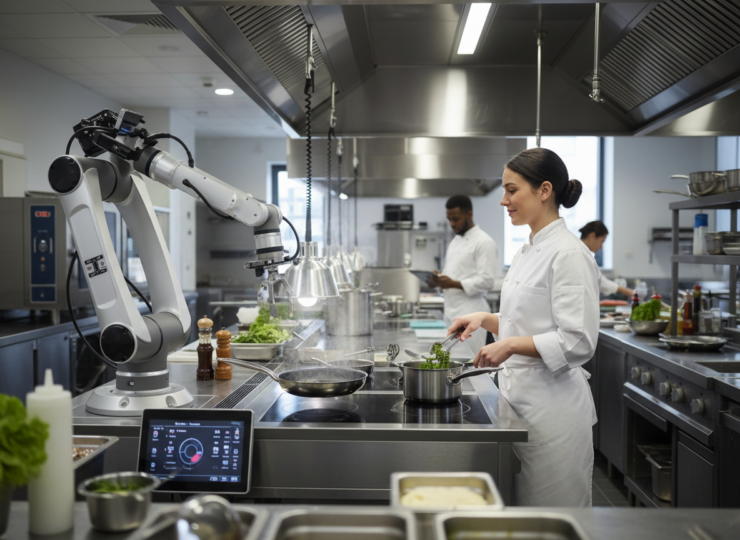
Human-machine collaboration is no longer limited to tightly controlled industrial settings. Restaurants and other service businesses are experimenting with machines that prepare food, deliver meals and perform tasks once handled almost entirely by employees.
Cooking robots are a particularly revealing case because users must accept several forms of vulnerability at once. They need to believe that the machine can perform the task correctly, that the food will be safe, that the system will behave predictably and that the risks of interacting with it remain acceptable.
Ying Yu, Xi Lyu, Yong Wang and Zhen Zeng approached that problem from a risk-based perspective. Rather than treating trust as a single reaction to technical performance, they examined several possible antecedents of trust and then tested how trust interacted with perceived risk, adoption intention and use behaviour.
The final sample contained 201 respondents. The researchers used partial least squares structural equation modelling, or PLS-SEM, a method designed to estimate multiple linked relationships between latent constructs simultaneously. This allowed them to test not only whether particular characteristics were associated with trust, but also whether perceived risk acted as an intermediary between trust and adoption intentions.
Competence was only one part of the trust equation
The analysis identified four factors associated with trust in collaborative cooking machines: competence, empathy, reciprocity and assurance.
Competence is the most intuitive. People need to believe that a cooking robot is capable of completing its task reliably. A machine that appears inaccurate, inconsistent or unable to handle ordinary variations in a task gives users little reason to place themselves in its hands.
But the other factors broaden the picture. Empathy captures whether the machine is perceived as responsive to human needs rather than merely executing a rigid sequence. Reciprocity concerns the sense of mutual exchange within the interaction. Assurance reflects signals that make the system appear dependable and reduce uncertainty around what it will do.
Together, these findings indicate that people evaluate collaborative machines partly through a social lens. A service robot is not experienced only as a piece of equipment. Once it interacts directly with customers, its behaviour can also be judged in terms that resemble evaluations of human service encounters.
Risk helps explain why trust does not automatically become adoption
The study’s most important contribution may be the role assigned to perceived risk. The analysis found that perceived risk mediated the hypothesised paths between trust and adoption intention.
That distinction matters. A customer can regard a machine as generally trustworthy while still deciding that a particular interaction carries too much uncertainty. In food preparation, those concerns could involve safety, malfunction, hygiene, loss of control or simply uncertainty about an unfamiliar technology.
Trust therefore does not operate in isolation. Its behavioural value depends partly on whether it lowers the risks that users believe they are taking. This offers a more realistic account of technology adoption than assuming that positive attitudes toward a machine directly produce usage.
The researchers’ model connects this process to both adoption intention and use behaviour. That moves the analysis beyond whether people say they like robots and toward the more commercially important question of whether trust can support actual interaction with them.
The design challenge is partly psychological
For developers, the findings imply that improving technical performance is necessary but may not be sufficient. A highly capable robot can still create hesitation if users cannot understand what it is doing, do not feel reassured by its behaviour or perceive the interaction as one-sided and difficult to control.
This has implications for interface design. Visible confirmation of actions, understandable feedback, predictable sequences and clear opportunities for human intervention may all help convert technical capability into perceived assurance. Interaction design can also influence whether a machine feels responsive to a user’s needs rather than indifferent to them.
The same logic can extend beyond restaurants. Hotels, hospitals, retail environments and logistics operations increasingly place automated systems in direct contact with customers and workers. In each setting, adoption may depend on a combination of what the machine can do and how safe, understandable and cooperative the interaction feels.
What businesses should not conclude
The study does not show that adding human-like features to every robot will automatically increase adoption. Empathy and reciprocity in a technology context can be communicated through behaviour and interaction design without attempting to make a machine indistinguishable from a person.
It also does not establish that the same trust structure will apply equally across countries or service categories. The sample consisted of 201 respondents in China, and attitudes toward automation, food preparation and service technology can vary across cultural and market contexts.
The survey design also limits causal interpretation. Structural equation modelling can test whether observed data fit a proposed network of relationships, but it cannot by itself prove that changing empathy or assurance will cause a particular increase in trust or adoption. Experimental and longitudinal studies would be needed to establish those effects more firmly.
Self-reported intentions are another consideration. People can express enthusiasm for a technology in a survey and behave differently when asked to pay for, rely on or repeatedly use it in a real service environment.
Trust becomes a design requirement
The broader lesson is that human-machine collaboration cannot be evaluated only by engineering performance. As machines move into service roles, customers increasingly encounter them as participants in an interaction.
A cooking robot must still cook well. But the research suggests that users also respond to whether the machine appears dependable, responsive and cooperative, and whether those qualities reduce the risks they associate with using it.
That turns trust from a marketing afterthought into part of the product itself. The commercial challenge is not simply to build machines capable of replacing or supporting human tasks. It is to build interactions in which people are comfortable allowing those machines to participate.
Source Information
Study Title: A risk-based view of trust in human-machine collaboration on cooking robots
Authors: Ying Yu, Xi Lyu, Yong Wang and Zhen Zeng
Journal: Scientific Reports
Published: 28 September 2026
DOI: 10.1038/s41598-026-72253-z
Sample: 201 respondents in China
Method: Survey analysed using partial least squares structural equation modelling