




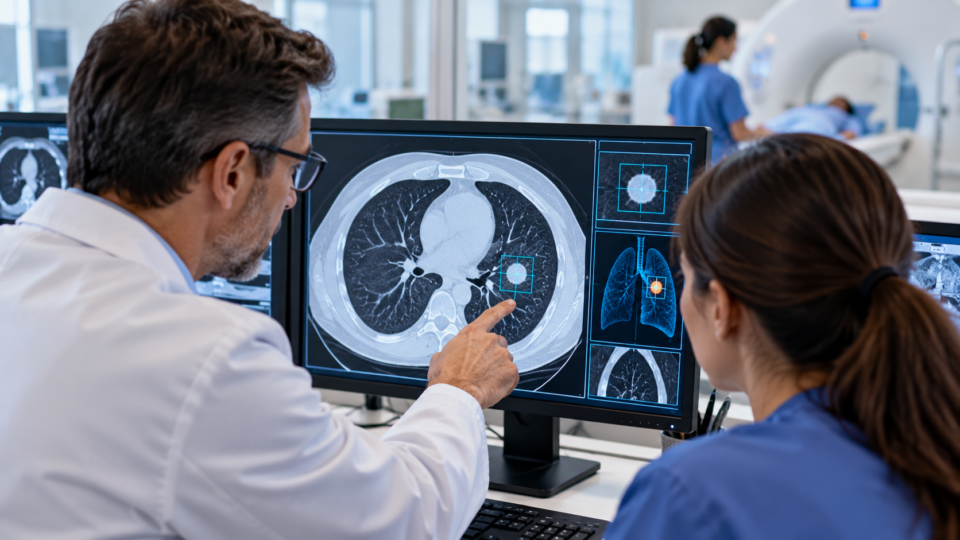
AI moved from the lab into three lung nodule clinics
Artificial intelligence systems can perform impressively in retrospective medical datasets, but a more difficult question is whether they improve care once introduced into everyday clinical workflows.
A new real-world study provides evidence from three United States health systems that implemented an AI-enabled platform for identifying, assessing and tracking patients with pulmonary nodules.
Published in PLOS One on 14 October 2026, the study compared matched periods before and after the technology was introduced.
Across the three clinics, the number of new patients increased substantially after implementation, as did the number of patients undergoing invasive diagnostic procedures.
However, the study did not find statistically significant improvements in the number of cancers diagnosed, early-stage cancer diagnoses or median time to diagnosis.
That mixed picture makes the research particularly useful. It shows how real-world AI evaluation can produce meaningful operational gains without automatically proving better clinical outcomes.
Why pulmonary nodules are difficult to manage
Pulmonary nodules are small abnormalities that can appear on chest computed tomography scans performed for many reasons.
Most are benign, but some represent early lung cancer, making reliable follow-up important.
The challenge is not simply recognising a nodule on an image. Health systems must also identify the patient, communicate the finding, assess risk, arrange appropriate surveillance or diagnostic procedures and make sure follow-up is not missed.
The study notes that routine US care has historically struggled with guideline-adherent follow-up for incidentally detected nodules.
Manual systems can fail because radiology reports are not consistently tracked, communication breaks down or responsibility for follow-up is unclear.
AI-enabled software has therefore been proposed not only as an image-analysis tool but as a way to support the entire management pathway.
What the software actually did
The participating clinics implemented a commercially available platform called the Virtual Nodule Clinic.
The system combined several functions rather than relying on a single AI prediction.
Natural-language processing was used to identify patients with pulmonary nodules from radiology reports.
A computer-aided diagnostic algorithm analysed CT images and generated a malignancy risk score intended to support clinical judgement.
A central dashboard then helped teams track patients over time and flag missed appointments.
Clinicians remained responsible for reviewing patients and deciding whether they required discharge, surveillance or intervention.
This is important because the study evaluated an AI-supported clinical pathway rather than autonomous diagnosis.
How the before-and-after study worked
Researchers compared clinic activity during matched 12.5-month periods before and after implementation across the three health systems.
The sites included a regional health system hospital, a community hospital and an academic medical centre.
Matching equivalent calendar months helped reduce the influence of seasonal differences in patient volumes.
The pre-implementation information was collected retrospectively, while post-implementation data were collected prospectively as part of the supported workflow.
The primary outcomes were new patient volume and the number of patients receiving at least one invasive diagnostic procedure.
Secondary outcomes included confirmed lung cancers, early-stage cancers and the time between the baseline CT scan and confirmed diagnosis.
The design is observational. It can identify changes associated with implementation but cannot prove that the AI system alone caused them.
Patient volumes rose by 68 percent
After exclusions, the analysis included 138 new patients in the matched pre-implementation period and 232 after implementation.
That represents a 68 percent increase in the total number of new patients attending the lung nodule clinics.
Monthly volume rose from 11.0 to 18.6 patients across sites.
The median paired-month count increased from nine patients before implementation to 16 afterward.
This difference was statistically significant, with a reported p-value of 0.0002.
The increase occurred at all three sites, although its size differed substantially between health systems.
The regional health system hospital showed the largest increase, with monthly new-patient volume rising by 131 percent.
These findings suggest that automated identification and tracking may help clinics capture patients who might otherwise remain outside a dedicated nodule pathway.
More patients underwent invasive procedures
The number of patients receiving at least one invasive diagnostic procedure also increased.
After matching the follow-up windows, 61 patients underwent a biopsy or surgical resection before implementation compared with 100 afterward.
On a monthly basis, the figure increased from 4.9 to 8.0 patients.
The paired change was statistically significant, with a p-value of 0.0085.
All three sites recorded higher procedural volumes.
Greater procedure volume can indicate that more appropriate patients are reaching diagnostic care, but it can also create concern about unnecessary interventions.
That is why the study’s exploratory analysis of procedure yield is important.
The increase in procedures needs careful interpretation
Among patients who underwent invasive procedures, 24.6 percent had a benign final diagnosis before implementation compared with 35.0 percent afterward.
The difference was not statistically significant, with a p-value of 0.219.
Total invasive procedures per confirmed cancer increased from 1.89 to 2.27, another difference that was not statistically significant.
These exploratory results do not demonstrate that the AI pathway caused unnecessary procedures.
They do show why higher throughput should not automatically be interpreted as an improvement without considering appropriateness and patient outcomes.
The authors call for continued monitoring of procedure yield in larger and longer studies.
A useful AI system must help health services find relevant patients without creating disproportionate downstream testing.
Cancer diagnoses increased numerically, but evidence was uncertain
Confirmed lung cancer diagnoses increased from 37 before implementation to 48 afterward within the matched analysis.
That corresponds to an increase from 3.0 to 3.8 cancers per month.
However, the difference was not statistically significant, with a p-value of 0.3242.
Early-stage diagnoses increased from 18 to 30 overall among the relevant cancer types with stage information available.
Monthly early-stage diagnoses rose from 1.4 to 2.4, but this difference also failed to reach statistical significance, with a p-value of 0.125.
The numerical increases are potentially encouraging, but the sample was too limited to establish that the platform improved cancer detection.
Claims that the AI system definitively found more cancers or shifted diagnosis to earlier stages would therefore go beyond the evidence.
Median time to diagnosis barely changed
The researchers also investigated whether implementation shortened the interval between the baseline CT and confirmed cancer diagnosis.
Median time to diagnosis was 58 days before implementation and 57 days afterward.
The difference was not statistically significant, with a p-value of 0.26.
One notable change occurred in the spread of diagnostic times.
The interquartile range narrowed from 125 days before implementation to 58 days afterward.
This suggests that timelines became more consistent even though the typical median duration remained almost unchanged.
A sensitivity analysis that retained very long diagnostic delays reached the same broad conclusion: no significant change in the median, but a narrower spread after implementation.
Why real-world evaluation matters for medical AI
Medical AI research often concentrates on accuracy measures obtained from curated datasets.
Those studies are essential, but they cannot show whether a technology integrates effectively into staffing, referral and follow-up processes.
A highly accurate algorithm may have little clinical value if patients are never identified, referrals are lost or clinicians cannot act on its output.
Conversely, software that improves case finding and tracking can change clinic activity even when the diagnostic algorithm itself is only one component of the intervention.
This study therefore evaluates AI at the level where health systems ultimately need evidence: routine service delivery.
The results show why operational outcomes and clinical outcomes should be assessed separately.
The three clinics started from different positions
The magnitude of the observed changes differed across the participating sites.
The regional health system hospital had no previous system dedicated to capturing lung nodule patients and recorded the largest proportional increases.
The community hospital had an existing referral process and experienced more moderate increases.
The academic medical centre already had established specialty referral pathways but lacked automated identification of incidental nodules.
These contextual differences make it difficult to assume that another hospital would experience the same results.
An AI platform may deliver its greatest operational gains where existing tracking systems have the largest gaps.
Institutions with mature nodule programmes may see different benefits or different bottlenecks.
Important limitations
The research used a before-and-after design rather than random assignment.
Changes in staffing, referral behaviour, patient populations or other aspects of the health systems could have contributed to the observed differences.
The researchers matched calendar months to reduce seasonal effects, but they could not control for every potential confounder.
The study involved only three US health systems and relatively short matched periods.
Some outcomes, particularly cancer and early-stage cancer counts, involved modest numbers of patients and therefore limited statistical power.
The pre-implementation period was retrospective while the post-implementation period was prospective, creating another possible source of difference.
The software developer, Optellum Ltd, contributed to study design, data collection planning, statistical analysis, interpretation and manuscript preparation.
Clinical investigators at the participating sites reviewed the findings, but the industry involvement is relevant when assessing potential conflicts and the need for independent replication.
What hospitals should take from the findings
The strongest evidence from this study concerns clinic throughput, not improved cancer survival or faster diagnosis.
Health systems considering similar technology should therefore define what problem they are trying to solve.
If patients with incidental nodules are being lost before specialist review, automated identification and tracking may address a meaningful workflow gap.
If the primary goal is to reduce time to cancer diagnosis, these results do not demonstrate a significant improvement in the median.
Hospitals should monitor procedure rates, benign interventions, cancer yield and patient outcomes alongside patient volume.
They should also evaluate whether increased referrals can be supported by available specialists, imaging capacity and procedural services.
Real-world monitoring remains necessary after deployment because AI can change the demand placed on the rest of the healthcare system.
What the study adds to the AI debate
The study offers a useful counterweight to both exaggerated optimism and blanket scepticism about medical AI.
Implementation was associated with a clear increase in the number of patients reaching specialist nodule clinics and undergoing diagnostic procedures.
At the same time, the evidence did not establish significant improvements in cancer diagnoses, early-stage diagnoses or median diagnostic time.
That combination shows why medical AI should be judged against multiple outcomes rather than a single performance metric.
Better patient identification can be valuable, but it must ultimately be connected to appropriate care and meaningful health outcomes.
Larger independent studies, longer follow-up and stronger comparative designs will be needed to determine whether the operational changes observed here translate into better lung cancer outcomes.
Source Information
Study: Real-world before-and-after evaluation of AI support for lung cancer diagnosis at three US lung nodule clinics.
Authors: K. A. Lee, A. Borah, G. Fiscus, L. Petricca, S. Dean, A. Rings and colleagues.
Journal: PLOS One.
Published: 14 October 2026.
Methods: Multicentre ambispective before-and-after observational study across three US lung nodule clinics, comparing matched 12.5-month pre- and post-implementation periods.