A major information gap around rivers and lakes
In Jalisco, Mexico, nearly nine in ten surveyed adults said they had never received information about the quality of local rivers, lakes or other surface waters. The figure was 88.8%, representing 920 of 1,036 interviewees, in a peer-reviewed study published in Frontiers in Environmental Science on 7 October 2026.
Yet a large majority said they wanted updates, and many expressed interest in taking part in monitoring or public meetings. The findings point to a problem beyond the technical measurement of pollution: environmental information has limited value to residents if it does not reach them in an accessible form.
Why this matters for water governance
Surface-water conditions can affect ecosystems, recreation, farming and public confidence in environmental management. Agencies may collect samples, publish measurements and maintain websites, but publication is not the same as communication. Residents must know where to look, understand what the measurements mean and know whom to contact when they have concerns.
The research examined these different steps rather than assuming that a lack of engagement reflects a lack of public interest. It is important to distinguish this survey from a water-testing study: it measured people’s experiences of communication and their stated willingness to participate, not the chemical or biological condition of individual waterways.
How the research was conducted
Researchers Fernando Amador-Castro, Gabriela Lopez-Gonzalez, Paula Novo and Misael Sebastián Gradilla-Hernández used a statewide face-to-face survey in Jalisco, western Mexico. Fieldwork took place in July 2024 and included 1,036 adults aged 18 or older.
The sampling design selected geographic areas, residential blocks and dwellings in stages, while age-by-sex quotas guided recruitment within sampled areas. Researchers used survey weights calibrated to census population margins and statistical methods that accounted for geographic clustering.
The questionnaire contained 33 items on water-quality perceptions, communication, interest in monitoring and demographic characteristics. Interviews were conducted in Spanish.
The strongest finding: information rarely reached residents
A total of 920 respondents reported never having received information about the quality of surface waters. The survey-weighted estimate was 88.8%, with a 95% confidence interval of 86.1% to 91.0%.
Among those with middle-school education, 94.9% reported no prior updates; among respondents with postgraduate education the estimate was 78.8%, although uncertainty was greater in the smaller postgraduate subgroup.
In a model adjusting for gender, age and education, middle-school respondents had lower odds of reporting prior information receipt than high-school respondents, with an odds ratio of 0.37 and a 95% confidence interval of 0.19 to 0.70. After adjustment for multiple comparisons, most other demographic contrasts were not statistically distinguishable.
Wanting updates did not mean actively searching for them
The survey found that 77.9% of respondents were interested in receiving water-quality information, with a 95% confidence interval of 74.7% to 80.8%. Among 810 respondents interested in updates, monthly information was the most popular frequency at 36.9%, followed by twice-yearly updates at 24.9%.
But only 23.6% of this interested group said they had actively searched for water-quality information. Interest and searching are different behaviours: someone may want reliable updates delivered directly without knowing which agency publishes them or having the time to search several websites.
The study did not test which specific communication intervention would close this gap.
Which channels people preferred
Among respondents interested in receiving updates, television was selected by 67.5% and social media by 63.2% as preferred communication channels. Dedicated webpages were chosen by 36.1% and radio by 28.6%. Respondents could select up to three channels, so these percentages do not add to 100%.
Among the separate group of 182 respondents who had actively searched for information, 65.1% had used a dedicated webpage and 46.5% had used social media. These are different respondent groups, so the comparison cannot establish that individual people prefer one channel but use another.
Instead, it suggests that passive public broadcasting and active web-based searching serve different needs.
Two-thirds questioned the quality of communication
Around 66.4% of respondents said water-quality information was not communicated clearly and effectively, with a 95% confidence interval from 62.4% to 70.2%. Another 2.6% did not know how to assess it.
Among adults aged 50 to 59, the adjusted odds of judging communication ineffective or uncertain were 2.50 times those for adults aged 18 to 29, with a 95% confidence interval from 1.49 to 4.18. This measures public assessment, not an independent audit of agency messages.
Still, the combination of poor reach and low perceived effectiveness suggests that merely placing more measurements online may not meet the public’s communication needs.
People struggled to identify the responsible authorities
Only 37.1% of respondents identified the federal water commission CONAGUA or Jalisco’s state water commission CEA as a formally mandated inquiry authority under the study’s definition. For complaints, just 15.1% identified the relevant federal or state environmental prosecutors, PROFEPA or PROEPA. Many instead named the local utility SIAPA or other agencies.
This does not mean every named organisation was irrelevant to every possible water issue: public responsibilities overlap, and people may reasonably begin with a familiar provider. But it does show that the official division of responsibilities is difficult for residents to navigate.
Feedback routes were particularly unfamiliar
Only 11.0% of surveyed adults said they knew of a mechanism for giving the government feedback about water-quality issues, with a 95% confidence interval of 9.1% to 13.1%. The reported awareness was 13.4% among men and 8.7% among women, though these descriptive estimates should not automatically be interpreted as evidence of a meaningful underlying gender difference.
If people cannot identify where to submit an observation or complaint, a monitoring programme may struggle to translate local concerns into official action. The study did not independently verify the existence, accessibility or response quality of all government feedback channels.
Public hearings attracted interest but little familiarity
Among 1,020 respondents who gave a substantive answer, 73.7% expressed moderate, high or very high interest in participating in a public hearing or similar activity if they received timely information. About 45.2% reported high or very high interest.
At the same time, 64.3% of all respondents said they had never heard of such an exercise, and a further 14.2% said the latest one they recalled had taken place more than a year earlier. Among 348 people who remembered an exercise, 58.1% had never participated.
These figures show the distance between stated willingness and realised participation; they do not establish how many people would attend if invited.
Citizen monitoring also drew substantial interest
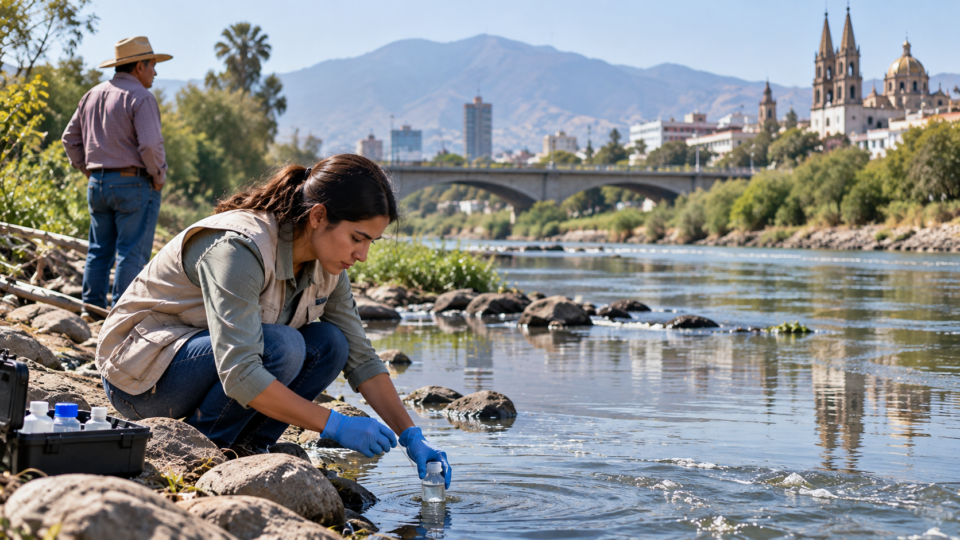
Among 1,025 respondents with a substantive answer, 71.5% expressed at least moderate interest in participatory water-quality monitoring, while 44.6% reported high or very high interest. Citizen monitoring might involve collecting samples, recording visible changes, reporting conditions or helping interpret local observations.
But a favourable survey response is not a commitment to participate, and enthusiasm does not guarantee scientifically reliable measurements. Well-designed programmes need training, appropriate equipment, quality assurance and clear arrangements for how agencies will use contributed information.
Time was a leading obstacle
Among 576 respondents asked about barriers to monitoring, 48.0% cited insufficient time or scheduling conflicts. Personal constraints such as health or older age were cited by 12.7%, insufficient information by 7.5%, and perceived lack of skills by 6.7%.
In a separate set of questions allowing up to three preferred project features, flexible schedules, clear explanations of how results would have an impact and opportunities to contribute from home were frequently chosen. Those percentages referred to shares of selections, not shares of people, so they should not be compared directly with the barrier percentages.
The practical lesson is that willingness alone does not remove logistical barriers.
Why people wanted to contribute
Among 460 respondents with high or very high monitoring interest, 35.2% selected helping the environment or community as their main motivation, while 21.4% selected protecting local water resources. Learning new skills accounted for 11.0%, and contributing to scientific knowledge or sharing skills for 4.6%.
Respondents selected one main reason, meaning the study did not measure all the motivations that might coexist for each person. The pattern nevertheless suggests that community benefit and environmental protection may be more compelling messages than career development or personal recognition when recruiting volunteers.
The statistical models did not reveal a simple pathway
Researchers also examined whether previous receipt of water information, perceived communication effectiveness and awareness of institutions were associated with interest in hearings or monitoring after adjusting for demographic characteristics.
Prior receipt and perceived effectiveness were not significantly associated with participation interest in the primary models. Awareness of a complaint authority corresponded to a roughly 10-percentage-point higher adjusted probability of hearing interest, and awareness of a feedback mechanism to a roughly 10.5-point higher probability of monitoring interest.
However, neither association met the prespecified threshold after the researchers adjusted for multiple comparisons. They should therefore be treated as suggestive rather than confirmed relationships.
What policymakers could change
The research supports treating information delivery, institutional guidance and participation opportunities as related but distinct tasks. A practical approach could combine simple explanations of what measurements mean with timely updates through several channels, visible contact details for enquiries and complaints, and accessible opportunities to participate.
For example, a water agency might publish a short monthly summary that explains location, date, water-quality indicator, uncertainty and any recommended action, then provide a single clear route for questions. These are plausible design implications rather than interventions experimentally tested by the survey.
Authorities would need to evaluate whether such changes actually improve understanding and participation.
Why local context matters
Jalisco includes major urban centres, agricultural areas and river systems under environmental pressure. Communication arrangements that work in one region may not transfer directly to another with different media access, trust in institutions or administrative responsibilities.
In addition, a person concerned about drinking-water safety may have different information needs from someone interested in the ecological condition of a river. This survey focused mainly on surface waters, including rivers, lakes and ponds.
Its findings should not be presented as a direct measurement of household tap-water quality or a demonstration that a particular water source is unsafe.
The limits of the evidence
The research was cross-sectional and relied on people’s recollections, perceptions and hypothetical intentions. It cannot prove that poor communication caused lower participation or that providing more information would automatically increase engagement.
Although sampling and weighting sought broad statewide coverage, recruitment did not randomly select a person within every sampled household, and some marginalised populations may have been underrepresented. Smaller subgroups produced wider confidence intervals.
The researchers did not audit official communications, confirm the dates of public hearings or measure the performance of complaint systems. Self-reported interest may overstate eventual attendance or volunteering.
What should be tested next
Future research could compare different forms of water-quality updates in a field experiment: concise television or radio announcements, mobile messages, social media posts and dedicated websites. Investigators could measure actual message reach, comprehension, trust and subsequent actions rather than stated preferences alone.
Another trial could simplify the path for reporting a concern and track whether enquiries receive useful responses. Citizen-monitoring projects should also assess whether community observations meet scientific quality standards and whether agencies respond visibly to them. Such evaluations would reveal which reforms deliver more than good intentions.
The central finding
The clearest result is a mismatch between public interest and public access. In a statewide survey of 1,036 adults, 88.8% reported never receiving information about local surface-water quality, yet 77.9% wanted updates and 71.5% expressed at least moderate interest in citizen monitoring.
Those percentages describe different survey questions and, in some cases, different eligible groups. The study does not prove that new communication channels would solve the problem, but it makes a strong case for testing clearer, more accessible and more accountable ways of connecting environmental measurements with the people they concern.
Source Information
Original research: Amador-Castro, F., Lopez-Gonzalez, G., Novo, P. and Gradilla-Hernández, M. S. (2026). Public perspectives on water quality communication and interest in participatory monitoring approaches in Jalisco, Mexico. Frontiers in Environmental Science, volume 14. Published 7 October 2026.
Research type: Peer-reviewed, cross-sectional statewide face-to-face household survey of 1,036 adults in Jalisco, Mexico, fieldwork July 2024, survey-weighted descriptive and regression analyses.
DOI: https://doi.org/10.3389/fenvs.2026.1912612.
Survey questionnaire dataset: https://doi.org/10.5518/1707.