



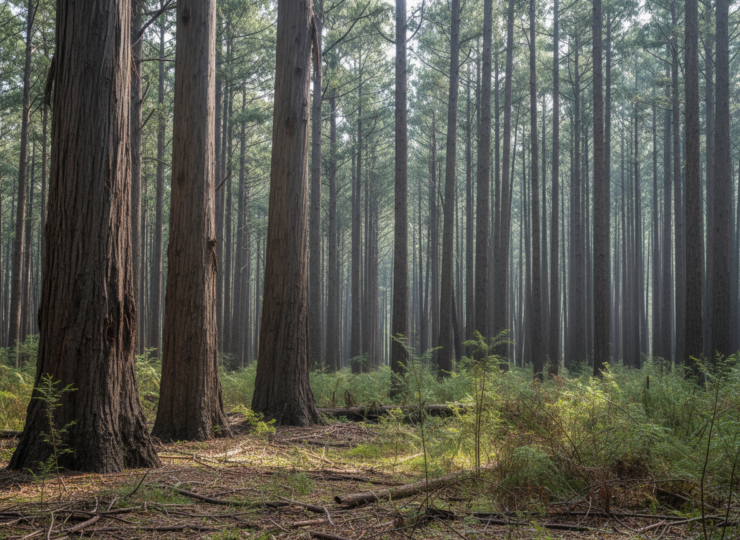
Forest management is often framed as a choice between leaving forests untouched and harvesting them for timber. A rare long-term experiment in south-eastern Australia suggests that, in at least one important forest type, the reality can be more complicated.
Researchers returning to an experimental mountain ash forest about three decades after different harvesting treatments were imposed found that stands where part of the original canopy had been retained developed especially large trees. The retained-tree treatments also maintained substantial amounts of carbon in living wood, while creating forest structures that differed markedly from conventional clearfelling.
The findings matter because mountain ash forests sit at the intersection of several difficult policy questions. They can produce valuable timber, store large quantities of carbon, support threatened wildlife and face severe wildfire risk. Decisions made after logging or fire can therefore influence economic production, climate mitigation and habitat for decades.
A forestry experiment that kept running after attention moved on
The experiment began at Tanjil Bren in Victoria’s Central Highlands in the late 1980s. Rather than comparing only harvested and unharvested forest, the original Silvicultural Systems Project tested a spectrum of management approaches in mountain ash, or Eucalyptus regnans.
In the new analysis, Kaitlyn Hammond and colleagues evaluated 53 study plots distributed across seven silvicultural treatments and unharvested controls. The treatments included clearfelling, a seed-tree system, gaps of 0.25, 0.5 and 2 hectares, and two levels of overstorey retention in which 30% or 50% of the original canopy was retained.
That design gives the study unusual value. Many ecological studies run for a few years, but trees respond to management over decades. Short-term measurements can capture regeneration while missing the eventual size, structure and carbon consequences of the same intervention.
The researchers revisited the plots roughly 30 years after the treatments began and compared stand structure, tree composition, carbon stored in living wood, sapwood area as a proxy for stand water use, and habitat-related features. The long interval allowed them to see whether initial differences persisted, disappeared or developed into new forest structures.
Three distinct forest structures emerged
The treatments did not converge on a single outcome. Instead, the researchers identified three broad structural groups.
The smaller gap treatments were characterised by relatively small-diameter mountain ash, more abundant Acacia and comparatively low basal area. Clearfelled and seed-tree plots occupied a middle position, with moderate mountain ash basal area and the most uniform distributions of tree sizes.
The strongest contrast appeared in the overstorey-retention treatments. These plots contained the largest trees across the experiment and showed the greatest basal area and inequality in tree sizes. In practical terms, retaining part of the original stand produced a structurally more varied forest, combining large surviving trees with subsequent stand development.
Reporting on the long-term experiment, the authors noted that the largest trees in heavily thinned areas were about 20% larger in diameter than comparable large trees in unharvested controls. Some retained trees exceeded 1.5 metres in diameter at breast height, despite being around 80 years old.
The carbon result complicates a familiar trade-off
Removing trees immediately removes carbon from a forest stand, so one of the central questions is what happens over the following decades. At Tanjil Bren, the heavily thinned stands eventually held as much or more carbon in living wood as the unharvested controls. Over roughly 30 years, growth in the retained trees compensated for the carbon removed during treatment and produced additional gains comparable with those in untreated areas.
This does not mean harvesting has no climate cost. The study assessed carbon retained in the forest’s living woody biomass rather than providing a complete life-cycle carbon account for harvested material, processing, substitution effects, soils and every greenhouse-gas consequence. Nor does it establish that thinning will produce the same result in other forests.
What it does show is that the long-term carbon response of a forest cannot always be inferred from the amount of biomass removed on the day of treatment. Growth rates, competition among surviving trees and the resulting stand structure can substantially alter the picture over decades.
Large trees can carry ecological value beyond carbon
Tree size matters for reasons beyond timber volume. Large trees are more likely to develop hollows used by wildlife, and their size can improve survival during some fires. The experiment also produced more Acacia in several treatments, adding another component of habitat complexity.
Camera-trap observations reported from the experimental landscape detected Leadbeater’s possums in the surveyed silvicultural treatment plots but not in the surveyed unharvested plots. That is an intriguing observation, particularly because the threatened possum uses Acacia for food and movement, but it should not be read as evidence that harvesting is generally better for the species. Wildlife detections depend on habitat context, survey effort and landscape conditions, and a single experiment cannot capture the full habitat requirements of a threatened animal.
The more defensible conclusion is that different silvicultural systems create different combinations of tree sizes, species and structural features. Management can therefore be used to influence the type of forest that develops rather than simply determining whether forest exists.
Why a 30-year result is more useful than a quick answer
The experiment is especially valuable because it exposes the limits of short-term forestry evidence. Early monitoring at the site showed that mountain ash regenerated strongly after larger clearings, while smaller openings and retained canopy favoured other vegetation. Three decades later, however, the retained-tree treatments revealed another dimension: surviving trees had used the additional space and resources to become unusually large.
For policymakers, the study argues against treating forest management as a binary contest between maximum harvesting and complete non-intervention. A mosaic of approaches may sometimes be capable of producing timber while accelerating particular structural characteristics, retaining carbon and maintaining habitat features.
That conclusion is highly context-dependent. Mountain ash is an exceptionally fast-growing eucalypt adapted to major disturbance. The results come from one long-term experimental system in Victoria, and the researchers do not present thinning as a universal prescription. Outcomes could differ in slower-growing forests, drier climates, different soils or stands exposed to other fire regimes.
The study also cannot settle broader debates about native-forest logging on its own. Carbon in wood is only one environmental measure, and biodiversity responses vary among species. Economic feasibility, road impacts, soil disturbance, landscape connectivity and the fate of harvested wood all matter when management is evaluated at policy scale.
Its contribution is narrower but important: after 30 years, alternative management treatments had created meaningfully different forests, and partial retention produced some outcomes that a simple harvested-versus-protected framing would not predict. Long-lived ecosystems can deliver surprises when experiments are allowed to run long enough to reveal them.
Source Information
Study: Alternative Silvicultural Systems Maintain Multiple Values in Tall Eucalypt Forest
Authors: Kaitlyn L. Hammond, Craig R. Nitschke, Raphaël Trouvé and Patrick J. Baker
Journal: Forest Science
Year: 2026
DOI: 10.1007/s44391-026-00076-6
Study design: Multi-decadal analysis of 53 plots spanning seven silvicultural treatments plus unharvested controls in mountain ash forest in Victoria, Australia.